Hi Guys! Hope you’re well today. I welcome you on board. In this post today, I’ll walk you through the Introduction to Arduino Nano 33 BLE.
Arduino Nano 33 BLE is an advanced version of Arduino Nano board that is based on a robust and powerful processor the nRF52840 from Nordic Semiconductors, a 32-bit ARM® Cortex™-M4 CPU. It comes with a crystal oscillator frequency of around 64MHz. It features 32 times bigger program memory than the Arduino Uno board, helping you store programs with much larger memory. With this device, you can produce a lot more variable as it comes with RAM that is 128 times bigger than the RAM of Arduino Uno.
Before you move further, I recommend you read this article on the Introduction to Arduino Nano which we have publish ...
Hi Mentees! I hope you all are having a Productive Day. In our previous lecture, we discussed the DLD Basic Logic Gates and simulated them in Proteus. Today, we are going to use these standard logic gates and will design another logic gate named NOR Gate and will also simulate it in Proteus.
In this tutorial, we'll learn the following concepts:
What is a NOR Gate?Why NOR is called Universal Gate?
How to derive other Gates through NOR Gate?
Advantages of NOR Gate.
Let's begin the exploration:
What is a NOR Gate?"NOR gate is designed by inverting the output of an OR Gate, so it gives a HIGH output, only when all the inputs are LOW."In simple words, a NOR Gate has an OR Gate followed by the NOT Gate, as shown in the below figure:
...
Hi Friends! Happy to see you around. Thank you for clicking this read. In this post today, I’ll document a detailed guide on the PCB fabrication process.
PCB is commonly used in modern electronics. If you uncover the TV set and have a look inside, you’ll find a printed circuit board, electrically connecting components on the board. There are copper traces incorporated on the board to electrically connect the components and provide the current flow from one part to another.
These printed boards make devices precise and compact that are capable of doing more functions than the devices where the end to end wiring is used.
Circuit boards are divided into three main types. Let’s discuss each type one by one so you can better understand the structure ...
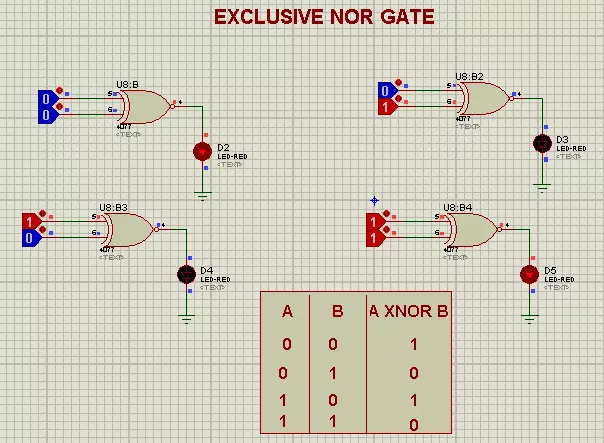
Hello Mentees!, I hope you have a productive day. Welcome to The Engineering Projects. In the previous lecture, we discussed the XOR Logic Gate and designed its circuit using basic logic gates i.e. AND, OR and NOT. Today, I am going to explain another Logic Gate named XNOR Gate in detail.We are going to discuss these concepts in today's lecture:
What are Exclusive NOR Gates
Experimental Proof in Proteus ISIS.
How Truth Table of Exclusive NOR Gate is designed.
How is its Timing Diagram?
Circuit of Exclusive NOR Gate in Proteus Simulation
Applications of Exclusive NOR Gates
XNOR Gate
The exclusive NOR Gate(also called XNOR Gate) simply inverts the output of the XOR Gate(we discussed in the last lecture).So, if we simply place a NOT Gate in front of the XOR Gate, we wi ...
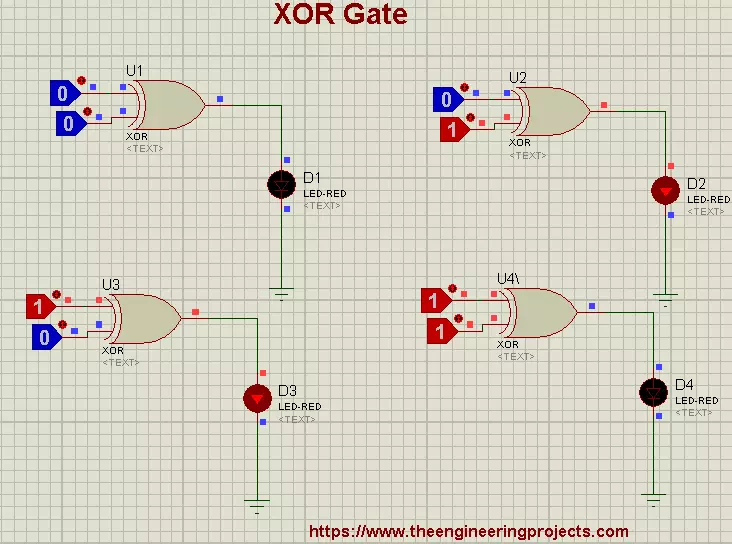
Hey pals, we hope you are doing well. In our previous lecture, we discussed the basic DLD Basic Logic Gates and simulated in Proteus. Today, we are going to discuss another logic gate called Exclusive OR Gate(XOR Gate). We will also design the XOR Gate in Proteus using the basic logic gates(i.e. AND, OR and NOT), discussed in the previous lecture.
In today's tutorial, we are going to focus on:
What are Exclusive OR Gates
Experimental Proof in Proteus ISIS.
How Truth Table of Exclusive OR Gate is designed.
How is its Timing Diagram?
Circuit of Exclusive OR Gate in Proteus Simulation
Applications of Exclusive OR Gates
Exclusive OR Gate(XOR Gate)
In the Exclusive OR Gate(XOR Gate), the output will be HIGH(1), only if the odd no. of inputs is HIGH(1) and at least one o ...
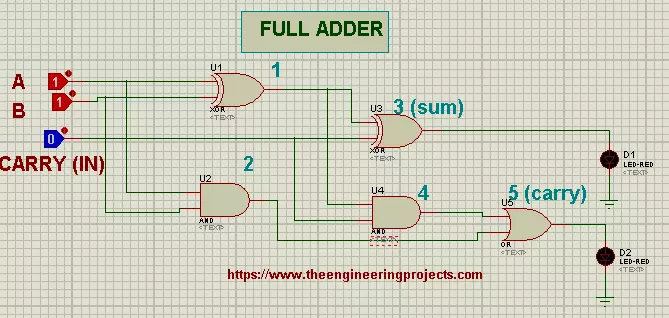
Hello Learners! I hope you are doing great. Welcome to The Engineering Projects. In our previous lecture, we discussed How to design Half Adder with Universal Gates. In today's tutorial, we are going to design Full Adder with Logical Gates.
In today's tutorial, we will learn the complete information about:
What is Adder?
What is Full Adder?
How is the Truth Table of Full Adder?
How can we design Full Adder in Proteus ISIS?
What are the uses of Full Adder?
What is Adder?
Recalling from our previous lectures:The Adders are simple Logical Circuits that take the bits in as the input, sum the bits together and generate the sum and the carry at the output.Adders are present in computer architecture, mainly to control the ...
Hello Learners, hope you are doing well. I am here with a new tutorial. We'll discuss about Junction Field Effect transistors. In this tutorial, we will learn the basic Introduction to JFET nad will also have a look at its practical Implementation and simulation in Proteus.
Basically, Junction Field Effect is a type of transistor, similar to Bipolar Junction Transistors but they have different characteristics due to some reasons as discussed below:
Introduction to JFET
We Define the JFET as:
"Junction Field Effect transistors or simply JFET is the semiconductor ,Voltage Control, three terminal device that is present in both configurations either N channel or P channel."
JFET are named so because the the operation of JFET relies on the Field of th ...
Hello friends! Welcome to another useful article of The Engineering Projects. I hope you are having a shinning day. Let's add some reproductive information in your day. Today we'll grasp about the establishment skills in Engineering Consultant Firm. Consequently, we'll learn about 6 tremendous ideas for the Establishment an Engineering Consultant.
Starting any business can be difficult. As a matter of fact, some individuals state that around a third of new enterprises fail within the first year of operation. From there, this does not get any easier. These numbers increase to half by the second year of running a business.
This might put you off when you decide to start your engineering consulting firms. However, you can make an engineering consult ...
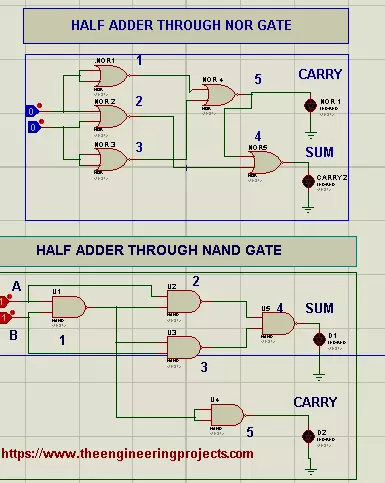
Hello Pupils! I welcome you to The Engineering Projects. I hope you are having a good day. In our previous lecture, we discussed Half-Adder Circuit Designing with XOR and AND logic gates. Today, we are going to design the same circuit using universal logic gates i.e. NOR and NAND gates.We are going to learn the following topics, in today's lecture:
What is Adder?
What is Half Adder?How can We make Half Adder Circuit through NAND Gate?
How can We make Half Adder through just NOR Gate?
Hence without wasting time, Let's find all the Answers.
What is Adder?As we discussed in the last lecture, the DLD Adder is a simple electronic circuit, used to add binary numbers in bit form.There are two types of DLD Adders, named:
Half Adder
Full Adder
In this article, we'll f ...
Hi Guys! I welcome you on board. Happy to see you around. In this post today, I’ll give you a detailed Introduction to Arduino MKR WiFi 1010.
The Arduino MKR Wifi 1010 is a solution to your basic IoT applications. Using this device, you can develop a WiFi-connected sensors network or can produce a BLE device connected to your cell phone. This board is based on the SAMD21 microcontroller and comes with a clock speed of around 32.768 kHz (RTC), 48 MHz. There are 8 digital pins, 13 PWM pins, and 7 analog pins incorporated on the board. The operating voltage is 3.3V while the voltage through USB or Vin is 5V.
I suggest you read this post all the way through, as I’ll detail the complete introduction to Arduino MKR Wifi 1010 covering pinout, pin descr ...