Hey Guys! Hope you are doing well. I always take pleasure to keep you updated with valuable information related to information and technology. Today, I'll discuss the detailed Introduction to ULN2803 which is a relay driver that comes with a high-voltage and high-current Darlington transistor array. In order to obtain higher current capability, the Darlington pairs are connected in a parallel configuration.
The component is incorporated with eight NPN Darlington pairs, featuring high-voltage outputs with common-cathode clamp diodes that are directly related to switching inductive loads. Each Darlington pair features a decent amount of collector-current rating i.e. around 500 mA.
You must have a look at ULN2003 which is almost similar to this IC ...
Hello friends! Hope you’re well. In today’s tutorial, we’ll cover a detailed Introduction to BME280. BME280 is a digital environmental pressure, humidity, and temperature sensor mainly designed for mobile applications. This module comes with extremely compact metal-lid LGA packages. It has low power consumption (consumes only 5µA during idle and less than 1mA during measurements) and small dimensions that make it a perfect fit for battery-driven devices such as GPS, mobiles, and smartwatches. The BME280 working protocols are I2C and SPI which consist of separate pinouts. The module contains a built-in LM6260 regulator, allowing you to effortlessly use it with a 3.3V or 5V logic microcontroller or Raspberry Pi.
...
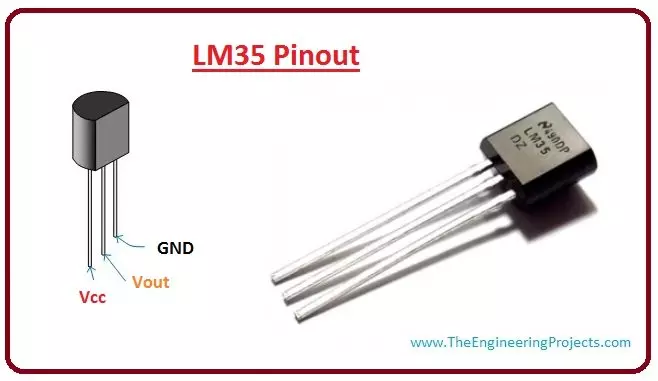
Hello friends, I hope you all are doing great. In today's tutorial, we are gonna have a look at a detailed Introduction to LM35. LM35 is a type of commonly used temperature sensor, that can be used to measure temperature with an electrical output compared to the temperature in (°C). In can measure temperature in a better way than a thermistor.
LM35 is used in industries and commercial buildings where high accuracy of temperature measuring is needed. I will give you a detailed overview of this temperature sensor in today’s post where we will have a look its pinout, working, protocol, etc. I will also share some links of projects where I have interfaced it with Arduino or other microcontrollers. If you have any questions please ask in the comments, I will resolve your queries and will gu ...
Hi Guys! I welcome you on board. In this post today, we’ll discuss the KSC1845 NPN Transistor. We will have a look at the KSC1845 Datasheet, Pinout, Power Ratings, Equivalents & Applications in detail. As it's an NPN transistor, electrons are the majority charge carriers and thus play a major role in conductivity. KSC1845 is mainly used for fast-switching and amplification purposes.NPN transistor carries 3 terminals, known as:
Emitter
Collector
Base
If the applied voltage at the base terminal exceeds 0.7V, it will forward bias this NPN transistor and the current will start to flow from Collector to Emitter. If the base voltage is less than 0.7V, KSC1845 will remain in the reverse-biased state.
I suggest you buckle up as I’ll discuss the KSC1845 ...
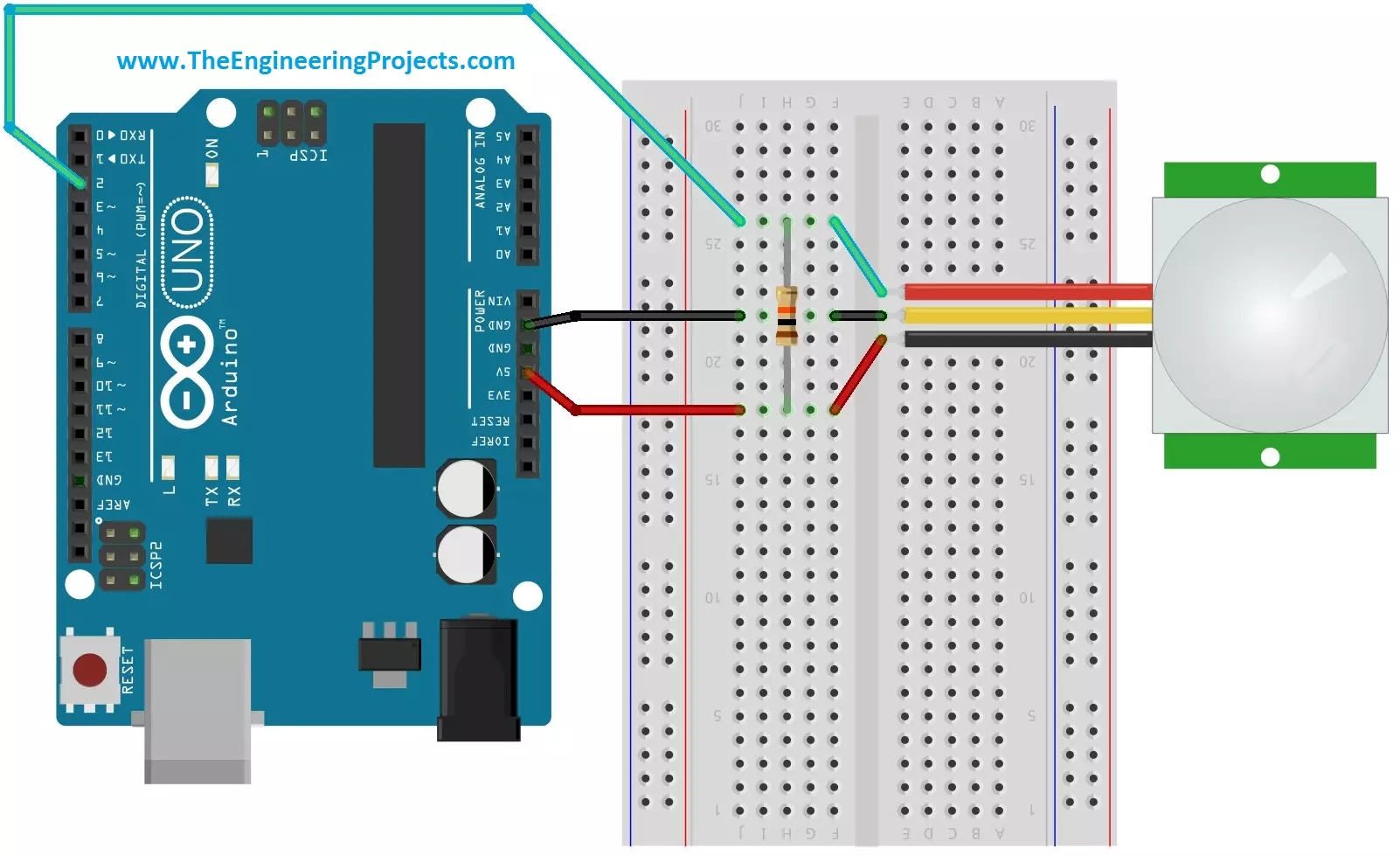
Hello friends, i hope you all are fine and enjoying. Today i am going to share a new project tutorial which is Interfacing PIR sensor with Arduino. First of all lets, have a little introduction about the basics and working of the PIR sensor. PIR sensors are in fact a Passive Infrared Sensor. PIR sensors are actually electronic sensors and they are used for motion detection. They are also used to detect the Infrared waves emitting from a particular object. You should also have a look at PIR Sensor Library for Proteus, using this library now you can easily simulate your PIR Sensor in Proteus software.
PIR sensors are widely used in motion detection projects now a days. Since my today's tutorial is about interfacing of PIR sensor with Arduino micro c ...
Hello friends, I hope you all are fine and having fun with your lives.Today I am not gonna post a new topic or tutorial, instead I am going to arrange all my Arduino Projects and tutorials in this post, as its better to have all of them in one place. I recently posted a PIC Microcontroller Projects post and it was highly appreciated by the followers so I thought to do the same with Arduino as well because I have posted more Arduino projects as compared to PIC Microcontroller.
I will post all the Arduino Projects & Tutorials links below in sequence i.e. from easy to pro level so if you are a new user and want to get command over Arduino projects then read all of them one by one. Moreover, I will also keep on updating this post whenever I am go ...
Hi Guys! Hope you’re well today. Happy to see you around. Today, I’ll walk you through the Introduction to IRF520.The IRF520 is an N-channel power MOSFET mainly used for switching and amplification purposes. It comes with a breakdown voltage of around 100V and a low gate threshold voltage is 4V, making it an ideal pick for microcontroller applications.
I suggest you read this post all the way through as I’ll detail the complete Introduction to IRF520 covering datasheet, pinout, features, and applications.
Let’s get started.
Introduction to IRF520 MOSFET
The IRF520 is an N-channel power MOSFET mainly used for switching and amplification purposes.
It comes with three terminals named: gate, source, and drain and is available in the TO-220 package.
It is important to note t ...
Hello friends, I hope you all are doing great. In today’s tutorial, we will have a look at Introduction to ADC0804. In electronic engineering different modules used to conversion of analog signal into a digital signal. These tools are recognised as analog to digital converter or ADC. Thes signal converter also used to find the value of input current and voltage. Normally the output of these converters are 2 binary numbers but other values are also possible. These analog to digital converter are available in different structure scheme but mostly they are available in integrated circuits packaging.
The working ability of these signal converter depends on their bandwidth and signal to noise ration (SNR). Their bandwidth can be fined by their sample r ...
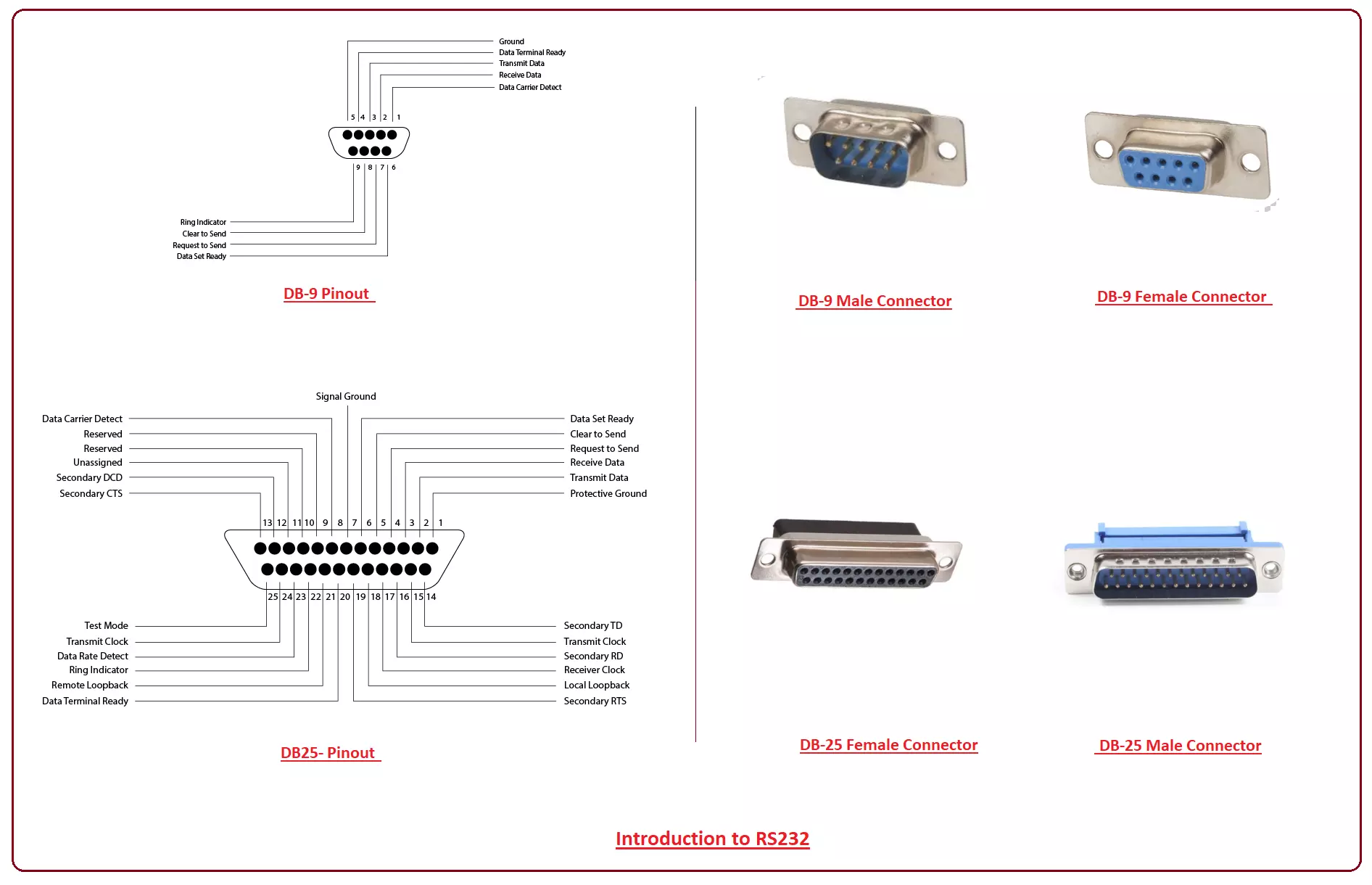
Hello Friends! Hope you are doing well. I am back to give you a daily dose of valuable information. Today, I'll discuss the detailed Introduction to RS 232 which is a standard communication protocol mainly used for serial communication between two devices. It was first introduced by the EIA (Electronic Industries Association) in 1960 to provide a pathway for connecting one device with other peripheral devices for flawless digital communication.
It is true, that the inception of USB has grossly reduced the need for RS232 protocol, still, we can't brush off its significant importance in some industrial applications where Programmable Logic Controllers and Computerized Numerical Control Equipment are specifically programmed using RS 232 connectors ...
Hello friends, I hope you are all fine and will be doing something interesting in your life. in today's post, I am going to discuss Introduction to DHT22. It is a temperature and humidity measure sensing device. It is easily used but it needs a specific time for an operation. Its temperature measuring range is from -40 to +125 degrees Celsius with +-0.5 accuracy. This sensor measures moisture content and temperature. This sensor is easily connected to other microcontrollers.
DHT22 plays an important role in our environment in measuring temperature and moisture. It is a low cost easy-to-use small sensor. This sensor is used at different weather stations to measure temperature and ratio of moisture in the air, in this way, they tell about tem ...