Hello Everyone! I welcome you on board. Hope you’re well today. In this post today, I’ll detail the Introduction to FR106.The Fr106 is a fast recovery diode mainly employed in fast-switching applications. It supports loads under 1A and carries a peak inverse voltage of 800 V.
I suggest you read this post all the way through as I’ll walk you through the complete Introduction to FR106 covering datasheet, pinout, features, characteristics, and applications. Let’s jump right in.
Introduction to FR106
Fr106 is commonly known as a fast recovery diode mainly employed in fast-switching applications. This is a two-terminal device named anode and cathode.
The gray-colored band at one side of the diode indicates the cathode side while the other side is the anode terminal.
...
Hello friends, i hope you all are fine and enjoying. Today i am going to share a new tutorial which is Interfacing Arduino with HC05 Bluetooth module. First of all lets have a little introduction about HC-05 Bluetooth module. HC-05 is a bluetooth module, which was designed for wireless data communication. This little module is capable of both sending and receiving data but it performs only one thing at a time, which means at a particular time it can only send or receive data but can't do the both tasks.
In order to send or to receive data, you have to make one module as a master and the other module as a slave. If both the modules are acting as master then, data will not transmit and if both the modules are acting as a slave then, again data will ...
Hello friends! I hope you will be absolutely fine and having fun. Today, I will give you an elaboration on Introduction to SG3524. I have already shared articles on Introduction to 74HC245, 74HC595, CD4051, L293D, L298, LF351 and LF411. You should also go through all of these tutorials in order to have a better understanding. SG 3524 consists of all the important functions necessary to design inverters.
Moreover, using SG-3524 we can also design regulation power supplies as well as switching regulators. This all design is based on a single chip. High power applications can also be controlled through this device. SG-3524 is especially designed for voltage doublers without transformers, transformer coupled DC to DC converters. Their design was als ...
Hello everyone! I hope you all will be absolutely fine and having fun. Today, I will give an elaboration about Introduction to LF351. LF-351 is basically JFET (Junction Field Effect Transistor). It is a very high speed input Op-amp (Operational Amplifier). This device is most common in the market due to its low cost and good performance characteristics. LF-351 provides a high gain bandwidth product even though it needs a very low current supply.
LM 351 also provides higher slew rates. This device is most of the times known on the basis of its applications. LM-351 is the most popular device due to its unique features. These features include low input bias current, high gain bandwidth product, loww current supply, high input impedance, internal tr ...
Today, we are gonna have a look on How to Interface Ultrasonic Sensor with Arduino. Few days ago, I have posted a complete tutorial on How to Use Ultrasonic Sensor Library in Proteus and later I have posted different examples on How to Simulate Ultrasonic Sensor in Proteus. Those posts were about Proteus Simulations and weren't about hardware interfacing, so I thought today let's interface it in hardware.
Simulation is a good starting point for projects but they are really far away from real world. It happened to me a lot of times that my simulations are working perfectly fine but when I design the same circuit in hardware then it says no I am not gonna work. :) So, the bottom line is never trust simulations, unless you properly test it on hardwar ...
Hello everyone, today I am going to share a complete project which is DS1307 Arduino based digital Clock in Proteus ISIS. In this project, I have designed a digital clock using Arduino UNO and DS1307 RTC Module. So, first of all, if you haven't yet installed then, you should install Arduino Library for Proteus using which you will be able to easily simulate Arduino baords in Proteus. Along with Arduino Library you will also need to install DS1307 Library for Proteus, which I have shared in my previous post as we are gonna use this RTC Module DS1307 for designing our digital clock.
So, now I hope that you have installed both these libraries successfully and are ready to design this DS1307 Arduino based Digital Clock. I have given the Simulation and ...
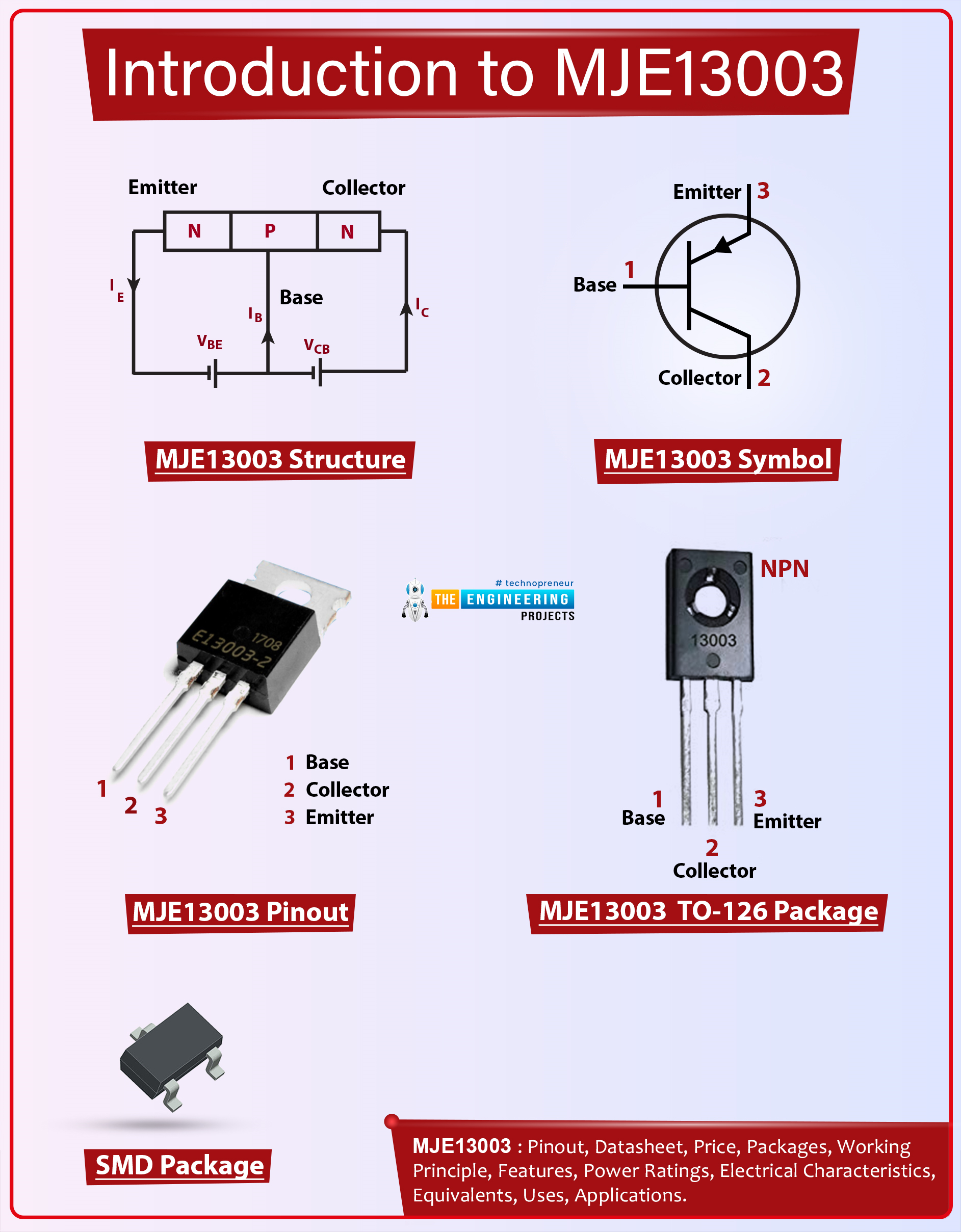
Hi Friends! Hope you’re well today. I welcome you on board. In this post today, I’ll demonstrate the Introduction to MJE13003.
MJE13003 is an NPN silicon transistor mainly used for high-speed high voltage power switching applications. This chip is a three-terminal device where a small current at one terminal is used to produce a large current at the remaining terminals. The collector current is 1.5A which projects this device can support load up to 1.5A.
I suggest you buckle up as I’ll describe the complete Introduction to MJE13003 covering datasheet, pinout, working principle, applications, power ratings, and physical dimensions.
Let’s get started.
Introduction to MJE13003
MJE13003 is a bipolar junction transistor that belongs to the NPN transistor family. It is mainly used ...
Hello everyone! I hope you all will be absolutely fine and having fun. Today, I am going to give you detailed discussion on Introduction to LM2904. LM 2904 consists of two builtin amplifiers. These amplifiers have high gain and they are internally frequency compensated. These amplifiers are designed for the operation from a single power supply for a large range of voltages. We can also operate them from multiply power supplies as well.
LM-2904 operates on 3.3V power supply, it is the most common power supply in digital systems. LM 2904 is also available in small sizes i.e. they are available in the latest technology DSBGA. LM-2904 has a lot unique features in comparison to the other standard amplifiers. These features include large DC voltage ga ...
Hello everyone! I hope you all will be absolutely fine and having fun. Today, I am going to give you an elaboration on Introduction to LM293 an Integrated Circuit (IC). LM-293 is a dual independent accurate voltage comparator. LM 293 has a capability to perform its operation from a single supply source as well as from split power supply. The purpose to design LM-293 is to permit a common mode range to the ground level and it perform this operation with single power supply source.
LM-293 is the most common device in the market these days due to its high performance and cost effectiveness. This device is considered to be an ideal for a lot of electronics applications. LM-293 has a lot of features which make it different from all other devices. The ...
Hey Guys! Hope you are doing great. Today, I am going to discuss the details on the Introduction to BJT (Bipolar Junction Transistor). It is an electronic component mainly used for amplification and switching purpose. As the name suggests, it is composed of two junctions called emitter-base junction and collector-base junction.
Don't confuse BJT with regular transistors. A transistor is a semiconductor device, comes with three terminals that are used for external connection with electronic circuits. A transistor is termed as a trans resistor which is used as switch or gate for electronic signals. Small signals applied between one pair of its terminals are used to control much larger signals at the other pair of terminals.
Actually, transistors are divided into two categories called u ...