Hey Guys! Hope you are doing great. I always try to fill your appetite with relevant information you can excel and grow in your field. Today, I am going to unlock the details on the Introduction to 2n2907. It is basically a PNP bipolar junction transistor (BJT) which is mainly designed for switching and low power general purpose amplification applications. It has an ability to operate at very high speed and moderate temperature. I'll try to cover every aspect related to this transistor, so you don't have to go anywhere else for finding the information regarding this transistor. You can also check Introduction to 2n2222 which is complementary NPN transistor of this PNP transistor. Let's hop on the board and explore what it does and what are its mai ...
Thank you for being here for today's tutorial of our in-depth Raspberry Pi programming tutorial. The previous tutorial taught us how to install a PIR sensor on a Raspberry Pi 4 to create a motion detector. However, this tutorial will teach you how to connect a single seven-segment display to a Raspberry Pi 4. In the following sections, we will show you how to connect a Raspberry Pi to a 4-digit Seven-Segment Display Module so that the time can be shown on it.
Seven-segment displays are a simple type of Display that use eight light-emitting diodes to show off decimal numbers. It's common to find it in gadgets like digital clocks, calculators, and electronic meters that show numbers. Raspberry Pi, built around an ARM chip, is widely acknowledged as ...
Hello everyone! I hope you all will be absolutely fine and having fun. Today, I will give an elaboration about Introduction to LF351. LF-351 is basically JFET (Junction Field Effect Transistor). It is a very high speed input Op-amp (Operational Amplifier). This device is most common in the market due to its low cost and good performance characteristics. LF-351 provides a high gain bandwidth product even though it needs a very low current supply.
LM 351 also provides higher slew rates. This device is most of the times known on the basis of its applications. LM-351 is the most popular device due to its unique features. These features include low input bias current, high gain bandwidth product, loww current supply, high input impedance, internal tr ...
Hello Friends! I hope you are enjoying your life and having fun. Today, I am going to give you brief details on the Introduction to 6n137. It is a photocoupler that is used to transfer electrical signal with the help of light between two separated circuits. It consists of one chip photo IC and high emitting diode. It is a 8 pin device which comes in DIP package. I'll try to cover as many aspects as possible related to this photocoupler. Let's get started.
Introduction to 6n137
6n137 is a photocoupler also known as optocoupler that is used to connects the two electrically isolated circuits with the help of light.
It consists of 8 pins where inputs and outputs terminals are electrically isolated which help in controlling the large power, curren ...
Hello everyone! I hope you all will be fine and having fun. Today I am going to tell you that how can you make a simple program for Interfacing Flame Sensor with Arduino. Flame sensor is used in offices, home and at different places to detect the fire. First of all I would like to tell you about the working principle of the flame sensor. Flame sensor is a device designed for the detection of the fire and to respond it. They are usually designed for the detection of most frequently used industrial fuel e.g. diesel, gasoline, karosene, ethylene, hydrogen etc. They are designed in way to distinguish between the radiations from the sunlight and the actual flames.
There different types of flame sensors e.g. Ultraviolet (UV) detectors, Infrared (IR) f ...
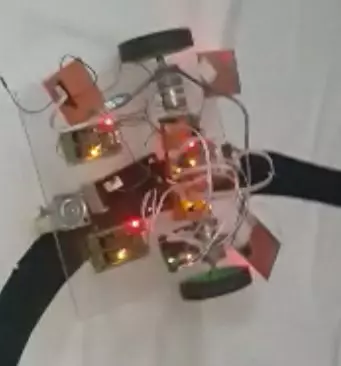
Hello everyone, I hope you all are fine and having fun with your lives. Today, I am going to share a very basic project named as Line Following Robot using Arduino. I have designed a three wheeler robot and have placed IR sensors beneath it to detect the black line and then I have made it move over this Black Line.
This Line Following Robot is not doing any extra feature i.e. turning or rotating back. It will just simply move in the straight line. I have also posted a short video at the botton of this tutorials which will give you better idea of how this robot moves. You should first read this tutorial and design the basic robot and once you are successful in designing the basic Line Following Robot then you should have a look at my recent Project ...
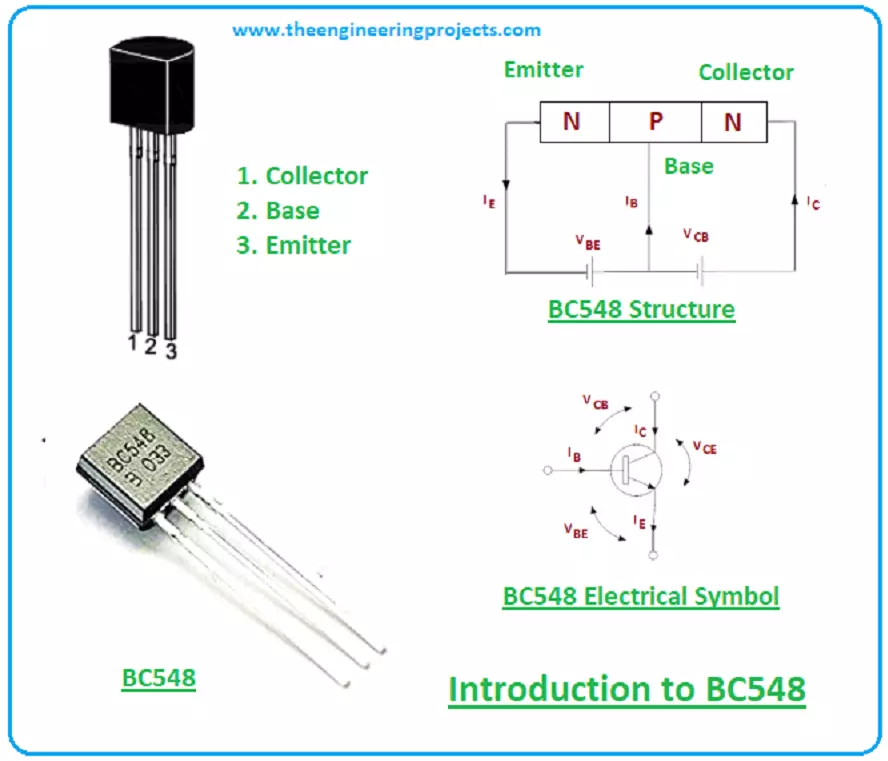
Hi Friends! Glad to see you here. I hope you’re well today. In this post, I’ll walk you through the Introduction to BC548. BC548 is a general-purpose transistor that falls under the family of NPN transistors. It carries three pins that are mainly used for external connection with the circuit. The small current at one terminal is used to control the large current at other terminals. Moreover, it can drive loads under 500mA and is available in TO – 92 package.
I suggest you read this post all the way through as you’ll get to know all nuts and bolts of BC548 transistor i.e. pinout, working principle, power ratings, applications, and physical dimensions. Let’s jump right in.
Introduction to BC548
BC548 is an NPN general-purpose transistor, comes w ...
Hello friends, I hope you all are doing great. In today's tutorial, we are gonna have a look at detailed Introduction to C1815. The C1815 is a transistor like other it is used to amplify acoustic frequency signal. Most transistors are coded for easy documentation through these titles can differ by builders. One or two erudition are typically trailed by a sequence of statistics, and then probably additional statistics. Consequently, a C1815 transistor can also be recognized as a 2SC1815 transistor.
It is used as a switch to initiative loads below 150mA. The use of transistors aided the electronics manufacturing alteration quickly, and developments in expertise are permitting minor apparatuses to be used to production of slighter expedients. In toda ...
Hello Guys! Hope you’re well today. I welcome you on board. In this post today, I’ll walk you through the Introduction to BD136.
BD136 is a medium power general-purpose transistor mainly used for switching and audio amplification purposes. It belongs to the PNP transistor family and comes with collector current 1.5A, indicating it can drive loads under 1.5A. The amplification factor ranges from 40 to 250, which means it can amplify the input signal up to 250 times. Both collector-emitter and collector-base voltages are 45V while the emitter-base voltage is 5V, indicating only 5V is required to bias this transistor.
I suggest you read this entire post, as I’ll be detailing complete introduction to BD140 covering pinout, working principle, power r ...
Hello friends, I hope you all are happy, healthy and, content. We have been discussing transistors lately, from the basic definition to the types and characteristics of transistors we have covered it all. If you have a brief idea about transistors, you must be aware of the field effect transistor or you might have heard or read about it somewhere, it is one of the earliest known types of transistors which is our topic of discussion today.
Field Effect Transistors were made to cover up the lacking of previously known transistors which occupied large space and produced a lot of noise, another major problem was the low reliability of previous versions. So, let's get started with the FETs.
Definition of Field Effect Transistor
Let us define field effect transistor first,
"The Field e ...