Hello, fellows, I hope you all are doing great. In today’s tutorial, we will discuss 5 Reasons to Get A Degree in The Engineering Field. Engineering represents the practical application of science and mathematics to find solutions to technical problems. Engineers don’t just sit back and watch. On the contrary, they design, invent, fix, improve, research, and so on. Engineers bring things to life, whether it’s physical buildings or robots.
If you want to create technology and products that make our lives easier, think about getting a degree in the engineering field. Not only is it one of the most popular college majors but also one of the most profitable ones. It might just be the right fit. These reasons will convince you that engineering is the b ...
Hello friends, I hope you all are doing great. In today's tutorial, we are gonna have a look at detailed Introduction to TIP121. The TIP121 is an NPN Darlington pair transistor. It exists in a TO-220 casing and creates for normal amplification and less moving speed switching submissions. Like other transistors, it has three pinouts emitter, base, and collector. The central part this transistor which is known as the base is thinner in size and other two emitters and collector has larger areas.
Transistors are playing an important rule in our electronic circuits and industries. Every electronic device like mobile, radio, LCD, etc all these have different types of transistors. Like other transistors, TIP121 is performing an important rule in electron ...
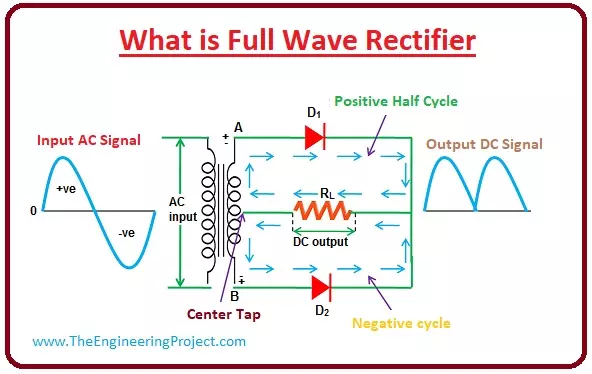
Hello friends, I hope you all are doing great. In today’s tutorial, we will discuss What is Full Wave Rectifier. Transformation of alternating current into the direct current is known as rectification. This conversion can be done by using a single diode or more than one diode. The diode that used for rectification is named as a rectifier. There are 2 main categories of the rectifiers, the first one is the half-wave and the other is full-wave rectifier.
In half-wave rectification circuitry, there is only single diode is used to convert alternating current into the direct current. So it can very easily design for rectification. But it has one drawback that it converts one half of the AC wave into direct current. Due to this, there is a higher power ...
Hello friends, I hope you all are doing great. In today's tutorial, we are gonna have a look at detailed Introduction to Atmega32. ATmega32 is eight-bit higher enactment microcontroller, it is manufactured by an Atmel (it is a designer and builder of different semiconductors materials). It is founded on enriched RISC which stands for (Reduced Instruction Set Computing) design which consists of 131 (one thirty-one) potent commands.
Mostly commands implement in one mechanism sequence. The maximum frequency at which it operates sixteen MHz. It delivers a subtle equilibrium among enactment and balance. It is the Pico Power sort of the normal ATmega328 kind which permits it to work below lesser voltage and power necessities, nearly 1.62 volts. In today’s post, we will have a look at its fort ...
I hope you all are doing great. In today's tutorial, we are gonna have a look at detailed Introduction to ESP-01. ESP-01 is an inexpensive, small-sized WiFi module, which consists of TCP/IP stack along with a built-in microcontroller. So, we can directly program this small chip and can bring WiFi capability in our Embedded projects. When first time this ship came into the market in August 2014, it got a lot of attention by users. The main reason for it to seek attention is that this module allows the microcontroller to connect with a WiFi available (and programmed to connect) and it follows Hayes Style Commands and develops a TCP/IP network.
ESP-01 chip integrates an antenna, RF balun, power amplifier, filters, and power arrangement module. ESP-01 is used in industry and many projects a ...
Hello friends, I hope you all are doing great. In today's tutorial, we are gonna have a look at a detailed Introduction to HC-SR501. HC-SR501 is a motion detector sensor, that uses infrared waves for the detection of an object. It is an automatic control device, and also has large sensitivity and high reliability. It is used in auto-sensing control devices, where we need to perform motion detection.
HC-SR501 is used in industrial projects and buildings for security purposes. In today's post, we will have a look at its pinout, working, protocol, circuit diagram, etc. I will also share some links to projects where I have interfaced it with Arduino and some other microcontrollers. Friends if you have any questions please ask in the comments I will try my best to solve your problems and I w ...
Hello friends, I hope you all are doing great. In today's tutorial, we are gonna have a look at detailed Introduction to 74ls04. 74LS04is a participant of 74XXYY integrated sequence. The seventy-four sequences are numerical logic incorporated circuitries. This integrated circuit consists of 6 not gates. These gats do the function of reversing of different functions. To the existence of six gates, it also is known as hex inverter.
This integrated circuit is offered in numerous suites. You can select a suitable suite dependent on conditions. This module has fourteen pinouts which perform different functions. It is used in different memory units. In today’s post, we will have a look at its protection, wreck, oddness, privileges, etc. I will also shar ...
Hello friends, I hope you all are doing great. In today's tutorial, we are gonna have a look at detailed Introduction to ACS712. ACS712 is an AC or DC current sensor, which is used to measure AC or DC current. You should also have a look at Difference between AC & DC Power, that will help. The maximum value of AC and DC which can be measured is 30A, its output current signal can be read via analog I/O port of Arduino. It is also available in 5A and 20A version which provides precise and economical solutions for AC or DC current sensing in industrial and commercial systems.
ACS712 consists of a precise and low offset linear Hall sensor circuit with a copper conduction path located near the surface of the die. ACS712 is used in different industrial projects and commercial electr ...
Hello friends, I hope you all are doing great. In today’s tutorial, we will have a look at What is Hall Effect Sensor and how to use for measurement of electromagnetism. As we can easily find the value of current flowing through any elements, by using ammeter, and galvanometer. But it is very challenging for us to measure the strength of the magnetic field. If we ask someone to find the magnetism and tell us its value. He will not have an answer to this question.
In 1879 an American physicist invented the hall effect sensor for the measurements of the electromagnetism. After the invention of Hall effect sensor, almost twenty years scientists were thinking about how we can use the Hall effect practically. With the simplification of the semiconduct ...
Hello friends, I hope you all are doing great. In today's tutorial, we are gonna have a look at detailed Introduction to TIP35. It is a reliable silicon NPN transistor that is projected to use in common persistence amplification and swapping capitulations. It is existing in TO-247 that is no more used by most fabricators. It's corresponding transistor TIP36 which is PNP transistor.
It is a communal transistor which is used in several industrial projects where audile magnification is required. Its structures are good-observing much the similar refusing for the exciting power acceptance that is rather lesser. In today’s post, we will have a look at its fortification, wreckage, eminence, claims, etc. I will also share some links where I have connecte ...