Hi Guys! Hope you’re well today. In today's tutorial, we will have a look at the 2SC1345 NPN Transistor. We will also discuss 2SC1345 Datasheet, Pinout, Power Ratings, Equivalents & Applications. As this is an NPN transistor, the conductivity is mainly carried out by electrons as the major charge carriers. 2SC1345 is mainly used for switching and amplification purposes.Let's first recall NPN transistors: NPN transistor comes with 3 terminals, named:
Emitter
Collector
Base
If the voltage at the base terminal is above 0.7V, the NPN transistor gets forward biased & starts conducting i.e. current will flow from the Collector to Emitter terminal. If the Base voltage is less than 0.7V, it remains reverse-biased.So now let’s get started with the 2SC1345 NPN Transistor.
2SC134 ...
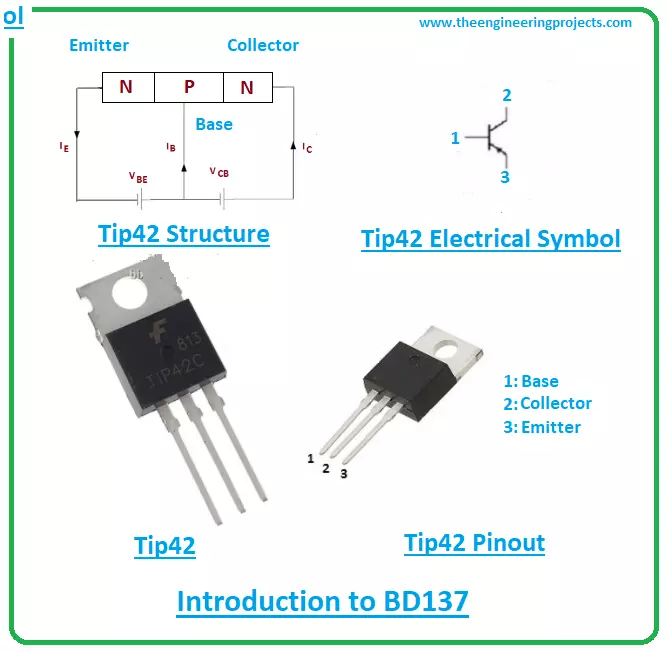
Hi Guys! Thank you for clicking this read. Hope this finds you well. In this post today, I’ll document the Introduction to Tip42.
Tip42 is a medium power silicon transistor mainly used for switching and amplification purpose. It belongs to the PNP transistor family and comes in the TO-220 package. The collector current is 6A which signals it can support load under 6A. Both collector-base and the collector-emitter voltages are 40V. And the only 5V is required to initiate the transistor action as the emitter-base voltage is 5V. The power dissipation is 65W which defines the amount of energy released during the working of this transistor. The storage junction temperature is -65 to 150C and transition frequency is 3MHz.
Just stay with me for 2-min a ...
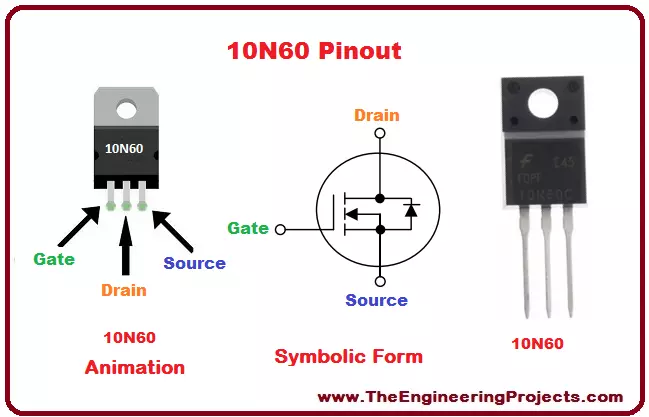
Hello everyone! I hope you all will be absolutely fine and having fun. Today, I am going to provide you a detailed discussion on Introduction to 10N60. Before going into the details of this article you should also have a look at Introduction to 4N60, 78M05, 2N3772, 2SC3320, 20N60. It is basically a high voltage Metal Oxide Semiconductor Field Effect Transistor (MOSFET). It is a power MOSFET and is able to control the certain level of the power. 10-N-60 is also a high current power MOSFET. This device has three terminals and is made up of silicon. It has around 10 ampere of current conduction capability i.e. this device is able to conduct 10A of current through it. 10-N-60 has a lot of amazing features.
It features include low on-state resistance ...
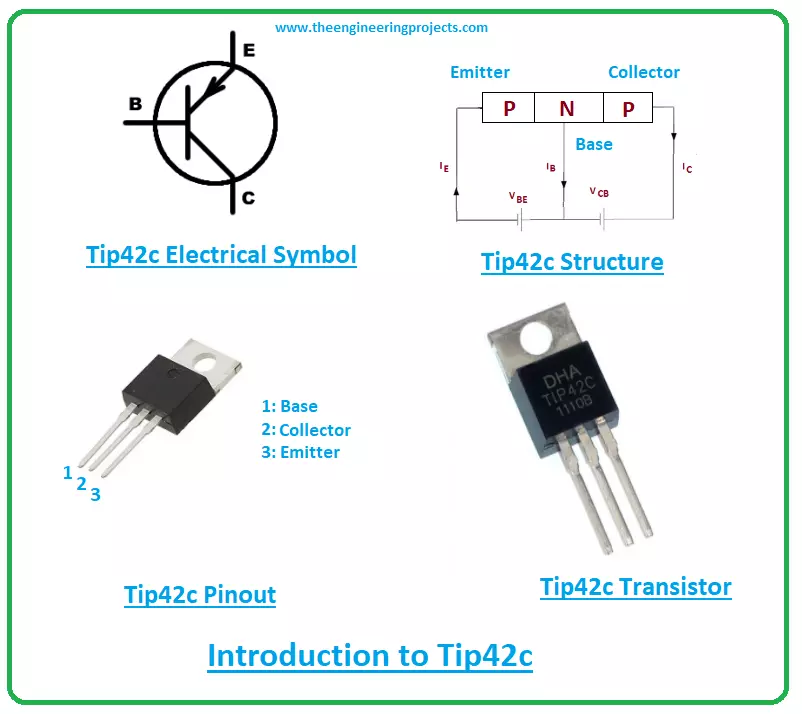
Hi Friends! I welcome you on board. Happy to see you around. In this post, I’ll detail the Introduction to Tip42c.
Tip42c is a medium power transistor mainly used for amplification and switching purpose. It is made up of silicon material and falls under the category of PNP transistors. The voltage across collector and emitter terminals is 100V and the voltage across base and collector terminals is 100V. The 5V is the voltage across base and emitter terminals which projects the value of voltage required to bias this transistor. The 6A is collector current which indicates the value of loads this transistor can support.
Just bear with me for a little while as I’ll be documenting the main features, pinout, applications, and datasheet of this tiny co ...
Hello everyone! I hope you will be absolutely fine and having fun. Today, I am going to give you a detailed Introduction to ULN2003. We will also discuss the ULN2003 Datasheet, Pinout, Circuit Diagram & Proteus Simulation. If you have ever controlled any motor (i.e. DC Motor, Stepper Motor etc.) with a microcontroller (i.e. PIC, Arduino etc.), then you must have heard about drivers. Why do we need to use drivers? We use drivers (to control motors) because of two reasons.
First: Microcontrollers operate at 5V while motors operate at different voltages (5V, 12V, 24V etc.).
Second: Motors are Inductive loads thus they produce back emf, which may damage your microcontroller permanently (if not handled correctly).
Because of these two reasons, we have to use the driver in between t ...
Hello everyone! I hope you all will be absolutely fine and having fun. Today, I am going to elaborate about the Introduction to LM324. It is an Operational Amplifier (Op-amp) consists of four channels. Its a low cost device having true differential inputs.For single supply applications LM 324 are superior to the other operational amplifiers. LM-324 is capable of operating at the minimum voltage up to 3V and at the high voltage levels up to 32V.
One of the major advantage of LM-324 is that common mode input range includes negative supply which eliminates the need of external biasing. Negative power supply voltage is also included in output voltage range. This device is lead (Pb) free, halogen free and RoHS compliant. It consists of four amplifier ...
Hey Fellas! I hope you are doing great and getting most out of your lives. Today, I am going to uncover the details on the Introduction to 2n5401. It is a PNP(positive-negative-positive) bipolar junction transistor which comes in TO-92 casing. It consists of N doped semiconductor that exists between the two layers of P doped material. It is useful for the applications where regulated negative voltage is required at a modest current level. I'll give you brief details about this amplifier transistor. Let's get started.
Introduction to 2n5401
2n5401 is a PNP bipolar junction transistor, also known as amplifier transistor, that comes with collector-emitter voltage of 150V and mostly used for amplification purpose.
In order to operate this transis ...
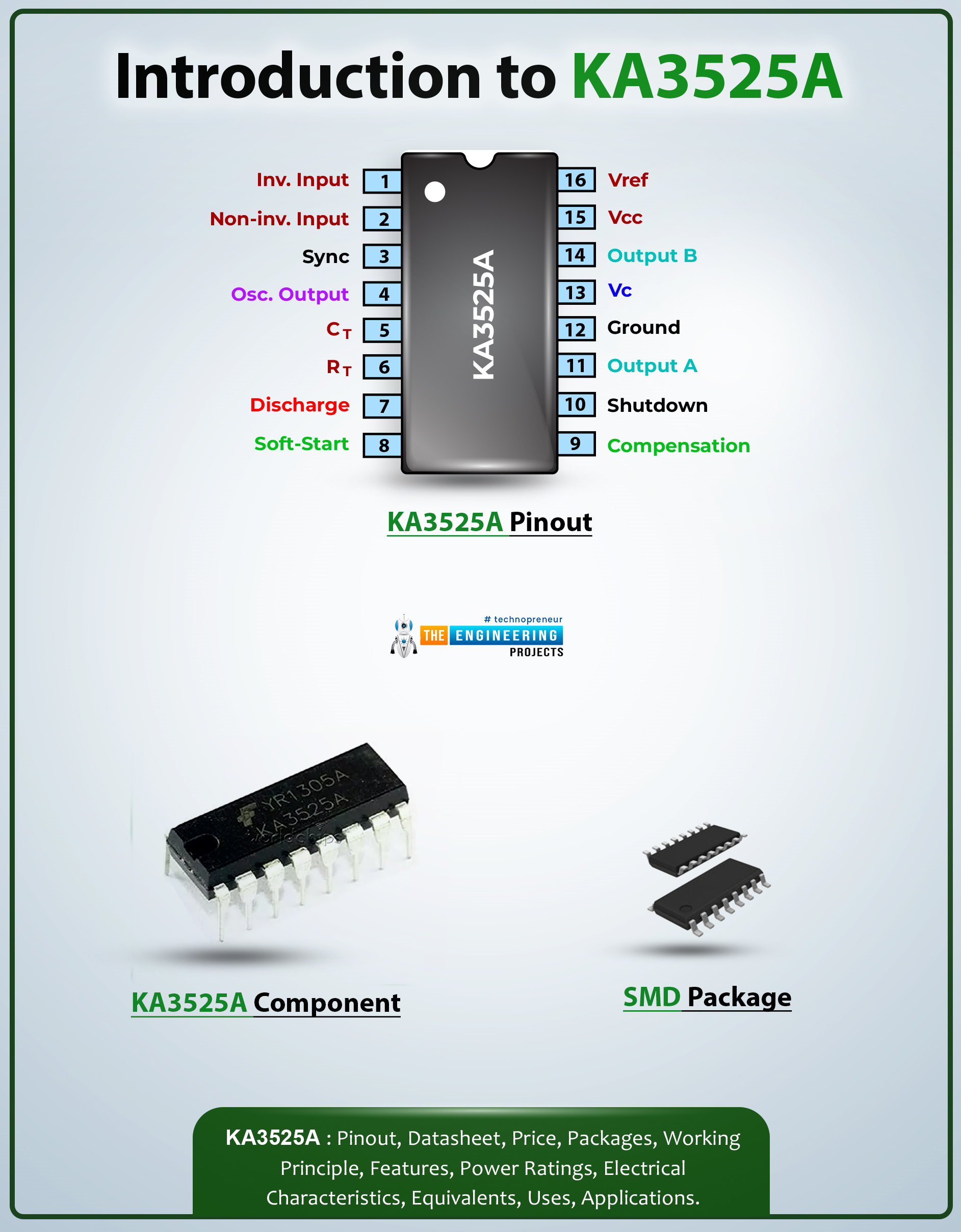
Hi Everyone! I welcome you on board. Happy to see you around. In this post today, I’ll walk you through the Introduction to KA3525A.The KA3525A is a monolithic IC chip that features the control circuitry mainly required for a pulse width modulating regulator. This device comes with an error amplifier, voltage reference, pulse width modulator, an under-voltage lockout, an oscillator, the output driver, and a soft start circuit, all in one package.
I suggest you buckle up as I’m going to discuss the complete introduction to KA3525A covering datasheet, pinout, features, and applications. Let’s jump right in.
Introduction to KA3525A
The KA3525A is a monolithic IC chip that incorporates the control circuitry used for pulse width modulation.
During the PWM process, the control circui ...
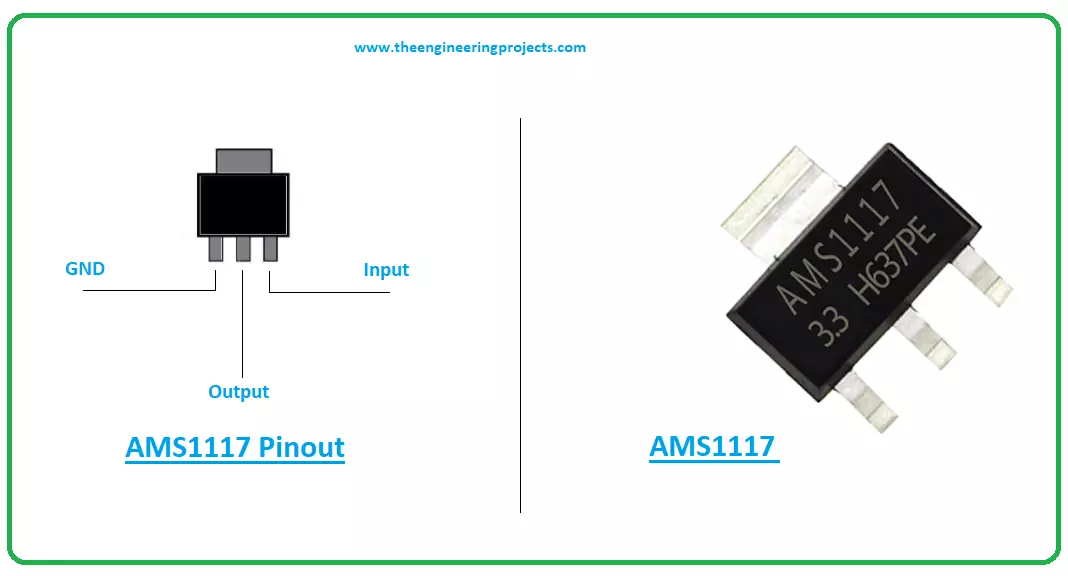
Hello Guys! Hope you’re well today. I welcome you on board. Thank you for clicking this read. In this post today, I’ll walk you through the Introduction to AMS1117.
The AMS1117 is a common voltage regulator that comes with both fixed and customizable voltages. It is a 3-pin device mainly used to drive load under 1A. The output voltage ranges from 1.5V to 5V. When it works at maximum current, it results in a low dropout voltage of 1.3A.
I suggest you read this post all the way through, as I’ll be discussing Pinout, datasheet, features, and applications of this tiny device AMS1117.
Let’s jump right in.
Introduction to AMS1117
The AMS1117 is a common voltage regulator mainly used for high-efficiency linear regulation and post-regulation switchi ...
Hello friends, I hope you all are doing great. In today's tutorial, we are gonna have a look at detailed Introduction to TIP41. It is an NPN power transistor. It exists in (TO-220) malleable suite which marks this expedient appropriate for acoustic, power rectilinear and swapping submissions. Its corresponding transistor is TIP42. It is intended by joining three (3) components of semiconductor material by doping with different materials. It's center portion is base which is tinny and the other two outer parts are prominently doped than the base.
Several transistors can strengthen a trivial current which will then be leading adequate to effort attention or other greater current maneuvers. These discretion are proficient to notice a shift in voltage ...