Hello everyone! I hope you all will be absolutely fine and having fun. I am going to give you a detailed Introduction to CD4051 today. CD 4051 is an analog multiplexer and demultiplexer. It has very low OFF leakage current and low ON impedance. Over full voltage ranges, very low power is dissipated by CD-4051.
CD-4051 is an eight (8) channel multiplexer and has three control input named as A, B and C. These inputs connect only 1 out of 8 channels to the output in order to obtain the desired output. Channel I/O terminals became outputs and common O/I become input terminals when CD 4051 is used as a demultiplexer. CD-4051 has a lot of amazing features e.g. binary address decoding on chip, break before make switching eliminates channel overlapping, ...
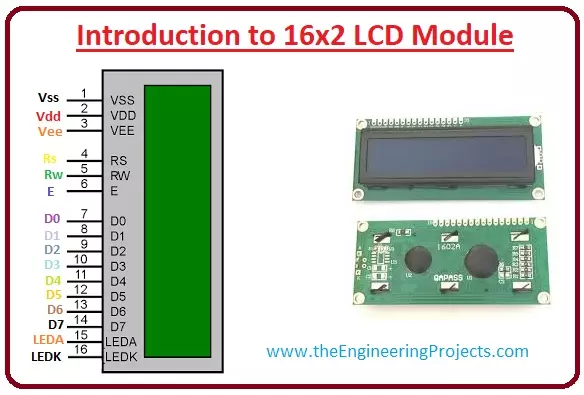
Hello friends, I hope you all are doing great. In today’s tutorial, we will have a look at Introduction to 16x2 LCD Module. LCD stands for liquid crystal display it is mostly used in different electronic projects and devices to display different values. LCD uses liquid crystals for the generation of visible images. 16 x 2 liquid crystal display is a basic LCD module used in DIY electronic projects and circuits. In this LCD module, there are two rows every row consists of sixteen numbers.
With the two rows in this module, there are sixteen columns. The VA dimensions of these modules are (66 x 16) millimeters and the thickness is 13.2 millimeters. Its operating voltage is plus five or plus three volts. In today's post, we will have a look at working, applications, circuits, features, adv ...
Hello friends, I hope you all are doing great. In today’s tutorial, we are gonna have a look at detailed Introduction to RN4020. RN4020 is a completely licensed Bluetooth category 4.1 low energy consuming unit. This module is surfaced with the Bluetooth which is organized by Unpretentious ASCII instructions by UART interfacing. It also comprises all Bluetooth SIG sketches and (MLDP) Microchip low Energy data for customized data.
The scripted features can be secondhand to allow unconnected process without any Microcontroller or mainframe computer. It can be controlled from a distant position by other modules with the protected assembly and it can be reorganized by means of UART interfacing or by air. In today’s post, we will have a look at its casing, pins, structure, applications, ...
Hello friends, I hope you all are doing great. In today's tutorial, we are gonna have a look at detailed Introduction to 2sa1943. The 2sa1943 is a high power consuming PNP transistor, firstly it was created by a famous company Toshiba. As it has a high gain of current and consumes higher current at collector it is mostly used for such audio circuits which consume higher power or in AF amplifiers.
Nonetheless, currently the Transistor is outright from Toshiba and it has been swapped with TTA1943. We can also found old 2sa1943 in marketplaces because still it is replicated by other assemblers in China. In today’s post, we will have a look at its fortification, wreckages, implication, proposals, etc. I will also share some links where I have connecte ...
Hi Guys! Happy to see you around. In this post today, I’ll detail the new version of Arduino Mega 2560 Library for Proteus V2.0. I have already detailed the Arduino Mega 2560 Library for Proteus that is the previous version of the Arduino Mega 2560 board. This new version of Arduino Mega 2560 is more efficient, robust, fast, powerful, and small in size.
I keep getting messages requesting to design the library for the new version of Arduino Boards. So, today I’m willing to comply with your requests and have designed this library for the new version of Arduino Mega 2560. I have previously discussed the Arduino UNO Library for Proteus V2.0 and Arduino Mini Library for Proteus V2.0
In this tutorial, we will simulate Arduino Mega 2560 in Proteus. Ini ...
Hey Fellas! Hope you are doing great and having fun in your lives. We always try to keep you updated with useful information that resonates with your needs and expectations so you can grow and excel in your relevant field. I am back to give you a daily dose of useful information that may help you resolve your queries and problems related to engineering and technology field. Today, I am going to unlock the details on the Introduction to 2n6547. It is an NPN bipolar junction transistor that comes with high voltage and current capability and fast switching speed, mainly used in switched mode power supplies and flyback and forward single transistor low power converters. I'll try to cover each and everything related to this NPN transistor, so you don't ...
Hey Guys! Welcome you onboard. Today, I'll discuss the details on the Introduction to IRF4905. It is a P-Channel HEXFET Power MOSFET available in a TO-220AB package and is based on Advanced Process Technology. It is mainly used for fast switching purpose, capable of providing ultra-low on-resistance.
This tiny device comes with three terminals called gate, drain and source where the gate terminal is used to control the current on remaining two terminals. The area between source and drain is known as a channel that is widely dependent on the voltage applied to the gate terminal.
In this post, I'll cover each and everything related to this P channel MOSFET, its main features, working, pinout and applications. Let's jump right in and explore everyt ...
Hello friends, I hope you all are doing great. In today's tutorial, we will have a look at How to Create Web Server with ESP8266 using SPIFFS.
We've already seen how to create a web server and how to provide an HTML page on our ESP8266. We use the PROGMEM command to store an HTML code in FLASH memory. For a simple page, this works fine, but what if we have a more complex webpage? With a better style? What if we want to include images?
Today we will learn how to use SPIFFS with ESP8266 to store files (regardless of type) in FLASH memory.
What is SPIFFS?
SPIFFS (SPI Flash File System) is a system designed for managing SPI flash memory in embedded devices. Its main goal is to use minimal RAM to access files. It's very useful when using pen drives ...
Hello readers, I hope you all are doing well. Welcome to the Section 2 (ESP32 Features) of the ESP32 Programming Series. ESP32 is equipped with numerous built-in features and in each chapter of this Section 2, we will explore one of these ESP32 features in detail.
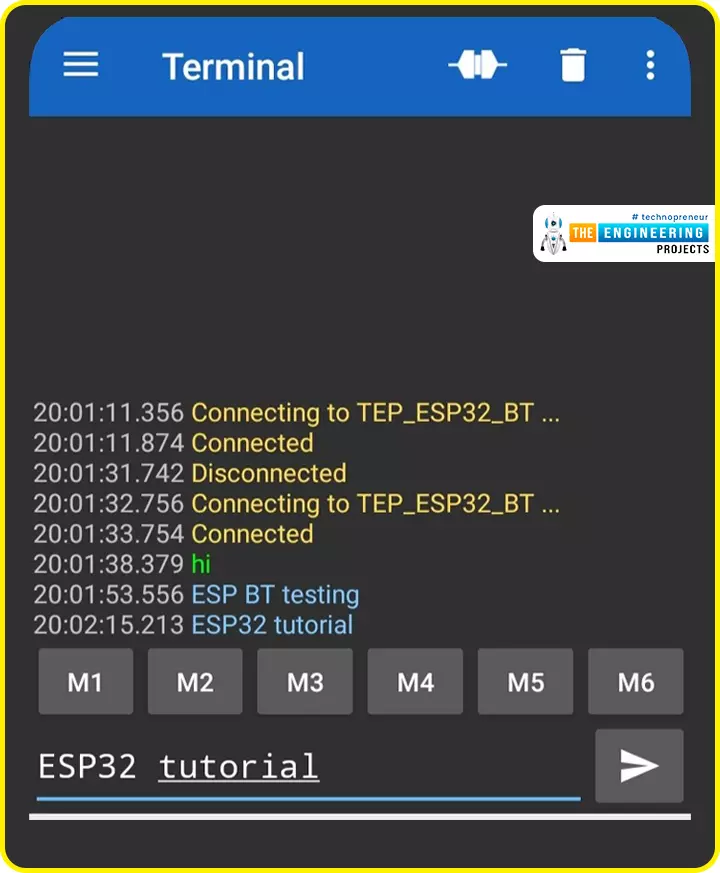
In the previous Section(Section 1: ESP32 IDEs), we installed different software IDEs to program ESP32 boards. Among these IDEs, we are going to use Arduino IDE for programming ESP32. So, I hope all of your tools are configured properly and you are ready to explore the built-in features of ESP32.Today's the 1st Chapter of Section 2, and here we will discuss How to communicate with ESP32 Bluetooth Classic from a smartphone using Arduino IDE.
Here's the video tutorial for ESP32 Bluetooth Classic:
ESP32 Wireless Features ...
Hey everyone! Hope you all are doing great. Today, I am going to give you the details on the Introduction to 2n4391. It is a simple N type JFET (Junction field effect transistor) which consists of three terminals called drain, source and gate and are denoted by D, S and G receptively. It is mostly used in analog switches and current limiters. I am going to give you a brief details on this transistor. Let's get started.
Introduction to 2n4391
2n4391 is a field effect transistor that consists of three terminals known as drain, source and gate.
It is called field effect transistors because static field performs as important part in the operation of this transistor.
Unlike normal transistors, it is a voltage controlled device as it doesn't requ ...