Wave soldering is a widely used mass soldering process in the manufacturing of electronics, especially for through-hole elements and intricate technology printed circuit boards. In this method, a PCB is ignored, and a wave of melted solder permits solder joints to form on vulnerable part leads and pads at the same time. While wave soldering is effective and cost-efficient for high-volume manufacture, it is also liable to certain flaws if the method parameters, textiles, or patterns deliberation are not handled carefully.
Wave soldering defects in PCB assembly refer to general soldering flaws, such as spanning, defective solder, voids, and cold joints, that happen during the wave soldering process and can negatively affect the electrical execution, reliability, and long-term endurance of p ...
Hi Guys! Hope you’re well today. I welcome you on board. In this post, I’ll walk you through How a Hobbyist Can Work on Electronic Projects in America.
Working on electronic projects is a bit inundating.
From selecting the topic to research work and development to execution, you need to hustle, grind and drill to keep your final product up and running.
When you are new to the electronic field, you must not be afraid to get your hands dirty in diving deep into the nitty-gritty of the project. This means that no matter what kind of technical project you pick, you need to spend a significant amount of your time and money to reach your final goal. It's not just about making sure that whatever it is you're looking for is done well—it's also about making sure that your project is done ri ...
Hello friends, I hope you all are doing great. In today's tutorial, I am going to share a new Vibration Sensor Library for Proteus V2.0. It's the second version of the Vibration Sensor Library for Proteus. In this library, we have four vibration sensors.
These vibrations sensors have both digital and analog output pins and can easily be connected with microcontrollers i.e. Arduino, PIC, Atmel etc. Before downloading the Proteus Library zip file, let's first have a look at the brief overview of Vibration Sensor:
What is Vibration Sensor?
A vibration sensor is a small embedded sensor, which is used to detect vibrations on any surface.
These vibration sensors are used for various purposes i.e. fault detection on heavy machinery, placed on doors ...
Hello Everyone! Happy to see you here. I welcome you on board. In this post today, I’ll be discussing the Introduction to BC558.
BC558 is a bipolar junction transistor used for amplification and switching purposes. It belongs to the PNP transistor family and is available in a TO-92 package. It contains collector current 100mA, indicating it can drive load under 100mA.
I've previously detailed the Introduction to BC640 & BC327.
I suggest you read this entire post as I will cover a complete introduction to BC558 explaining pinout, working, power ratings, physical dimensions, datasheet, and applications of BC558.
Let’s jump right in. Continue reading.
Introduction to BC558
BC558 is a PNP bipolar junction transistor mainly used for ...
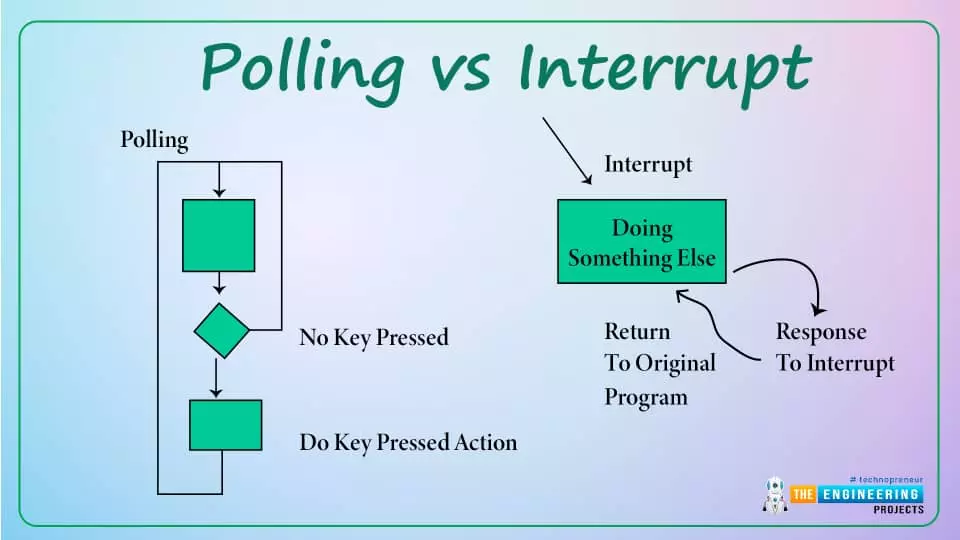
Hello readers, hope you all are doing great. Today, we will discuss interrupts and timers in ESP32 and how to handle internal as well as external interrupts. So, we will discuss What is interrupt, Polling, ESP32 interrupt, Software interrupts, Hardware Interrupts, IRS (Interrupt Service routine), Steps to execute an interrupt or how is an interrupt handled in the microcontroller, Code description for ESP32 interrupts with Arduino IDE, Code description for hardware interrupts, Why is it preferred to use timer to add delay instead of using delay() function. So, let's get started:
What is Interrupt?
Interrupts are used when a micro-controller needs to continuously monitor for an event while the same micro-controller is executing a particular task ...
Hello everyone! I hope you all will be absolutely fine and having fun. Today, I am going to tell you guys about Introduction to LM2902. LM2902 basically has four (4) internal builtin operational amplifiers. There builtin amplifiers are internally frequency compensated. The basic purpose behind designing this type of device is to support control systems in industries as well as automotive applications. LM-2902 is capable of operating for a wide range of voltages using a single power supply source.
Moreover, we can also operate this device from a split power source. Low current drain supply and magnitude of the power supply source, both are totally independent to each other. LM-2902 has a lot of features which make it different from the standard g ...
Hello friends, I hope you all are doing great. In today's tutorial, I will share a Proteus Library of another embedded module i.e. NodeMCU. NodeMCU is a microcontroller board and if you are new to this board, you should read Introduction to NodeMCU to get your hands dirty. NodeMCU is not present in the components library of Proteus and using this library you can easily simulate NodeMCU in Proteus.We can't add WiFi and BLE capabilities to our module in the Proteus software, that's why it will just perform the basic functions i.e. sensors interfacing, PWM, I/O control etc. So, you can use it for simple code testing and can also use it to design circuit diagrams of your projects.So, let's have a look at How to download NodeMCU Proteus Library and simulate it:
NodeMCU Library for ProteusFirst ...
Hi learner! I hope you are doing great. Today, I am sharing version 3.0 of the PIR sensor library for Proteus. We have already shared V1.0 and V2.0 of the PIR Sensor Library. PIR Sensor V1.0 Library for Proteus adds a digital PIR Sensor in Proteus, while the PIR Sensor V2.0 Library adds an analog PIR Sensor to simulate. These libraries were loved by the users and this motivated us to work more on it. PIR V3.0 is analog in nature, has an error-free structure and the Pinout structure is better organized. Moreover, the design is improved a little bit and we have omitted the website link from the sensor to make it look professional.
Same as the previous version, this PIR has four pins and the details of each of them will be discussed in detail later. Therefore, don’t worry if you have no expe ...
Hi Friends! Hope you are doing well. Today, I'll give you a detailed Introduction to Arduino LilyPad. It is an Arduino Microcontroller Board, based on ATmega168/ATmega328 and is introduced by Leah Buechley and SparkFun Electronics.
This board is mainly developed for e-textiles and wearables projects. As per the designed purpose, it can be attached to fabric, sensors, power supplies, and actuators. You may need a conductive thread for joining this board with the required object.
In this post, I'll try to cover each and everything related to Arduino LilyPad, what is this about and how it is used for the development of desired projects. Let's jump right in and get down to the nitty-gritty of this board.
Introduction to Arduino LilyPad
Arduino Lil ...
Hi Guys! Hope you’re well today. I welcome you on board. In this post today, I’ll walk you through the Introduction to Arduino Esplora.
Looking like a videogame controller, the Arduino Esplora is an electrical device that contains an Arduino Leonardo board (microcontroller) and a number of outputs and inputs. There are a colored LED and a buzzer as outputs. And there is a light sensor, four buttons, a joystick, a microphone, an accelerometer, and a temperature sensor as inputs. In other words, it is just like another Arduino Board with integrated actuators and sensors.
Just stay with me for a little while, as I’m going to document the complete Introduction to Arduino Esplora covering pinout, working, pin description, how it’s different than othe ...