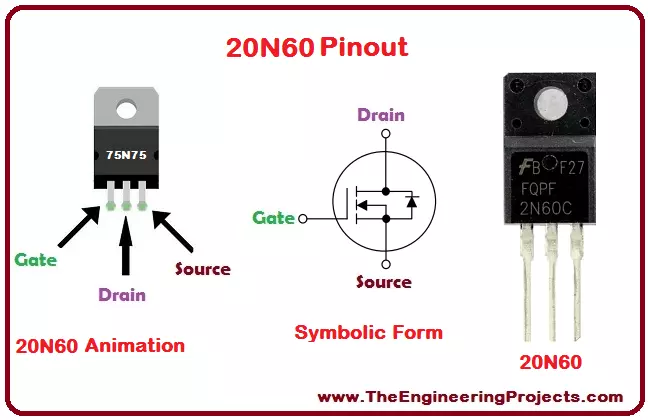
Hello friends! I hope you all will be absolutely fine and having fun. Today, I am going to give you an elaboration on Introduction to 20N60. 20-N-60 is basically a power Metal Oxide Semiconductor Field Effect Transistor (MOSFET). Power MOSFET is a device that can handle a specific level of power. I have already shared information about MOSFET in my previous tutorials e.g. Introduction to 75N75, SG3524, 50N06, IRFZ44N, C945 and TL072. Before going into the details of this article you must have a look at these articles. They will result in the better understanding of this article.
MOSFET family is divided into two categories. P-channel MOSFET and N-channel MOSFET. 20-N-60 belongs to the N-channel MOSFET. It is based on United Technologies Corporat ...
Hi Friends! Hope you’re well today. I welcome you on board. In this post today, I’ll describe the Introduction to 74LS74.
74LS74A flip-flop IC carries the Schottky TTL circuitry to generate high-speed D-type flip-flops. Every flip-flop in this chip comes with individual inputs, and also complementary Q and Q`(bar) outputs.
Flip-Flops are normally considered as the basic building blocks of modern digital electronics. These flip-flops are used to store the binary data where stored data can be varied by applying the different inputs.
I suggest you buckle up as in this post I’ll walk you through the complete introduction to 74LS74 covering datasheet, pinout, features, and applications.
Let’s get started.
Introduction to 74LS74
74LS74A flip-flop ...
Hello readers, I hope you all are doing great.
ESP32 is a powerful chip for Internet of Things applications. This tutorial is also based on one of the ESP32 applications in the field of IoT.
Project Overview
In this tutorial, we will learn how to update LCD display with new data or input using a web server created with ESP32.
Fig. 1
To achieve the target, we will be using an HTML (Hypertext Markup Language) form to provide web input and then update the text displayed on LCD. The values or input received from the webserver will be further stored inside a variable in the code for further use (to display on LCD).
We have already posted a tutorial on LCD (Liquid Crystal Display) interfacing with ESP32. In that tutorial, we demonstrated how to displa ...
Hello friends, I hope you all are fine and enjoying. I have been working on a project these days and one portion of my current project includes the NRF24L01 Arduino Interfacing. So, I thought why not share this knowledge with you people, I hope you will learn something new and more interesting. If you don't know much about it, then you should have a look at Introduction to NRF24L01.
Few days ago, I have also posted a tutorial on XBee Arduino Interfacing, in which we have seen how to make wireless communication between two XBee Modules which is also an RF module. So, now we are gonna have a look at How to make Wireless Communication between two NRF24L01 modules. I hope you are gonna enjoy this nrf24l01 arduino Interfacing. Here's the video demonstr ...
Hello Everyone! I always love to keep your stomach filled with useful information so you can excel and grow in your relevant field. Today, I am going to reveal the details on the Introduction to 1n914. It is a small signal diode that allows the current to flow in one direction and blocks the current in other direction. It features operating junction temperature of 175 ºC and forward surge current of 4A. It is widely used for industrial and power management applications. I'll give you a brief details about this diode, so you don't have to go anywhere else for finding the information regarding this small signal diode. Let's get started.
Introduction to 1n914
1n914 is a small signal diode that is widely used in portable devices.
It exhibits zero ...
Hi readers! I hope you are having a creative day. Today, I am sharing the list of the top embedded proteus libraries in V1.0 especially designed for engineering students. Till now, you have seen blogs on different projects, components, libraries, and simulations. Yet, I am sharing the list of the first versions of these embedded libraries that will help the students throughout multiple projects. These libraries are highly useful in multiple domains of engineering, and if you don’t know how to download the new libraries
, then you must see the link provided.
This is the list of all new proteus libraries for engineering students
. The zip files are present in the link to the related manual, which has details on how to download, install, and use these libraries. Now, let’s start learning ...
Hi Guys! I welcome you on board. In this post today, we’ll discuss the KSC1845 NPN Transistor. We will have a look at the KSC1845 Datasheet, Pinout, Power Ratings, Equivalents & Applications in detail. As it's an NPN transistor, electrons are the majority charge carriers and thus play a major role in conductivity. KSC1845 is mainly used for fast-switching and amplification purposes.NPN transistor carries 3 terminals, known as:
Emitter
Collector
Base
If the applied voltage at the base terminal exceeds 0.7V, it will forward bias this NPN transistor and the current will start to flow from Collector to Emitter. If the base voltage is less than 0.7V, KSC1845 will remain in the reverse-biased state.
I suggest you buckle up as I’ll discuss the KSC1845 ...
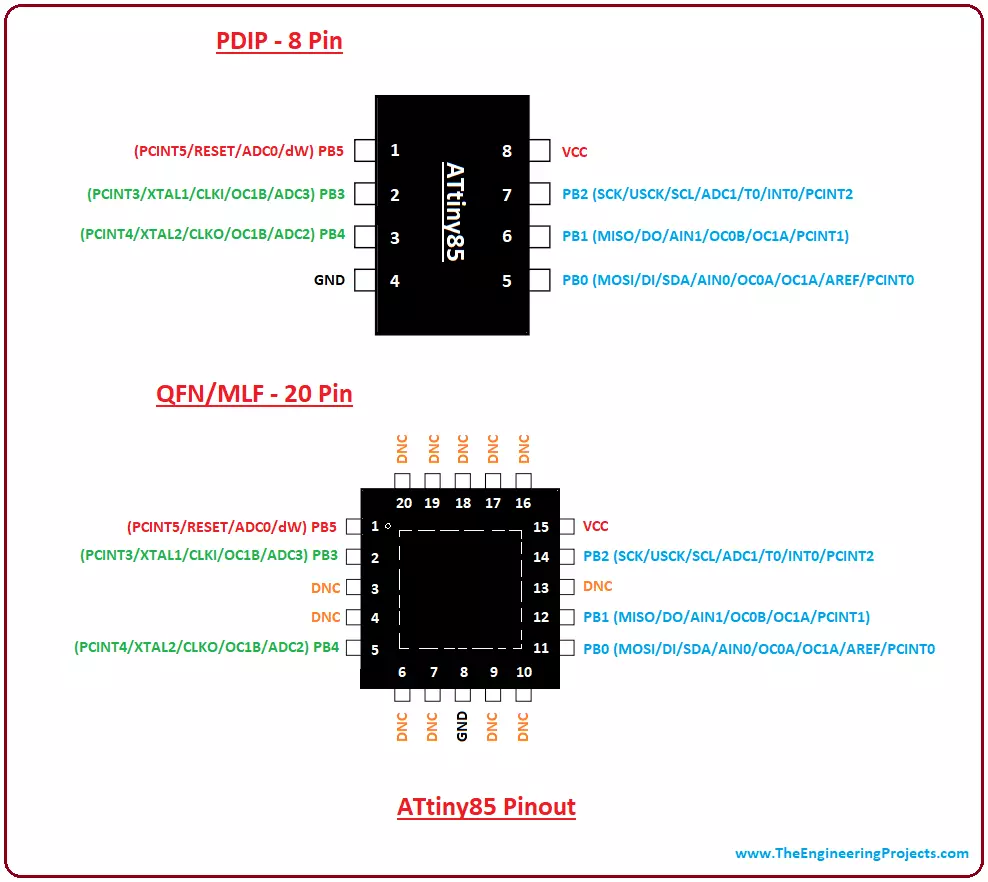
Hey Guys! Hope you are doing well. I am back to give you a daily dose of valuable information. Today, I'll discuss the details on the Introduction to ATtiny85. It is an 8-bit AVR microcontroller, introduced by Microchip, and is based on RISC CPU. It comes with 8-pin interface (PDIP) and falls under the category of low power controllers. Programmable watchdog timer and 10-bit ADC converter are added in the device that makes it suitable for sensor interfacing and resetting the device in case it gets stuck in an infinite loop.
Microchip never fails to satisfy the requirements of any individual by providing flawless microcontroller modules that are directly or remotely connected with automation and embedded systems. With the invention of these tiny o ...
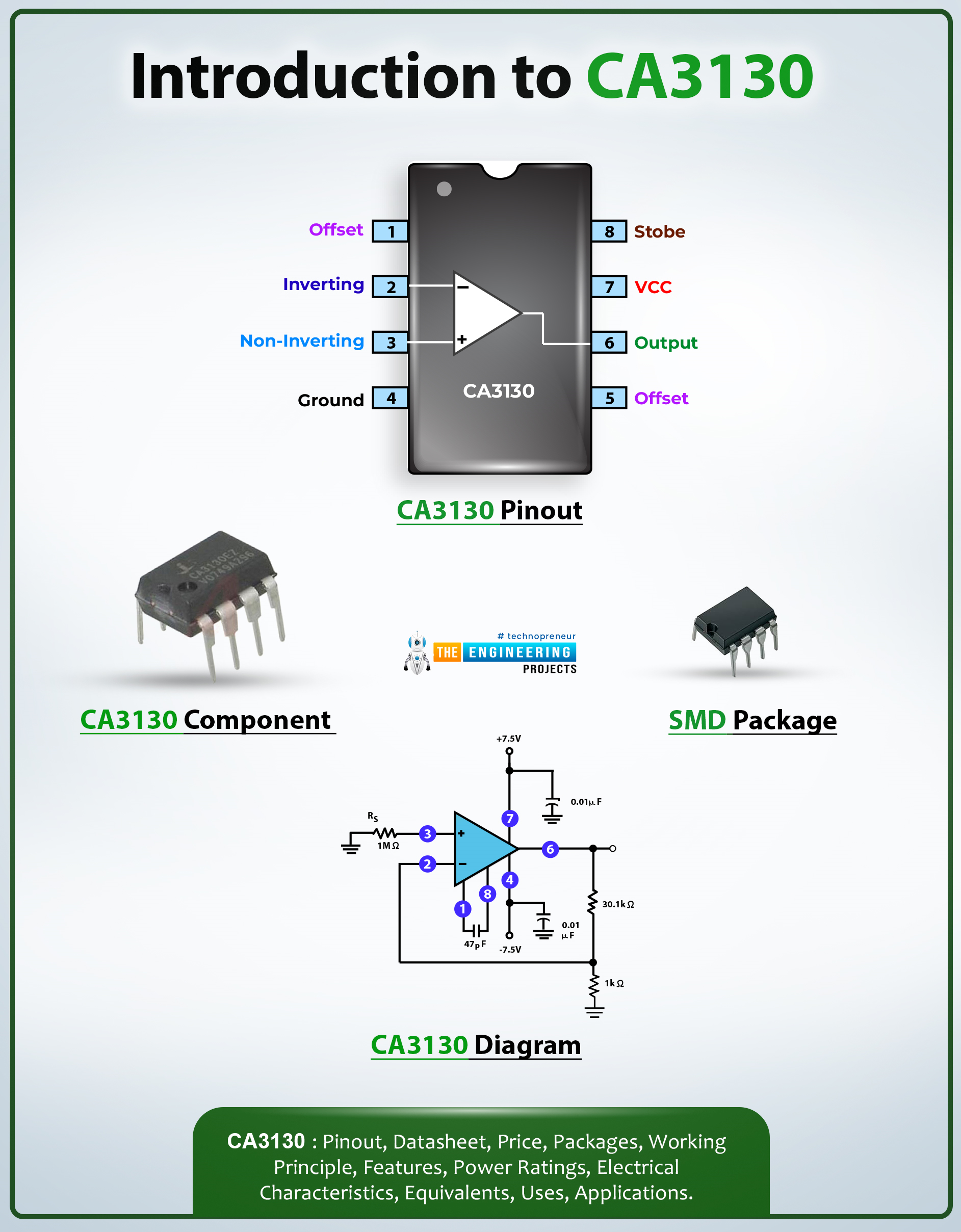
Hi Everyone! Hope you’re well today. I welcome you on board. In this post today, I’ll walk you through the Introduction to CA3130.The CA3130 is a BiMOS Operational Amplifier that comes with MOSFET at the output. The term BiMOS suggests that it projects the advantage of both Bipolar and CMOS op-amp technology.
This IC comes with high bandwidth due to bipolar op-amps and consumes less current due to CMOS op-amp, making it a perfect fit for mobile jammers and voltage follower circuits.
I suggest you read this post all the way through as I’ll detail the complete Introduction to CA3130 covering datasheet, pinout, features, and applications. Let’s get started.
Introduction to CA3130
The CA3130 is a BiMOS Operational Amplifier that contains MOSFET at the output. This chip consumes les ...
Hello friends, hope you all are fine and enjoying good health. Today I am posting the next part of Proteus tutorial which is Interfacing of LCD with PIC Microcontroller. . In the previous post of this tutorial, we have seen the basics of Proteus and discussed various functions of Proteus ISIS. If you are new to Proteus then I would recommend that before starting this tutorial, you should first read the first part so that you get the better idea of Proteus as I wont go in detail in today's post. Today, we will first design a circuit of LCD with PIC on Proteus ISIS which includes PIC Microcontroller and then we will see how to burn the microcontroller in Proteus and at the end we will run our circuit and will display some text on the LCD. It will ...