


10 Best Cloud Migration Companies in 2026: Top Service Providers Compared


If you only have a minute, here is what you will learn:
• The full scope of cloud migration services, aligned with the 6 R’s strategy model
• The objective, security-first framework we used to rank the ten best cloud migration companies in 2026
• Deep-dive profiles of each vendor so you can map strengths to your own workload mix
• Practical cost bands, real-world benefits, and a ready-to-use question list for vendor selection
Introduction
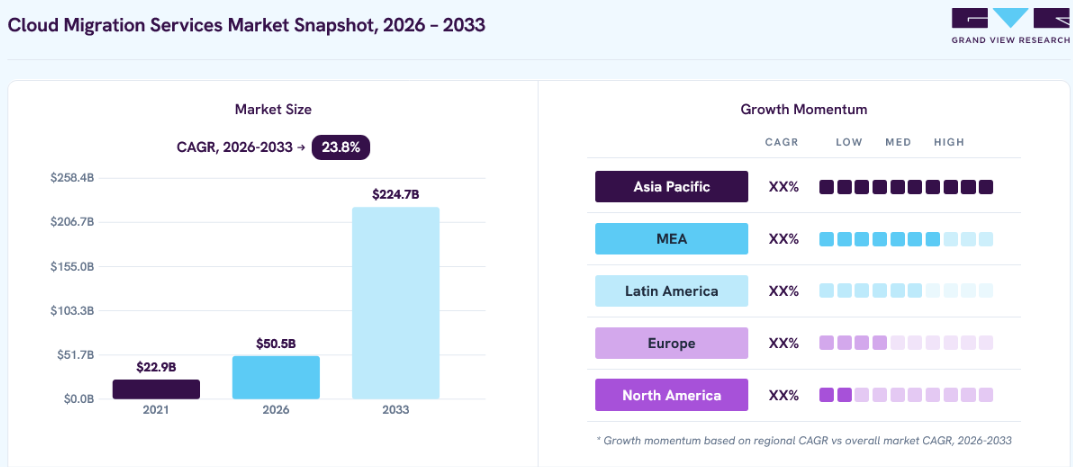
Every CIO now has a standing board directive to “get to cloud but control cost.” The mandate would be straightforward if most estates were modern, documented, and lightly regulated. In reality, they are the opposite: decades-old ERP systems, compliance frameworks updated yearly, and staff attrition that has eroded institutional knowledge. This complexity explains why spending on external cloud migration services is projected to reach $50.5 billion by the close of 2026.
A seasoned cloud migration company delivers both the engineering muscle and the program discipline to move workloads safely while preserving audit trails and uptime targets. The following guide unpacks what such firms actually do, how to grade them, and which ten vendors perform best in 2026.
What Are Cloud Migration Services?
Organizations rarely migrate for technology bragging rights. They migrate because there is a measurable business case: cut hardware refresh costs, shorten release cycles, or unlock AI services not viable on-prem. Cloud migration services companies wrap that business objective in an engagement that moves data, applications, and sometimes entire data centers into AWS, Microsoft Azure, Google Cloud, or a private stack.
Types of Cloud Migration Services
Before 2024, most mid-market work was a direct lift-and-shift. In 2026, any cloud migration company now map workloads against the six standard strategies, often combining them across phases:
Rehost keeps VMs intact but leverages cloud elasticity. Think 400 VMware guests moved to Amazon EC2 by the deadline so a colocation lease can expire.
Replatform makes changes such as replacing a self-hosted MySQL with Azure Database for MySQL, which reduces ops effort.
Repurchase refers to phasing out custom code, or SaaS (an on-premise HR solution replaced by a Workday solution).
Refactor/Re-architect modernizes core; breaks down monoliths to microservices or serverless. Expensive to implement, but essential for digital-first roadmaps.
Retire removes applications that no longer fit the business objectives, which can result in 10-20 percent of total VM count being freed up.
Retain agrees that workloads remain on-prem for latency and sovereignty – and that this is now the standard approach for regulated hybrid deployments.
Real projects sequence these actions: first rehost to buy time, then refactor the riskiest modules. That pragmatic mix helps companies cloud migration deliver value early without betting the farm on a single big-bang moment.
Public, Private, and Hybrid Cloud Migration
Public cloud regions are unmatched for elasticity and edge services, yet 2026 regulatory guidance in industries such as healthcare mandates that certain datasets remain inside the customer’s physical control. Hence the rise of pragmatic hybrid architectures: patient data sails into a private OpenShift cluster while front-end appointment apps scale out on Google Cloud Platform. Effective cloud migration providers understand the design trade-off and template network links, IAM brokering, and monitoring so traffic can cross those boundaries safely.
When Businesses Need a Cloud Migration Company
You might engage a cloud migration service provider when:
Your Oracle Solaris hardware hits end-of-life, and the vendor quotes a 40 percent uplift for renewal.
A data center contract expires in nine months, and your CFO refuses another five-year lease.
A recent acquisition left two ERP stacks; the board wants a single system of record within a year.
New PCI DSS v4.0 controls go live, and your on-prem firewall cannot meet segmentation rules.
AI product features require Nvidia H100 GPUs that your local colocation has on a three-year backorder.
These inflection points often converge, turning “cloud later” into “cloud now.”
How We Selected the Best Cloud Migration Companies
Choosing winners required a transparent scoring rubric because every vendor markets itself as “cloud-first.” We assigned numeric weights, shown in Table 1, then validated claims with public records and reference interviews.
Criterion | Weight (%) | Evidence We Required |
Multi-cloud depth (AWS, Azure, GCP) | 20 | At least 15 certified engineers per platform |
Enterprise migration record | 15 | Two reference projects > 500 VM or $500k budget |
Security & compliance maturity | 20 | ISO 27001 or SOC 2 plus regulated industry case study |
Client satisfaction | 15 | ≥ 4.8/5 average on Clutch or Gartner Peer Insights |
Innovation & automation | 15 | Internal AI-based discovery or FinOps toolkit |
Partner-tier status & certifications | 15 | AWS Advanced/Premier, Microsoft Solutions Partner, or GCP Partner |
The table underscores why a boutique with brilliant engineers but no compliance story might score well on depth yet fall short overall.
Technical Expertise Across Major Cloud Platforms
We verified active certifications on each hyperscaler’s public partner portal. A dormant badge earned four years ago did not count.
Experience Delivering Enterprise Cloud Migration Services
Reference calls focused on measurable outcomes: cutover downtime, cost after 12 months, and incident backlog reduction.
Certifications and Cloud Partnerships
AWS Advanced Tier is now entry-level for enterprise RFPs; Premier remains rare. Azure Solution Designations and GCP Specializations tell a similar story.
Client Reviews and Proven Success
There's a bit of an enterprise balance with Gartner Peer Insights, which provides feedback from enterprise clients as opposed to SMB companies like Clutch.
Security, Compliance, and Risk Management
ISO 27001, SOC 2 Type II, and, where relevant, HITRUST or FedRAMP were mandatory if the vendor marketed to healthcare or federal buyers.
Innovation, AI, and Cloud Automation
FinOps dashboards, AI code-analysis tooling, and policy-as-code pipelines distinguish leading cloud migration services company partners from staffing-only firms.
Top 10 Cloud Migration Companies in 2026
By design, every vendor here is a legitimate cloud migration services company, but each has situational strengths.
1. Techstack
Source: Techstack
Techstack has practiced cloud engineering for more than a decade, and cloud migration is not an add-on but the bedrock of longer-term software partnerships. Its six-stage framework covers strategy, audit, architecture, data migration, phased deployment, and ongoing optimization. The company publishes 50+ case studies across its portfolio. Dedicated pods cover infrastructure, platform, database, and application modernization. The firm’s ISO/IEC 27001:2022 and ISO/IEC 27701:2019 certification, audited by Swiss Approval, resonate with healthcare and fintech boards.
Recent public work includes a five-year-plus engagement modernizing a California-based sales-enablement platform: transforming a monolithic codebase into modular microservices, rebuilding its live-meeting module as a standalone product with Amazon Chime integration and AI-powered transcription, and unifying multiple legacy products under a single sign-on system. Separately, Techstack built a serverless fundraising platform on AWS Lambda, S3, and CloudFront that now supports over 400,000 daily visitors while keeping infrastructure costs under 0.2% of revenue.
2. Sombra
Source: Sombra
Sombra operates from Ukraine and the United States, but its influence lies in deeply regulated work. The company embeds PCI-aware DevSecOps engineers directly into client squads, mapping each AWS control to a compliance artifact. A card-issuer client reduced quarterly audit prep from three weeks to four days after migration with Sombra’s templated evidence collection. Sombra favors IaC via Terraform and AWS Control Tower landing zones, simplifying future remediation. Although similar in size to Techstack, Sombra cherry-picks verticals it will turn down, say, ad-tech if it dilutes focus. That discipline keeps delivery metrics tight; 94 percent of its projects since 2021 launched within 10 percent of the agreed schedule.
3. Yalantis
Source: Yalantis
Yalantis approaches cloud moves by spending extended time on dependency mapping. Engineers instrument existing workloads, often logistics suites with sprawling EDI feeds, to build a living architecture graph before migrating the first VM. That discovery has surfaced brittle dependencies (hard-coded IPs, SMB shares) early, preventing last-minute firewall panic. Once in the cloud, Yalantis’s DevOps/SRE group installs continuous performance tests; a freight-broker client caught latency variance that traced back to an upstream carrier API and patched it pre-peak season. Yalantis holds an AWS Select Tier Services Partner badge, focusing on the mid-market rather than the Fortune 100. For leaders who value methodical prep over heroic weekends, Yalantis is a credible pick.
4. MobiDev
Source: MobiDev
MobiDev’s AI pedigree shapes its migration game plan: every project includes a target-state design for machine-learning pipelines, even if the client has no immediate AI backlog. In 2025, the company moved its retail analytics platform to Azure, moving away from a nightly ETL process and connecting this with managed Azure Synapse pipelines and managed Spark, and then hooked up managed feature stores for future forecasting models. Post-migration, the retailer developed an ML demand-forecast module, which increased same-store sales by three percent in a single quarter. Security is a priority: MobiDev has a dedicated compliance office in the US and UK units of the company, while the R&D centers are located in Poland and Ukraine.
5. Belitsoft
Source: Belitsoft
Belitsoft has been in custom software since 2004 and leverages that tenure during cost-sensitive lifts. Its engineers routinely tune EC2 right-sizing and Azure Reserved VM Instances for 30 percent+ savings compared to first-pass estimates. A manufacturing client collapsing four regional data centers into AWS saved $1.8 million over three years versus hardware refresh, with Belitsoft’s rate model staying flat – no hidden percentage of savings. The firm’s lower overhead appeals to SMB CFOs, yet it still fields 40+ AWS and Azure certifications. Where compliance depth is lighter than Sombra’s, Belitsoft compensates with transparency: clients access its real-time timesheet system to monitor effort burn.
6. Cleveroad
Source: Cleveroad
Cleveroad leans into business growth stories. When an e-commerce marketplace expected influencer-driven traffic spikes ahead of a major cosmetic brand launch, Cleveroad re-platformed from a shared host to AWS EKS, CloudFront, and Aurora Serverless. The launch sustained 10× baseline traffic with zero downtime. Beyond infra, Cleveroad’s UI/UX lab tidied the checkout flow in parallel, pushing conversion up three points. Security credentials are solid – the company is ISO 9001 and ISO 27001 certified and holds AWS Select Tier and Service Delivery Partner status – and a small dedicated GRC team manages data-processing agreements. Cleveroad is therefore a balanced cloud migration services company for scale-ups seeking infrastructure and product polish in one contract.
7. Trinetix
Source: Trinetix
Trinetix begins every multi-cloud program with a two-week “decision accelerator” workshop. Stakeholders map business drivers, risk appetites, and licensing constraints before any tooling discussion. This consult-first stance won it a multi-region migration for a US industrial distributor that ended with AWS for IoT telemetry, Azure for analytics (leveraging existing Power BI licenses), and on-prem Oracle for plant floor MES – an intentionally hybrid fabric. Trinetix’s change-management office builds communication packs so non-technical staff understand new support models and cost centers. The firm is a certified Google Cloud partner and, on review sites, scores slightly lower on pure code velocity but higher on governance, a trade-off that many enterprise PMOs welcome.
8. Agiliway

Source: Agiliway
With roots in Salesforce consulting, Agiliway shines when CRM ecosystems sprawl. A nonprofit with five overlapping donor databases hired Agiliway to consolidate them on Azure SQL and surface analytics in Power BI. The move trimmed integration headcount by two FTEs and enabled GDPR-compliant erasure across a single data map. Agiliway’s DevOps division then codified pipelines via Azure DevOps, allowing marketing teams to ship donor-facing features daily rather than weekly. ISO 27001 certified, the company offers optional managed detection and response, bridging the gap between migration and day-two security ops.
9. Softermii

Source: Softermii
Every Softermii migration starts with concurrency benchmarks because its customers operate video-heavy portals. For a telehealth startup, Softermii lifted services to Google Cloud, inserting Cloud CDN edges near patient clusters and auto-scaling media servers behind global TCP load balancing. The result: 150 ms average latency down to 60 ms, validated by New Relic dashboards. HIPAA BAAs and custom encryption wrappers protect PHI at rest and in motion. While smaller than first-tier vendors, Softermii’s tight focus on real-time media makes it the go-to cloud migration company for low-latency video workloads.
10. Existek
Source: Existek
Existek serves an underrepresented market: SMBs with 20-60 servers. Its step-by-step workbook covers assessment templates, a change-freeze calendar, and plain-language rollback scripts. An Ohio insurance co-op with no internal DevOps team completed its Azure lift in four months at a fixed $140k all-in – less than one year of data center rent. Existek has fewer flashy AI tools but compensates with near-daily Slack syncs and video demos so non-technical owners can literally watch progress. That hands-on rapport earns a 4.9/5 average across 19 verified Clutch reviews, validating that smaller firms can still access quality cloud migration providers without enterprise budgets.
Best Cloud Migration Service Providers by Business Needs
The categories below distill market feedback rather than arbitrary labels. There is always overlap, but the matrix offers a first-pass filter.
Best Cloud Migration Company for Enterprises
Techstack's mature compliance office, nearly 200-person team, and zero-downtime playbooks make it the natural choice when board committees demand provable governance.
Best Cloud Migration Services Company for SMBs
Belitsoft’s pricing transparency and smaller-project experience resonate with owners who manage both the P&L and the tech stack.
Best Multi-Cloud Migration Provider
Trinetix excels at cross-cloud policy engines and human change management, the duo that usually sinks or saves hybrid plans.
Best AWS Migration Partner
Sombra’s PCI and HIPAA checklists mapped to AWS Config rules position it ahead of peers for compliance-heavy rehosts to the market leader.
Best Azure Migration Provider
Agiliway leverages Windows Server and SQL Server hybrid benefits to cut run costs by up to 85 percent, often the decisive factor for Microsoft-centric estates.
Best Google Cloud Migration Company
MobiDev’s machine-learning focus aligns with GCP’s AI portfolio, allowing customers to pivot into Vertex AI without re-architecture.
Common Cloud Migration Scenarios
Modern cloud programs rarely fit one pattern. Each scenario below influences tooling, timelines, and contract language.
Legacy Application Migration to the Cloud
Mainframe MIPS costs, or monolithic .NET 3.5 apps, often block feature velocity. Vendors may introduce an intermediary container wrapper so the refactor can proceed piecemeal, preserving nightly batch cycles while new microservices siphon traffic gradually.
Data Center to Cloud Migration
Data center exits involve absolute deadlines. The penalty for a missed lease termination can exceed $50k per month, so cloud migration companies stage “immovable” workloads such as license servers keyed to MAC addresses into dedicated sprint lines with extra float.
VMware and Virtual Machine Migration
Post-Broadcom price hikes now force CFOs to weigh license extensions against AWS Application Migration Service or Azure VMware Solution. Cloud-hosted VMware reduces CapEx but still locks firms into vSphere. Some choose a two-step: rehost VMs to AVS, then refactor high-cost guests into cloud-native services over 18 months.
Multi-Cloud and Hybrid Cloud Migration
A hybrid rollout usually places domain controllers and Oracle RAC on-prem, API layers in AWS, and analytics in Azure. Network architecture must address hairpinning latency; vendors deploy regionally peered Layer-3 fabrics to avoid trans-Atlantic back-and-forth trips.
Cloud-to-Cloud Migration
Egress charges headline, but the real cost lies in rewriting IAM policies. AWS IAM roles cannot port 1:1 to GCP IAM conditions; mapping takes engineers weeks. Underestimating this configuration complexity is why 38% of migrations are delayed by more than a quarter.
Benefits of Working With a Cloud Migration Service Provider
Engaging a seasoned cloud migration services company yields measurable, board-visible gains once the project stabilizes.
Benefit Area | Typical Improvement | Example Metric |
Infrastructure cost | 20-40% lower TCO after rightsizing | Data-center exit saved $1.8M for a manufacturer |
Scalability | Near-instant capacity adds via auto-scaling | Black Friday traffic surge absorbed |
Security & compliance | Built-in encryption, audit logs | SOC 2 gap closure in 6 weeks |
Time to market | CI/CD cycles drop from weeks to days | Weekly releases → daily for nonprofit CRM |
Business continuity | RPO reduced to minutes | Cross-region failover in 90s DR drills |
Once cloud resources are optimized, case studies prove that clients are managing their spend at 60-73 percent of their previous on-premise spend. That savings increase when FinOps becomes an operating discipline, rather than a one-off project.
Improved Scalability and Performance
Auto-scaling groups, serverless bursts and global CDNs remove capacity guessing and protect revenue during flash sale events.
Enhanced Security and Compliance
Tools like AWS GuardDuty and Microsoft Defender in the cloud offer near real-time threat triage that you don’t typically see on-premises. This is crucial because compliance audit windows become smaller with ongoing monitoring.
Faster Digital Transformation
Developers do not have to spend as much time fixing OS kernels and instead can focus on adding API functionality, which translates directly to product revenues.
Better Business Continuity and Disaster Recovery
The price of cross-region replication is now based on the gigabyte and not an entire standby site, allowing enterprise-grade DR to be accessible for SMBs.
How Much Do Cloud Migration Services Cost?
Budgets depend on scope, but patterns have emerged.
Estate Size | Server / App Count | Typical Budget | Duration (Months) |
Small | 10-40 servers | $50k-150k | 2-4 |
Mid-market | 50-150 servers | $150k-750k | 3-8 |
Large | 150+ servers, > 300 TB data | $750k-3M+ | 6-18 |
A migration skewed toward refactor will cost 1.5-2x a pure rehost on the same estate. Cloud choice matters: Azure Hybrid Benefit can drop Windows licensing by up to 40 percent, whereas AWS Graviton instances lower compute cost but may require code re-compilation. Hardware-bound software (dongles, physical HSMs) adds outlier cost for device bridges.
How to Choose the Right Cloud Migration Services Company
Selecting a partner mirrors selecting any managed service, but cloud nuance adds hidden traps.
Evaluate Cloud Platform Expertise
Check not just certificates but current-year project counts per platform. Specializations and partner badges only carry weight when engineers actively deliver on the platform within the past twelve months; stale credentials can mask a gap in real-world experience.
Review Migration Methodology
Ask for the actual runbook. Look for checkpoint gating, rollback criteria, and a communication matrix. If templates seem generic, probe harder.
Assess Security and Compliance Experience
Map your control objectives – PCI segmentation, HITRUST logging – to past vendor work. Experienced cloud migration services companies will show redacted evidence reports, not marketing slides.
Verify Post-Migration Support
Many disappointments arise 45 days after go-live when CPU costs spike. Ensure the SOW outlines optimization sprints and cost reports, not just incident response.
Compare Pricing Models
Time-and-materials suits agile-style refactors; a fixed bid can work for tight rehosts so long as scope is frozen. Clarify who pays for bandwidth during terabyte-scale data transfer.
Questions to Ask Before Hiring a Cloud Migration Company
Before signing, hold a focused workshop – no more than seven questions to keep the call brisk.
How many full-time architects carry certifications on our target platform today?
Can you share two recent reference architectures in our industry vertical?
What is your fallback plan if data copy overruns the change window?
How do you handle secret rotation and key management in transit and at rest?
What dashboards will finance receive to track run-rate post-cutover?
Who signs off on any scope changes and at what hourly rate?
How will you transfer knowledge to our internal ops team?
A quick note on legal: insist on an MSA clause clarifying that intellectual property created during automation remains with your firm unless explicitly waived.
Cloud Migration Trends for 2026 and Beyond
Analyst outlooks converge on five trends shaping next fiscal-year budgets.
AI-Powered Cloud Migration
Automated scanners – code coupling is flagged and maintainability scores calculated, AI refactoring – 35% less complexity. With AI intervention, human error is reduced but still requires architect review.
Cloud-Native Modernization
Today, 70% of Google Cloud and 65% of AWS customers use serverless compute. Lambdas, Azure Functions, and Cloud Run accelerate feature releases but require new observability playbooks.
Multi-Cloud Strategies
Adoption is a choice in real life. Businesses retain 70 percent of what they spend on a primary cloud and use those funds on additional workloads such as AI in GCP or Windows licensing in Azure.
Zero-Downtime Migration
Clients now view downtime as a contractual breach, not an inconvenience. Vendors standardize blue-green deployments and automated DNS switching with built-in rollback.
FinOps and Cloud Cost Optimization
FinOps departments increasingly report directly to CTOs. Budget committees expect quarterly cost reports, and lack thereof can derail renewals.
FAQ
What does a cloud migration company do?
It assesses the existing estate, plans the target architecture, executes workload transfer using rehost/replatform/refactor techniques, validates performance, and then optimizes cost and security, often staying on as managed services.
How much do cloud migration services cost?
Typical budgets range from $150k to $750k for mid-market estates. Large, refactor-heavy programs can exceed $1 million, while very small scopes may land under $100k.
How long does a cloud migration project take?
Small lifts can wrap in about 3-4 months. When enterprise programs require a phased refactor, they generally run 6-12 months, as compliance sign-off is required at each phase.
Which are the best cloud migration companies in 2026?
The top 10 list for 2026 includes Techstack, Sombra, Yalantis, MobiDev, Belitsoft, Cleveroad, Trinetix, Agiliway, Softermii, and Existek, who are all strong in a variety of workload scenarios.
Comments
0