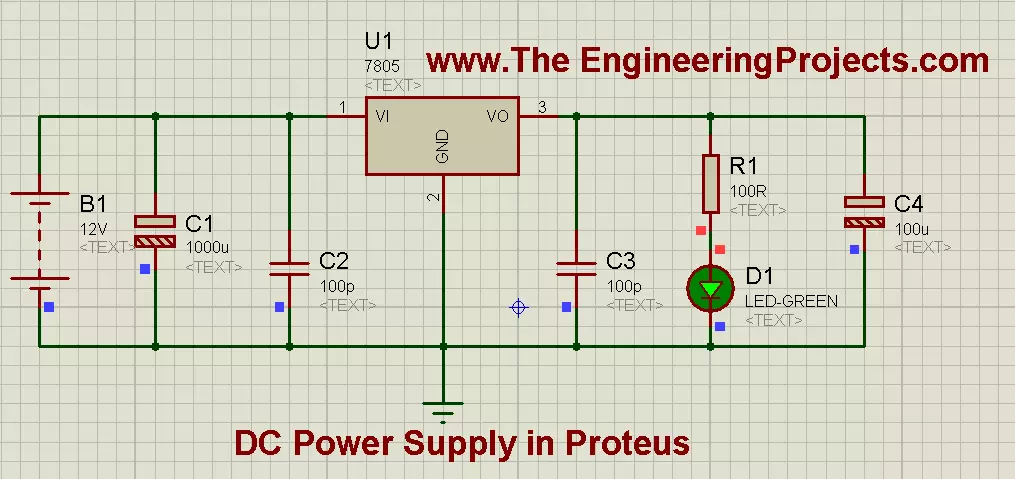
Hello friends, hope you all are fine and enjoying in your life. In the previous post, we have seen How to use Oscilloscope in Proteus ISIS, today I am going share a new and a very important Tutorial which is How to Design a 5V Power Supply in Proteus? This project is very simple and of basic level but importance of this project is that it is used as a base in almost all large electronics project, designed now-a-days. When I start working on any project then the first thing, I need to design is this DC power supply, because without powering up the components, we can't use them. :)
While designing a 5V Power Supply in Proteus ISIS, we will be using Voltage Regulator IC, which is commonly known as 7805. This voltage regulator is used to regulate or c ...
Hi learners! I hope you are doing great. Today, I am going to share the second version(V2.0) of the LCD library for Proteus. We have already shared the LCD V1.0 Library on our blog. Along with appreciation, we also get some complaints/suggestions about that library.
So, we have designed a better version of the LCD library by keeping the suggestions in mind.
Version 2.0 has error-free working, better pinout prints, and is identical to the real-world LCD. We have also removed our website link from the LCD. This library includes two alphanumeric LCDs in it i.e. LCD 16x2 and LCD 20x4.
If you don't have any experience with the LCD, no need to worry as we will guide you from scratch. Before installing the LCD, let's first have a look at its brief introduction:
What is Liquid Crystal D ...
Hello friends, hope you all are having fun and enjoying life. Today's post is quite a simple one and is about designing of circuit diagram of buzzer in Proteus ISIS. Buzzer is quite a common electrical component which is used in almost every Embedded Systems project. For example, you have seen a simple UPS, it gives a beep each time the light goes off or it has depleted its battery. Buzzer is normally used for given some indication and normally this indication is kind of a warning.
Proteus has a builtin component for buzzer and its an animated component means it gives a sound (beep) when its turned ON. So, I am gonna use that one and will give you an actual beep on it. So, it won't be much difficult and quite a simple procedure. In this post, I am ...
Hi mentees, we are here with a new tutorial. I hope you all are fine. So far, we have been designing combinational circuits i.e. Adder, Subtractor, Multiplexer etc. using logic gates. But from today onward, we will design sequential circuits using logic gates i.e. Latches, Flip Flops etc. Let's quickly recall what's the difference between combinational & Sequential Circuits:
Combinational Circuits:
Combinational circuits only use the current state of the input values to generate the output.Examples of DLD Combinational Circuits are: Adders, Subtractors, Multiplexers etc.
Sequential Circuits
Sequential Circuits use both the current & previous states of the inputs to generate the output.Examples of DLD Sequential Circuits are: Latches, Flip Flops, Timers, Counters etc.
Digital M ...
Hello friends, today I am going to post the next lecture of Proteus Tutorial. I am receiving quite a positive response about this Proteus tutorial. In the previous post, we have seen How to use Virtual Terminal in Proteus and today I am going to explain How to use Oscilloscope in Proteus ISIS. This oscilloscope is just the same which you have seen in your electronic or electrical labs. Oscilloscope is basically used to monitor signals or waveforms. Particularly when you are not much aware of the circuit and you need a little debugging then you use oscilloscope.
In oscilloscopes, we can visualize the electrical properties of waveforms, like we can check whats the frequency of electrical signal, what's its voltage or current. Digital oscillosco ...
Update: Here are the latest versions of this library: Arduino Library for Proteus V3.0 and Arduino Library for Proteus V2.0.
Hello friends, I hope you all are fine. In today's tutorial, I am going to share a new Arduino Library for Proteus. I am quite excited about today's post as it's my first complete Arduino Library for Proteus. In my previous tutorials, I have shared these Arduino boards in separate Proteus libraries but today I have combined all the boards together in a single library. You just need to download the Proteus library zip file and install it in Proteus software. You will get all the Arduino boards in your Proteus workspace. You should also give a try to Genuino Library for Proteus.We have tested all the boards with different types of sensors. So, now you can easily use ...
Hi Friends! Glad to have you on board. In this post today, we’ll cover How to Download Proteus Library of Arduino Modules.
If you are a regular reader of our blog, you must have noticed that we are sharing Proteus Libraries of different embedded sensors & modules on regular basis. Moreover, we have also launched version 2.0 of few libraries. So, today I am going to provide links to download Proteus Library of all Arduino Boards designed by TEP.
So, let's get started with How to Download Proteus Library of Arduino Modules:
Download Proteus Library of Arduino Modules V2.0
It's the most advanced version of Arduino Proteus Library and consists of 6 Arduino Boards in total, named as:
Arduino UNO
Arduino Mega 2560
Arduino Mega 1280
Ardu ...
Yesterday, I have posted a new Arduino Lilypad / Nano Library for Proteus in which we have seen how to add that library into Proteus so that you could be able to use these boards in Proteus. That was quite easy. Today I am gonna post a small project in which we will see how to use that library and produce an Arduino Lilypad simulation in Proteus. In this Arduino Lilypad simulation in Proteus, I am gonna use obviously he Arduino Lilypad board along with few LED lightsand will make them blink. Its also quite easy and you can also download the simulation and the hex file at the end of this project but I would suggest you to do it yourself so that you learn something out of it.
Before starting this project, you must have first integrated the Arduino L ...
Hey Guys! Glad to see you here. I welcome you on board. In this tutorial today, I’m going to share the Analog PIR Sensor Library for Proteus. We have already shared the digital PIR Sensor Library for Proteus V1.0. Moreover, you should also check the latest version of PIR Sensor Library V3.0. If you don’t know what is PIR sensor, you must read this post first where I’ve briefly discussed the Interfacing of PIR sensor with Arduino.
PIR (Passive Infrared Sensor) also known as a motion sensor, is used to detect motion using infrared rays. It is used in banks for security purposes. It can detect the presence of a person by identifying their motion inside. Similarly, it is used in home automation where it detects the movement in the room, giving a signal we need to turn on the light because ...
Hello students! Welcome to the new tutorial on Proteus Library. I hope you are doing well. Today, the purpose of this article is to describe the basic introduction of the MC34064 Boost Converter library in Proteus and its installation process. The Boost Converter is a popular step-up device that uses an MC34064 IC for voltage monitoring.
Proteus does not have this library by default; therefore, I designed this for the student seeking the solution to the Boost Converter project simulations. We’ll describe the procedure to use it as well, but let’s start with the basic introduction of the MC34064 Boost Converter.
Introduction to the MC34064 Boost Converter
The boost converter is the DC-DC converter device that converts the low input voltage into the high output voltage while maintain ...