


Design a 5V Power Supply in Proteus


Hello friends! Today we will design a regulated 5 V DC supply in Proteus using a 7805 regulator. We will connect the input, bypass capacitors, indicator and load, then calculate the current and heat so that the simulation becomes a useful starting point for hardware.
A regulated supply is often the first circuit a project needs, but the required voltage depends on the actual components. Some circuits use 5 V, others 3.3 V or different rails. Batteries also come in many voltages; the original article's statements that all batteries are 12 V and all electronics operate at 5 V were incorrect.
For this exercise, we will deliberately choose a suitable 12 V DC source and a modest 5 V load. The original diagrams and download remain below, with corrections to capacitor values and LED current limiting. We will keep the experiment on the low-voltage DC side.
What the 7805 Does
A 7805 is a fixed positive linear regulator intended to produce approximately 5 V within its specified input, load and temperature conditions. It adjusts an internal pass element to absorb the difference between input and output voltage.
It does not boost a low input to 5 V, and it does not remove unlimited noise or protect against every possible input fault. The selected manufacturer's datasheet defines the operating range and required external components.
The TI LM7805 family datasheet is the reference used here. Other parts sold under a 7805-style name may have different package, current, tolerance and capacitor details. Match the design to the exact device rather than relying only on the number printed on the case.
Understand Input Headroom
The regulator needs its input to remain sufficiently above 5 V. When that margin is lost, the output falls out of regulation. The required headroom depends on device behavior, current and temperature; check the datasheet instead of assuming a universal fixed voltage drop.
A nominal 12 V input gives ample headroom for the basic demonstration, but it also creates substantial heat at higher current. Choosing the highest available input is not automatically the best design. Use a source that remains within the permitted range under both loaded and unloaded conditions.
A source labeled 12 V is not necessarily exactly 12.000 V. Batteries change voltage with charge and load, and unregulated adapters can rise significantly at light load. Measure or specify the source's minimum, maximum and transient behavior.
If the input has ripple, its lowest point must retain adequate headroom. An average reading above the required minimum does not prevent brief dropout during ripple valleys. This becomes visible as output ripple or dips under load.
Identify the Regulator Pins
For the common three-pin TO-220 7805 arrangement, the functions are input, ground and output in the order shown by its package drawing. Confirm the viewing direction and manufacturer before wiring a physical part.
| Symbol connection | Purpose | Basic connection |
|---|---|---|
| VI | Input | Positive DC source |
| GND | Reference and return | Common circuit ground |
| VO | Output | 5 V load rail |
Do not assume that another three-terminal regulator has the same pin order. The LM317, for example, uses a different arrangement in common packages. A familiar package shape does not identify its electrical connections.
Check the metal tab connection when adding a heatsink. Mounting hardware can create an electrical connection as well as a thermal path. Follow the exact package's insulation and mounting requirements.
Build the Low-Voltage Circuit
- Place the 7805 model, a 12 V DC source, ground, capacitors, an LED and resistors.
- Connect the source positive terminal to VI and its negative terminal to ground.
- Connect the regulator ground terminal to the same reference.
- Connect the input bypass capacitor from VI to ground close to the regulator.
- Connect the output bypass capacitor from VO to ground.
- Connect the test load and indicator branch from VO to ground.
- Add voltmeters at input and output, plus a way to measure load current.
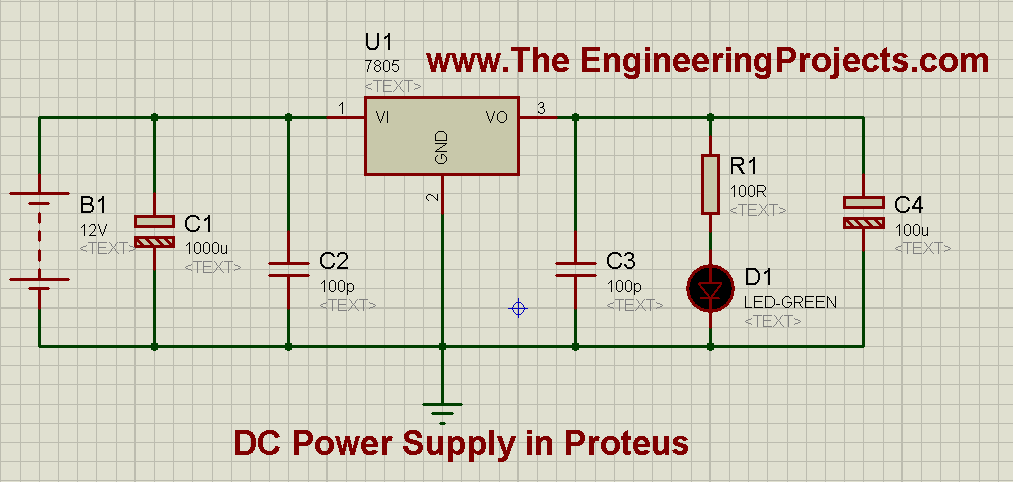
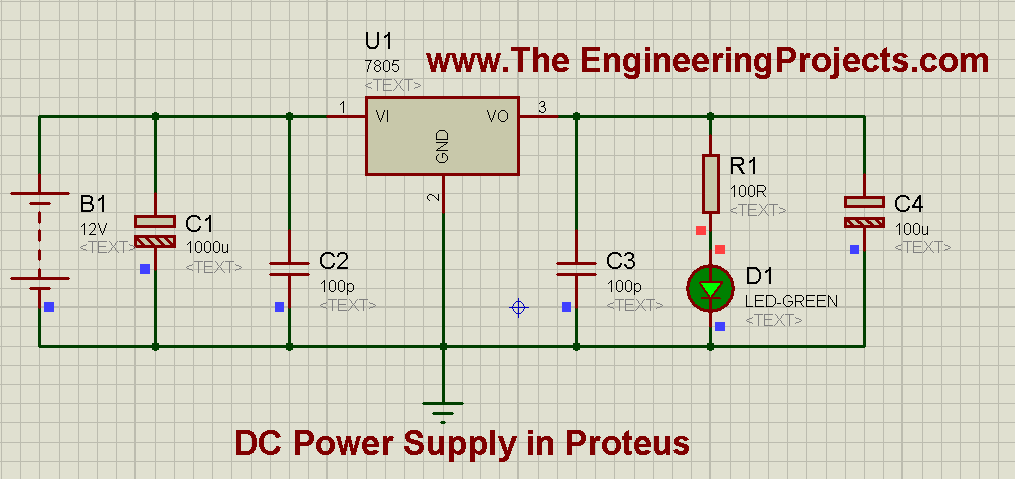
The historical diagram shows 1000 µF input bulk capacitance, 100 µF output bulk capacitance and two capacitors labeled 100 pF. Those small-capacitor labels should not be treated as appropriate general bypass recommendations.
For the cited TI device, its typical application uses a 0.22 µF input capacitor where required by the source arrangement and a 0.1 µF output capacitor to improve transient behavior. Follow the exact device documentation and place local bypass components close to the relevant terminals.
For this teaching setup, use those local values and add bulk capacitance only for a stated reason. A large capacitor at the far end of a long wire does not replace the local bypass capacitor at the IC.
Keep Capacitor Units Straight
One microfarad is 1000 nanofarads, and one nanofarad is 1000 picofarads. Consequently, 0.1 µF equals 100 nF, which equals 100,000 pF. The original 100 pF label is a thousand times smaller than 0.1 µF.
| Written value | Equivalent value | Typical role in this discussion |
|---|---|---|
| 100 pF | 0.0001 µF | Much smaller than the intended local bypass value |
| 100 nF | 0.1 µF | Local output bypass example |
| 220 nF | 0.22 µF | Local input bypass example |
| 100 µF | 0.0001 F | Possible bulk energy storage |
For polarized capacitors, connect the positive lead to the positive rail and observe the voltage rating. Allow margin above the maximum actual voltage, including relevant transients. A nominal 12 V source does not justify a capacitor rated below its possible peak.
Capacitors also have tolerance, leakage, equivalent series resistance and finite ripple-current capability. Ideal simulation values are helpful for learning, but a hardware part must be selected using these additional properties.
Add a Proper LED Indicator
An LED indicator should have its own series resistor. With a 5 V output, an illustrative 2 V LED drop and a 1 kΩ resistor, the estimated current is (5 − 2)/1000 = 3 mA.
The resistor absorbs the remaining voltage while limiting current. Its dissipation in this example is I²R = 0.009 W. Choose the actual resistor from the LED's forward-voltage range, desired brightness and current rating.
The original circuit uses 100 Ω. With the same illustrative 2 V LED drop, that would request about 30 mA, which is unnecessarily high for many indicator LEDs. A larger resistor gives a more modest test load and reduces wasted power.
Removing the resistor does not create a physically infinite current. Real sources and devices have impedance, but the resulting current is uncontrolled and can damage the LED or stress the supply. The correct lesson is to design the current path, not to rely on parasitic resistance.
Choose and Calculate a Test Load
Begin with a known resistor rather than an unknown circuit. A 50 Ω load at 5 V draws 100 mA and dissipates 0.5 W. A resistor with suitable margin, such as a 2 W part for a bench experiment, can handle this more comfortably than a small quarter-watt resistor.
| Resistance | Current | Load dissipation |
|---|---|---|
| 1 kΩ | 5 mA | 0.025 W |
| 100 Ω | 50 mA | 0.25 W |
| 50 Ω | 100 mA | 0.50 W |
| 10 Ω | 500 mA | 2.50 W |
The final row is a calculation, not permission to attach that load without reviewing the regulator, source and thermal design. Include the LED current and any other output branches when calculating total regulator load.
A motor, radio or processor board can have short current peaks that a static resistor does not reproduce. The resistor test establishes a baseline; it does not fully characterize the final application's transient demand.
Calculate Regulator Heat
The main regulator loss is approximately (VIN − VOUT) × IOUT. At 12 V input and 5 V output, a 100 mA load creates about 0.7 W of loss. At 500 mA, the loss rises to 3.5 W.
Additional internal current adds some loss, so this simple calculation is a starting estimate. A device rated for a substantial output current cannot necessarily supply that current on a breadboard without a heatsink.
Temperature rise can be estimated from power times thermal resistance. If a particular mounting arrangement had 60°C/W junction-to-ambient thermal resistance, 0.7 W would imply about 42°C rise. At 25°C ambient, the corresponding estimate would be about 67°C junction temperature.
The 60°C/W value is an illustrative assumption, not a universal 7805 property. Use the package, board and heatsink data that apply to your construction. Enclosures, airflow and nearby heat sources affect the result.
Thermal shutdown and current limiting are protective functions. An output that repeatedly disappears and returns is not a successful regulator simply because protection prevents immediate destruction. Reduce the stress or redesign the cooling and power conversion.
Understand Efficiency
Ignoring internal current, a linear regulator's efficiency is approximately VOUT/VIN. For 12 V to 5 V, that is about 41.7 percent. Much of the input energy becomes heat rather than useful output power.
At a 100 mA output, the load receives 0.5 W while the idealized input supplies 1.2 W. The difference is the calculated 0.7 W regulator loss. This connects the electrical and thermal calculations directly.
For larger currents or battery-powered operation, a suitable buck converter may be more efficient. It introduces switching-noise and layout considerations, so it is a different design problem rather than a drop-in claim that every switching module is appropriate.
A lower input voltage can reduce linear-regulator heating, provided the worst-case input still leaves enough headroom. Compare minimum-input regulation and maximum-input dissipation before choosing the source.
What Capacitors Can and Cannot Fix
A capacitor can temporarily supply current when a load changes. Ignoring regulator response and capacitor resistance, ΔV ≈ IΔt/C. If a 100 mA step must be supplied for 100 µs with no more than 0.1 V change, the ideal capacitance is 100 µF.
This simple calculation does not specify a complete transient solution. Capacitor ESR causes an immediate voltage step, wiring adds impedance, and the regulator control loop responds over time. The final waveform depends on all of them.
A capacitor also does not make DC “perfectly pure.” Its impedance varies with frequency, and the regulator has finite ripple rejection and bandwidth. Measure output ripple and transient response at the load rather than assuming a large capacitance removes every disturbance.
Large output capacitance stores energy during shutdown. If the input collapses or is shorted while the output remains charged, review the manufacturer's output-to-input protection-diode guidance. In the usual arrangement, the diode anode is at output and cathode at input.
Run the Simulation and Check More Than the LED
- Verify input polarity, regulator pin functions and ground.
- Check capacitor values, units and polarity.
- Start with a modest known load.
- Measure input and output voltages and total load current.
- Change the load in steps and observe the output.
- Inspect startup and shutdown with an oscilloscope.
- Calculate the regulator and load-resistor dissipation for every tested point.
The original screenshot shows the indicator illuminated. That establishes only that enough voltage and current were present to light the simulated LED. It does not prove output accuracy under load, low ripple, adequate thermal performance or safe fault behavior.
For waveform measurements, see our Proteus oscilloscope tutorial. Probe output relative to the intended load ground, and choose a time scale that reveals the event being investigated.
Consider Wiring and Fault Conditions
Voltage drop in a shared return can make the load see a different voltage from the regulator terminals. For example, 0.2 Ω of total lead resistance carrying 0.5 A produces a 0.1 V drop. Short, appropriately sized power wiring matters even at low voltages.
Keep the regulator ground connection close to the load-return reference where practical. Avoid routing large load currents through a thin trace that also establishes the regulator's ground reference. Local bypassing should complete a short loop rather than a long tour around the board.
Input reverse polarity is a separate fault from output overcurrent. The regulator's internal current limiter does not automatically make its input reverse-polarity tolerant. Add appropriate input protection when the source connector can be reversed, and account for any added voltage drop.
Likewise, do not connect another powered 5 V source to the output without checking backfeeding behavior. Two supplies at slightly different voltages can drive current into each other unless their sharing or isolation arrangement is designed for it.
Record load regulation consistently
Measure the output at two defined load currents while keeping input voltage and temperature conditions as consistent as possible. If an example supply measures 5.04 V at light load and 4.98 V at the higher test load, the change is 60 mV, or 1.2 percent of the nominal 5 V output.
These are example readings, not results from the supplied simulation. State whether your percentage uses nominal voltage or another denominator, and keep that convention consistent. Also record whether the regulator was cold or had reached a steady temperature.
A single load-regulation number does not describe startup overshoot, ripple or short transient dips. Use separate measurements for those behaviors so that a favorable average reading does not conceal a problem that can reset the connected circuit.
Download and Design Review
The original simulation is retained below. Its historical capacitor and LED resistor values have not been changed inside the archive. Update those details and review the exact regulator model before treating it as a hardware reference.
Design a 5V Power Supply in Proteus
| Symptom | Useful checks |
|---|---|
| Output below 5 V | Input headroom, load current, pinout and source collapse |
| Output falls after warming up | Regulator dissipation, heatsink and thermal protection |
| LED unusually bright or damaged | Series resistor and actual LED current |
| Noise or dips at the load | Local bypassing, bulk capacitance, wiring and transient demand |
| Works in simulation but not on breadboard | Physical pinout, polarity, connections, parasitics and heat |
The completed design should specify its input range, output tolerance, maximum intended current and cooling conditions. “It gives 5 V” is incomplete without those operating limits. Record the measured conditions so another reader can reproduce the result.
For a variable output, continue with our LM317 adjustable supply tutorial. The broader Proteus guide covers the simulation tools used throughout these projects.
Frequently Asked Questions
Can a 7805 make 5 V from a 3.3 V source?
No. It is a linear step-down regulator, so it needs adequate input voltage above the required output.
Are 100 pF and 100 nF the same?
No. They differ by a factor of one thousand. Check units when entering capacitor values.
Does an illuminated LED prove the supply is regulated?
No. Measure voltage under the intended load and inspect relevant transients and temperature.
Can every 7805 supply its headline current without cooling?
No. Available current depends on voltage drop, package, thermal conditions and the particular device.
Can I power a 3.3 V sensor directly from this output?
Only if that specific module is documented to accept 5 V at the chosen connection. Otherwise provide the required 3.3 V rail and compatible signals.

Tags


Hi again :-)
Buddy, after u run simulation there are Red and blue squares on your workspace.
what are those?
and how can I do like you? means I want my circuit show this Red and blue squares.
sorry about a lot my questions.
1 reply
Ops
I got it, you select digital LED :-)
I can't find 7805 and any other 78xx, 79xx, series in my library . Can u pls send me library files.
Comments
5