Hello Fellas! I aspire a happy and prosperous life for you. We always enjoy when you keep coming back for what we have to offer. Today, I am going to unlock the details on the Introduction to 2sa1015. It is a low frequency PNP (positive-negative-positive) bipolar junction transistor which is mainly used for general purpose amplification. It mainly consists of N doped semiconductor which exists between the two layers of P doped material. I'll try to cover every aspect of this transistor so you don't have to go anywhere else for finding the information regarding this transistor. Let's hop on the board and explore the details on this PNP transistor.
Introduction to 2sa1015
2sa1015 is a PNP low frequency transistor which is mainly used for genera ...
Hi Friends! Hope you are doing well. Today, I'll give you a detailed Introduction to Arduino LilyPad. It is an Arduino Microcontroller Board, based on ATmega168/ATmega328 and is introduced by Leah Buechley and SparkFun Electronics.
This board is mainly developed for e-textiles and wearables projects. As per the designed purpose, it can be attached to fabric, sensors, power supplies, and actuators. You may need a conductive thread for joining this board with the required object.
In this post, I'll try to cover each and everything related to Arduino LilyPad, what is this about and how it is used for the development of desired projects. Let's jump right in and get down to the nitty-gritty of this board.
Introduction to Arduino LilyPad
Arduino Lil ...
Hello everyone, I hope you all are fine and having fun with your lives. In today's post, I am going to share all about Arduino Data Types. Arduino Data Types play an important role in Arduino Programming and I have discussed them a little in my tutorial on How to do Arduino Programming. But today, we are gonna discuss it in more detail. I hope you guys are gonna enjoy from them and are gonna get benefit using them.
Before going any further I think you must have a llok at Arduino Basic Tutorials in which I have explained everything in a very easy way. Anyways, Till now I hopeo that you have the basic know how of Arduino Programming and you ahave also worked on Arduino LED Example. So, let's get started with Arduino Data Types:
What are Data Types ...
Hello friends, I hope you all are doing great. In today's tutorials, I am gonna share a new C945 Library for Proteus. If you have searched for this transistor in Proteus, then you must have known that it's not available in Proteus. We have designed this transistor in Proteus and here's its library.
If you don't know much about this transistor then you should have a look at Introduction to C945, in which I have explained in detail the basics of this transistor. Today, first of all, I will show you How to install this library and after that we will design a simple Proteus Simulation in which we will see How to simulate C945 in Proteus. You should also check this amazing list of New Proteus Libraries for Engineering Students. So, let's get started wi ...
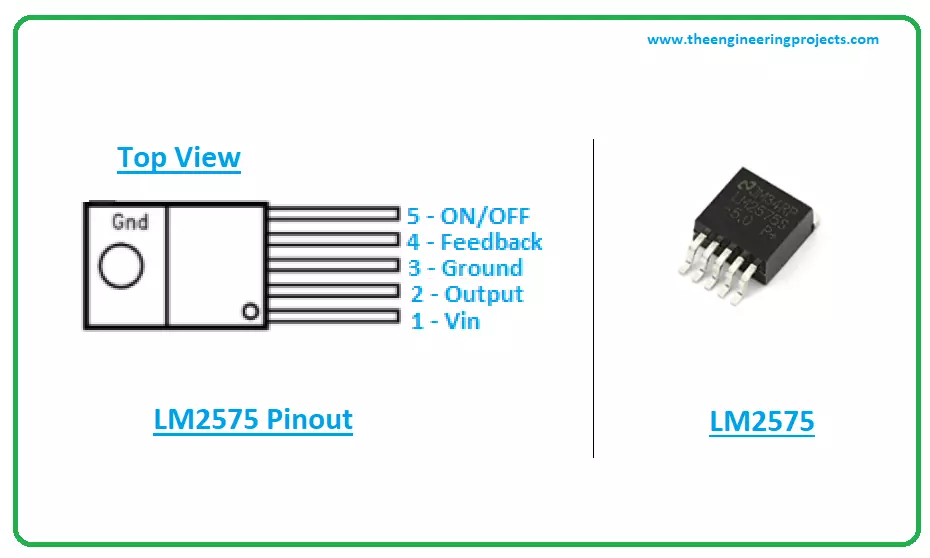
Hi Guys! Glad to see you around. I welcome you on board. In this post today, I’ll walk through the Introduction to LM2575.
LM2575 is a step-down voltage regulator mainly used to step down the voltage. It is also known as a buck converter and is used to drive load under 1A. In the customized output version of the buck converter, you can set the output voltage as you like better. It comes with an extremely good load and line regulation and is available in fixed output voltages with 3.3V, 5V, and 12V.
I suggest you read this post all the way through, as in this post I’ll detail the Introduction to LM2575 covering the datasheet, pinout, features, and applications of this component LM2575.
Let’s get started.
Introduction to LM2575
LM2575 is a vol ...
Hello everyone! I hope you all will be absolutely fine and having fun. Today, I am going to share my knowledge with all of guys about Introduction to IRF540. It is basically an N-Channel power Metal Oxide Silicon Field Effect Transistor (MOSFET) and operates in enhancement mode.
MOSFET is a lot sensitive in comparison to an FET (Field Effect Transistor) due to its very high input impdence. IRF540 can perform very fast switching as compared to the normal transistor. It is based on HEXFET technology and operates on the temperature ranging from -55 degrees celsius to 175 degree celsius. If we need some switching application between different signals or to perform any of amplification process, MOSFET IRF540 will be the best option in this case bec ...
Hello everyone! I hope you all will be absolutely fie and having fun. Today, I will elaborate you about Introductio to NE556 timer IC. NE-556 is a lot stable monolithic device. We can use precise delays and oscillation by using this device. NE 556 is bsically an dual version of NE 555 timer IC. Timing is provided for each function using an external capacitor and resistor. There are two internal timers which operates independently. They just share common power supply and ground. For the falling or rising wave forms we can trigger or reset the entire circuit.
The trigger level and the threshold levels are usually one third and two third respectively. We can alter both of these level by using control pin of NE-556. If the input at trigger falls bel ...
Hello friends, I hope you all are fine and having fun. In today's tutorial, I am going to show you How to use Arduino Software Serial. In my previous tutorial, we have had a look at How to use Arduino Serial Write and How to use Arduino Serial Read. In both of these tutorials, we have done the hardware Serial Communication. But we all know that Arduino has just one Serial Port placed at pins 0 and 1.
So, if you are having two or more serial modules, then there's difficulty in adding two modules because we just have one hardware serial port. So, in such cases, there's a need to add one more serial port and that serial port can be created at any two pins of Arduino and is called software serial. Software Serial is also named Virtual Serial Port.
It's ...
Hey Guys! I hope everyone's fine. Today, we are going to have a look at What is MOSFET? We will cover MOSFET Definition, Full Form, Symbol, Working & Applications in detail.
MOSFETs are commonly used in many electronic applications. A number of MOSFETs are added in tiny memory chips or microprocessors that are widely used in cell phones and laptops. It is a voltage-controlled device that is used for amplification and switching purposes. I'll try to touch every area related to MOSFET. Let's get started.
What is MOSFET?
MOSFET is an advanced type of FET, manufactured with controlled oxidation of semiconductor, having 4 Terminals, named:
Drain(D)
Gate(G)
Source(S)
Body(B)
where,
Gate(G) Terminal is practically insul ...
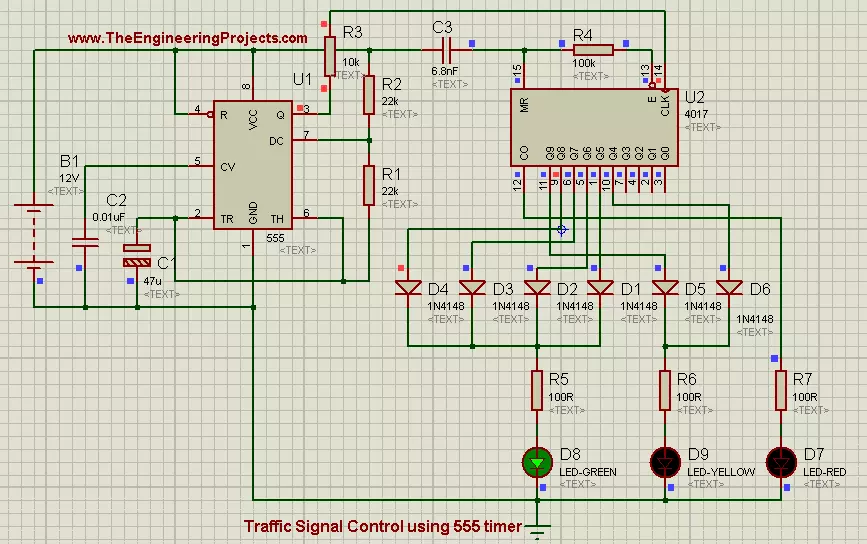
Hello Friends, i hope you all are fine and enjoying. Now i am going to share my new project tutorial which is Traffic Signal Control using 555 Timer. Up till now i have uploaded a no. of projects using 555 timer and i have got much appreciation from my friends, for some 555 timer based projects like How to use Capacitive Touch Sensor in Proteus ISIS, Sequential LED Blinking using 555 Timer and many more.
Now i am going to share another application of 555 Timer and here we will be using a shift register (4017) next to 555 timer to implement Traffic Signal Control circuit. 4017 is a SERIAL IN PARALLEL OUT shift register. Data enters in a serial manner into register and it leaves the register in parallel manner. 4017 is a 10-bit shift register and it ...