Hello friends, I hope you all are doing great. In today's tutorial, we are gonna have a look at a detailed Introduction to DS3231. DS3231 is a real-time clock (RTC) with an integrated temperature-compensated crystal oscillator. It consists of a battery that provides supply to DS3231 when the main supply is off. In this way, it continues working without any interference. It is available in industrial and commercial temperature ranges. It exists in a 16-pin, 300-mil SO package.
DS3231 is used in industrial projects and different electronic devices such as laptops, computers, and GPS for high accuracy of time. In today's post, we will have a look at its working, pinout, applications, protocol, etc. I will also share some links to projects where I have interfaced it with some oth ...
Hi Guys! Hope you’re well today. Happy to see you around. Today, I’ll walk you through the Introduction to IRF520.The IRF520 is an N-channel power MOSFET mainly used for switching and amplification purposes. It comes with a breakdown voltage of around 100V and a low gate threshold voltage is 4V, making it an ideal pick for microcontroller applications.
I suggest you read this post all the way through as I’ll detail the complete Introduction to IRF520 covering datasheet, pinout, features, and applications.
Let’s get started.
Introduction to IRF520 MOSFET
The IRF520 is an N-channel power MOSFET mainly used for switching and amplification purposes.
It comes with three terminals named: gate, source, and drain and is available in the TO-220 package.
It is important to note t ...
Hello friends! I hope you all will be absolutely fine and having fun. Today, I am going to give you an elaboration on Introduction to 2SC3320. I have shared the basic knowledge of different electronic devices in my previous articles like Introduction to ULN2003, LM317, LM393, IRF540, BC547, UA741 and MC34063. 2SC-3320 is a Negative Positive Negative (NPN) transistor. It is made up of silicon. It is basically a power transistor. Power transistor is an electronic device which is able to handle certain level of power. 2SC-3320 has three terminals whose detail will be given later. Its an efficient device with higher efficiency available at at lower cost in the market these days. Due to cost efficiency and its unique features it is more popular devic ...
Hi folks! Hope you’re well today. I welcome you on board. In this post today, I’ll detail the complete Introduction to BC517.
BC517 is an NPN bipolar junction transistor made up of silicon material and comes in a TO-92 package. It carries collector-current 1A, projecting it can drive loads under 1A. Total power dissipation is 625mW, indicating it releases power around 625mW while working. Collector-emitter and collector-base voltages are 30 and 40 respectively. The emitter-base voltage is 10V which means it requires only 10V to trigger the electron action inside the transistor.
Read this post all the way through as I’ll be documenting pinout, working, power ratings, alternatives, applications, and physical dimensions of transistor BC517.
Let’s ...
Hello friends, I hope you all are doing great. In today's tutorial, we are gonna have a look at a detailed Introduction to MSP430. MSP430 is a microcontroller portfolio that offers different varieties of sixteen-bit Microcontrollers. These microcontrollers are integrated with ultra-low power and digital and analog peripherals devices for sensing and measurement applications. MSP430 microcontrollers with non-volatile FRAM (ferroelectric random access memory) provide the lowest stand-by power (350nA with RTC), 100 µA/MHz active power and have the capability to recover system state after sudden power failures.
MSP430 is used in different applications such as sensor systems which receive analog signals and convert them into digital values and after processing send these values to host syst ...
Hello friends, I hope you all are doing great. In today's tutorial, we are gonna have a look at detailed Introduction to MPR121. MPR121 is a touch sensor controller, its working is like the capacitor's working principle. This module has twelve electrodes points, it communicates via I2C protocol. When any objects come closer to an electrode point, we can observe the presence of an object by variation in capacitance of an electrode. It's working voltage should be between 2.5 to 3.6 VDC.
MPR121 is used in different industrial projects and electronic devices such as mobile phone and remote control systems. In today's post, we will have a look at its working, pinout, protocol, applications, etc. I will also share some links where I have interfaced it with other microcontrollers. If you have ...
Hello friends, hope you all are fine and having fun with your lives. Today's post is about getting started with pixy camera. Now, the first thing comes in mind is what is Pixy Camera so let's first have a little introduction about Pixy Camera on which I recently worked. Pixy Camera is a small camera board which uses NXP microcontroller. Its a very powerful board and can get easily interfaced with simple Arduino UNO board. So, now we can do image processing even on Arduino UNO. Image Processing needs a powerful board that's why we can't interface simple webcam with Arduino UNO or mega etc. Before using pixy camera, when I need to do on board image processing I always used either Arduino YUN, Raspberry Pi or Arduino USB host shield but still it was ...
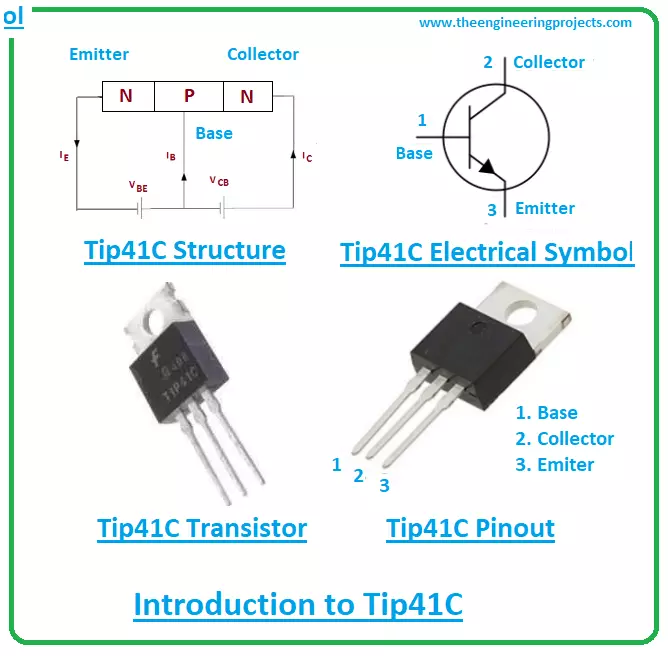
Hi Friends! Welcome you on board. Happy to see you around. In this post today, I’ll walk you through the Introduction to Tip41c.
Tip41c is an NPN transistor that comes in the TO-220 package and is mainly used for amplification and switching purposes. It’s a high switching speed device with improved current gain and a high collector current around 6A that indicates the value of load this device can support. Both collector-base and collector-emitter voltages are 100V (higher than other bipolar transistors) and the emitter-base voltage is 5V which shows the only 5V is required to bias this component.
Just stay with me for a little while as I’m going to detail the pinout, datasheet, applications, power ratings, working principle, and physical dimens ...
Update: We have created a new version of this library, which you can check here: Sound Detector Library for Proteus V2.0.
Hello friends, I hope you all are doing great. In today's tutorial, I am going to share a new Sound Sensor Library for Proteus. We are presenting this library for the first time and I would give the credit to our team, without their support it won't be possible. Proteus doesn't have this module in its library and it is used in a lot of Engineering Projects these days.
This sound sensor is used to detect the sound in the surroundings and is normally known as the Sound Detector sensor. It won't recognize the sound. As we can't produce the sound in Proteus, that's why we have placed a TestPin. When this TestPin is HIGH, that m ...
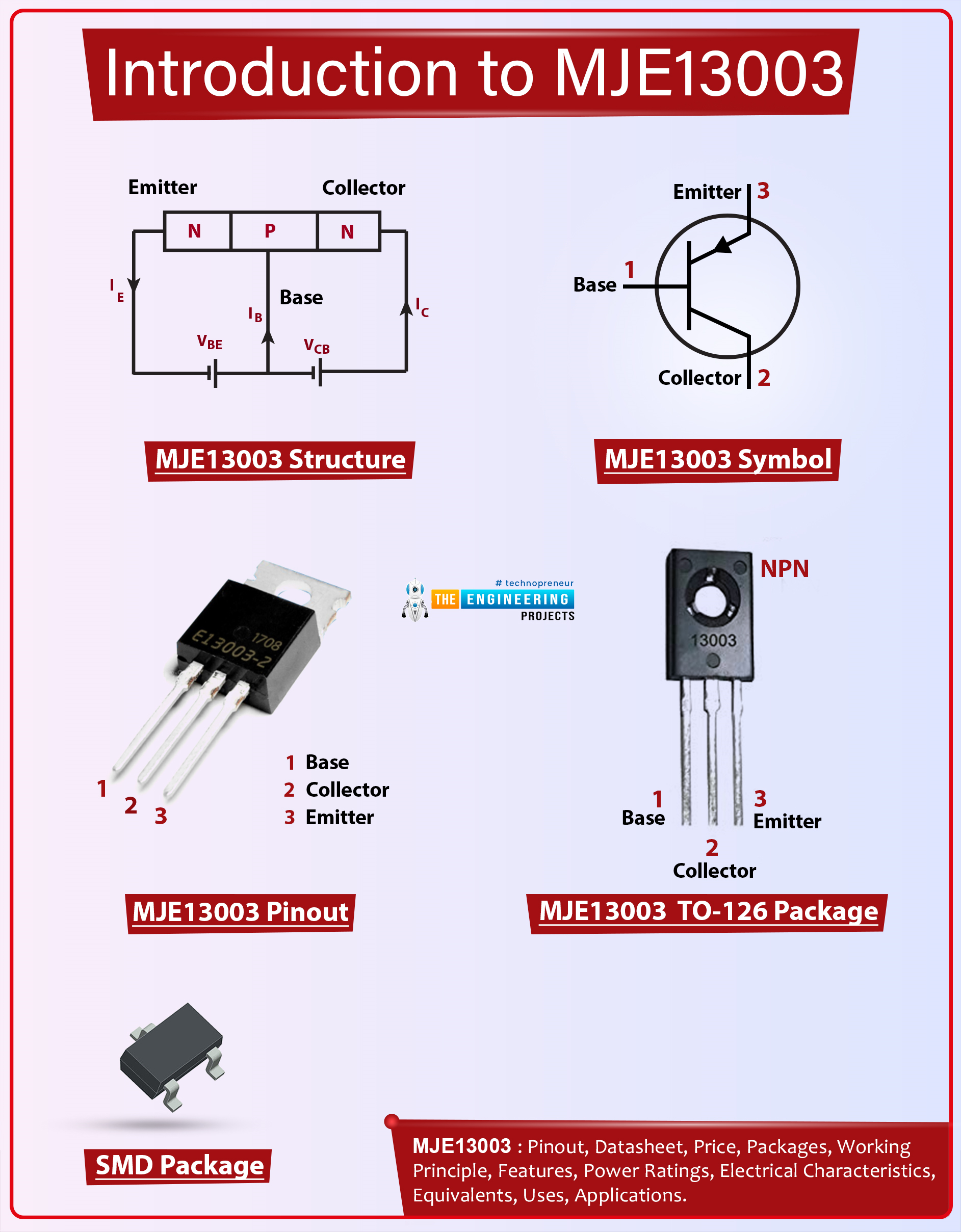
Hi Friends! Hope you’re well today. I welcome you on board. In this post today, I’ll demonstrate the Introduction to MJE13003.
MJE13003 is an NPN silicon transistor mainly used for high-speed high voltage power switching applications. This chip is a three-terminal device where a small current at one terminal is used to produce a large current at the remaining terminals. The collector current is 1.5A which projects this device can support load up to 1.5A.
I suggest you buckle up as I’ll describe the complete Introduction to MJE13003 covering datasheet, pinout, working principle, applications, power ratings, and physical dimensions.
Let’s get started.
Introduction to MJE13003
MJE13003 is a bipolar junction transistor that belongs to the NPN transistor family. It is mainly used ...