Hello everyone! I hope you will be absolutely fine and having fun. Today, I am going to give you a detailed Introduction to ULN2003. We will also discuss the ULN2003 Datasheet, Pinout, Circuit Diagram & Proteus Simulation. If you have ever controlled any motor (i.e. DC Motor, Stepper Motor etc.) with a microcontroller (i.e. PIC, Arduino etc.), then you must have heard about drivers. Why do we need to use drivers? We use drivers (to control motors) because of two reasons.
First: Microcontrollers operate at 5V while motors operate at different voltages (5V, 12V, 24V etc.).
Second: Motors are Inductive loads thus they produce back emf, which may damage your microcontroller permanently (if not handled correctly).
Because of these two reasons, we have to use the driver in between t ...
Hello everyone! I hope you all will be absolutely fine and having fun. Today, I am going to give you a detailed Introduction to BC547. It is an NPN bipolar junction transistor (BJT), mainly used for switching and current amplification.
Its maximum current gain is around 800. So, let's have a detailed overview of BC 547.
Introduction to BC547
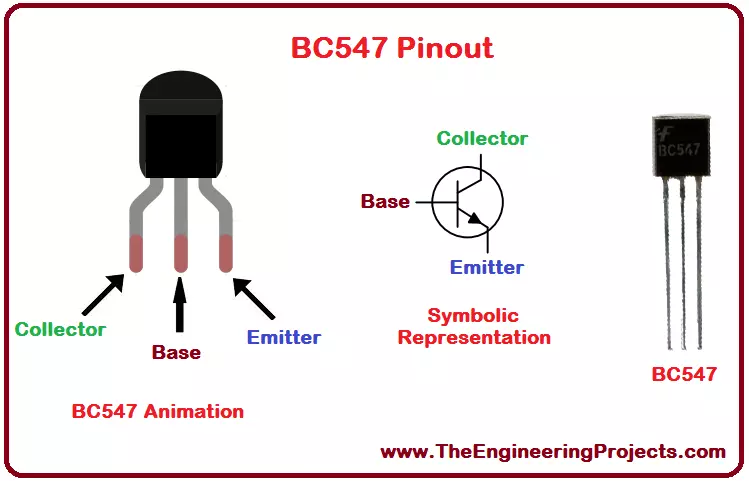
BC547 is a 3-Terminal NPN Bipolar Junction Transistor(BJT), mostly used for switching purposes and current amplification.
BC547 Pins(Terminals) from left to right are called:
Collector.
Base.
Emitter.
Depending on the voltage applied at Base Terminal, BC547 can operate in two states, named:
Forward Biased.
Reverse Biased.
BC547 as Reverse Bias ...
Hello everyone! I hope you all will be absolutely fine and having fun. Today, I am going to share my knowledge about Introduction to TL072. TL 072 is basically a high speed Junction Field Effect Transistor (JFET). It is also known as the dual operational amplifier. It has a bipolar transistor and high voltage JFET in its case. TL-072's important features include low offset current, high slew rates, low input voltage, low offset temperature coefficient etc.
Some of the major features may include low power consumption, low noise, common mode input voltage range includes Vcc, latch-up free operation etc. TL 072 has a very wide range of applications including oscilloscope, solar inverters, AC inverters and VF drives, audio mixers, Un-interruptable Pow ...
Hello everyone! I hope you all will be absolutely fine and having fun. Today, I am going to share my knowledge with all of guys about Introduction to IRF540. It is basically an N-Channel power Metal Oxide Silicon Field Effect Transistor (MOSFET) and operates in enhancement mode.
MOSFET is a lot sensitive in comparison to an FET (Field Effect Transistor) due to its very high input impdence. IRF540 can perform very fast switching as compared to the normal transistor. It is based on HEXFET technology and operates on the temperature ranging from -55 degrees celsius to 175 degree celsius. If we need some switching application between different signals or to perform any of amplification process, MOSFET IRF540 will be the best option in this case bec ...
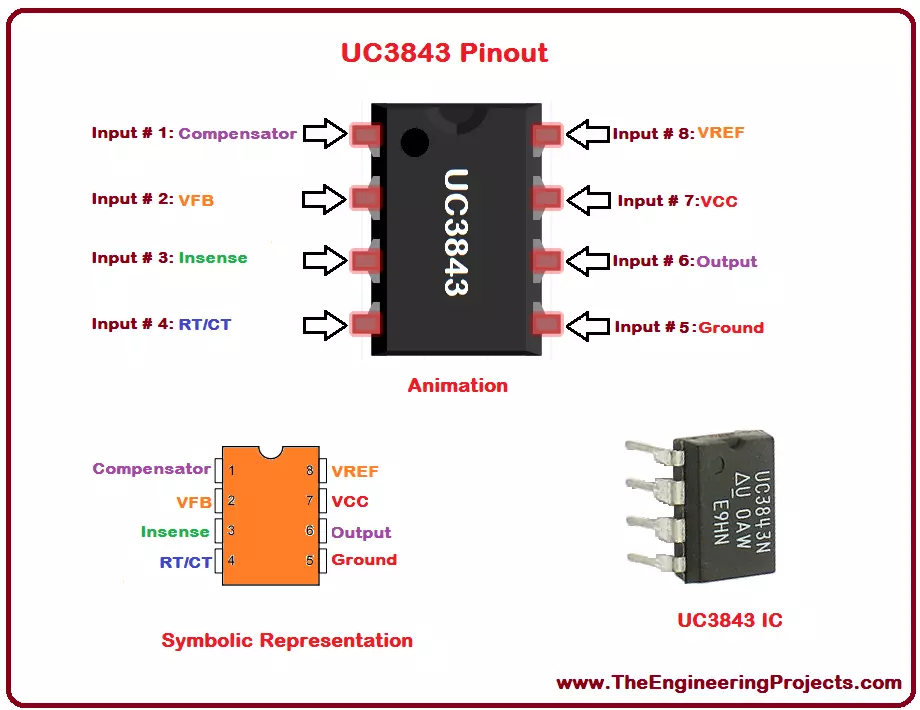
Hello everyone! I hope you all will be absolutely fine and having fun. I am going to give you the detailed discussion about Introduction to UC3843 today. UC 843 is basically a current mode Pulse Width Modulation (PWM) controller having fixed frequency. It is basically designed for DC to DC converter purposes as well as off line applications and it requires minimum external components. UC-3843 has three different packages which will be explained later.
UC-3843 has several different features which make it ideal and useful for a lot of real life applications. These features may include trimmed oscillator for the control of accurate duty cycle, high gain amplifier and to control power MOSFET, there is a high current totem-pole output. Moreover, some ...
Hello everyone! I hope you all will be absolutely fine and having fun. Today, I would like to provide a complete discussion on Introduction to C945. You will see a detailed description on the basics of the transistor C-945 and its different parameters. I have already shared Introduction to MMBD914, 74HC245, NE556, LM348 and PIC18F4550. So, must go through these tutorials in order to have better understanding about different IC's. C-945 transistor is basically a Negative Positive Negative (NPN) bipolar junction transistor.
C945 is usually used in the electronic circuits where there is a need of high speed transistor and a low current. C-945 has three semiconductor regions named as emitter, base and collector respectively. Since C-945 is a bipolar ...
Hello everyone! I hope you all will be absolutely fine and having fun. I am going to give you a detailed Introduction to CD4051 today. CD 4051 is an analog multiplexer and demultiplexer. It has very low OFF leakage current and low ON impedance. Over full voltage ranges, very low power is dissipated by CD-4051.
CD-4051 is an eight (8) channel multiplexer and has three control input named as A, B and C. These inputs connect only 1 out of 8 channels to the output in order to obtain the desired output. Channel I/O terminals became outputs and common O/I become input terminals when CD 4051 is used as a demultiplexer. CD-4051 has a lot of amazing features e.g. binary address decoding on chip, break before make switching eliminates channel overlapping, ...
Hello everyone! I hope you all will be absolutely fine and having fun. Today I am going to elaborate you about Introduction to L298. L-298 is an Integrated Circuit (IC) available in two type of packages now a days which will be given later. L 298 is a dual full bridge driver that has a capability to bear high voltage as well as high current. It receives basic TTL (Transistor Transistor Logic) logic levels and is able to operate the different loads such as DC motors, stepper motors, relays etc. You should also have a look at Introduction to L23D.
L-298 has two enable input to control any device by enabling or disabling it. L 298 IC is most commonly used to make motor drivers or motor controllers. These motor controllers can be controlled by any ...
Hi there! Hope this finds you well. I welcome you on board. Thanks for clicking this read. In this post today, I’ll be discussing the Introduction to D882 transistor.
D882 is a general-purpose transistor mainly famous for its high performance. It falls under the category of NPN transistor and is an ideal pick for commercial, educational, and hobbyists’ electronic projects. It comes in TO-126 with collector current 3A, projecting it can drive loads under 3A. There are three pins incorporated on the transistor which are used for external connections. The collector-emitter and collector-base voltages are 30V and 40V respectively with emitter-base voltage 5V, indicating only 5V are required to bias the component.
Read this post all the way through as ...
Hi Guys! We always feel happy when you come over to browse useful information that meets with your needs and requirements. Electronic components used in electronic industry are the backbone of recent technology that make our lives easy and help us get rid of the most conventional ways of running electronic projects. Today, I am going to discuss the details on the Introduction to 1n5819. This is a metal to silicon power diode, also termed as Schottky Rectifier, that applies Schottky Barrier Principle. It is mainly used as rectifiers in high frequency low voltage inverters, polarity protection diodes and free wheeling diodes. I'll try to cover each and everything related to this transistor so you don't need to go anywhere and find all information ...