Hello everyone! I hope you all will be absolutely fine and having fun. Today, I am going to give you an Introduction to LM741. It belongs to the series of general purpose amplifiers. It supports larger range of input voltages. LM741 provides high gain and short circuit protection as well. Its pins configuration is very similar to UA709 and there is no need of frequency compression in LM 741.
LM741 can be used as a comparator in order to determine the levels of applied input voltages i.e. either smaller or larger input voltages are applied at its input terminal. LM741 is an op-amp IC having 8 different pins, which will be explained later in this tutorial. LM-741 has a very wide range of applications e.g. function generator, comparator, DC amplifie ...
Hello everyone! I hope you all will be absolutely fine and having fun. Today, I am going to tell you about how to design an algorithm for Servo Motor Control using Arduino. First of all I would like to tell you a bit about the servo motors. Servo motors are small devices having an output shaft. We can adjust this shaft in different angular positions by continuously sending the servo coded signal. Servo motor maintains the angular position of the shaft as long as the coded signal is present at the input. If the applied coded signal changes, angular position of the shaft of a servo motor also changes correspondingly. If you are working on Servo Motor then i would suggest you to must have look at this tutorial Servo Motor control in Proteus, as its a ...
Hello Everyone! Happy to see you around. In this post today, we’ll cover the 2SC2240 NPN Transistor. We will have a look at the 2SC2240 Datasheet, Pinout, Power Ratings, Equivalents & Applications.
Electrons are the majority charge carriers in this NPN transistor, in contrast to PNP transistors, where holes are the majority carriers. The 2SC2240 comes with a power dissipation of 0.3W, the amount of energy this transistor dissipates while operating in the forward-biased state, while the collector current is 0.1A means it can support load up to 0.1A.
This NPN transistor contains 3 terminals, named:EmitterCollectorBase
If the voltage at the base terminal is above 0.7V, the transistor will get forward-biased and the current will start flowing from Collector to Emitter terminal. If the ...
Hey Fellas! I hope you are doing great and getting most out of your lives. Today, I am going to uncover the details on the Introduction to 2n5401. It is a PNP(positive-negative-positive) bipolar junction transistor which comes in TO-92 casing. It consists of N doped semiconductor that exists between the two layers of P doped material. It is useful for the applications where regulated negative voltage is required at a modest current level. I'll give you brief details about this amplifier transistor. Let's get started.
Introduction to 2n5401
2n5401 is a PNP bipolar junction transistor, also known as amplifier transistor, that comes with collector-emitter voltage of 150V and mostly used for amplification purpose.
In order to operate this transis ...
Hello Friends! Hope you are doing great. I am back to give you a daily dose of valuable information so you can excel and grow in your relevant field and keep coming back for what we have to offer. Today, I am going to unlock the details on the Introduction to 8051 Microcontroller. This is an 8-bit Microcontroller developed by Intel in the 1980s. It is considered as a small system on an integrated chip that comes with CPU, I/O ports, timers, counters, RAM and ROM. The Microcontroller is a one step forward to a microprocessor.
Both Microcontrollers and microprocessor work in a similar way with some exceptions. Microcottler comes with everything required to run an embedded system like CPU, I/O ports and inbuilt peripherals like timers, counters, ...
Hello everyone! I hope you all will be absolutely fine and having fun. Today, I am going to provide a detailed discussion on Flame Sensor Arduino Interfacing. Flame sensor is an electronic device which is capable of sensing/detection of fire or a high temperature zone. It gives an indication through an LED attached at its top, just after sensing the fire. These type of sensors are usually used for short ranges. They are able to detect the fire up to 3 feet. Flame sensors is the most common device available in the market these days due to its good results and cost efficiency. You should also have a look at Flame Sensor Library for Proteus.
Flame sensors are available in the market in two types one having three pins and the other having four pins ...
Hey Everyone! Hope you’re well today. I welcome you on board. In this post today, I’ll walk you through the Introduction to Arduino MKR Vidor 4000.
The Arduino MKR Vidor 4000 is a powerful board with which you can develop your own controller board. The inclusion of FPGA makes this device unique and separate from other Arduino boards available in the market. With this FPGA feature, you can do audio and video processing which is not possible with other Arduino boards.
Using this device, you can design a real-time computer reading sensor information and the best part is this board is compatible with all other Arduino boards. With this board, you can make all pins PWM signals (on the FPGA block side) for handling the speed of motors. Moreover, you c ...
Hello everyone! I hope you all will be absolutely fine and having fun. Today, I am going to explore my knowledge about Introduction to LM317. It is basically a positive voltage regulator having three terminals. It can a supply a current more than 1.5A and voltage in a range of 1.25V to around 37V. You should also have a look at this LM 317 Calculator.
For the adjustment of output voltage only two external resistors are required. It has improved standards of line regulation as well as load regulation. Full overload protection e.g. current limiting, area protection can be achieved using LM317. If its adjusting terminal is disconnected, even then all of the protection circuits will work properly. We can also use LM317 as precision current regulator ...
Hello everyone! I hope you all will be absolutely fine and having fun. Today, I am going to share my knowledge with all of you guys about DC Current Sensor ACS712 Arduino Interfacing. First of all, I would like to tell you about importance of current sensing/measuring. Sensing the amount of current passing through any circuit can be useful in a lot of applications. For example, in low power consuming equipment, current sensing will be helpful to understand the system's impact on its battery life. The current sensing can also be used to make the decisions regarding safety in over current protection circuits.
Simply, we can say that sensing and controlling the flow of the current through the circuits is now a fundamental requirement e.g. over curr ...
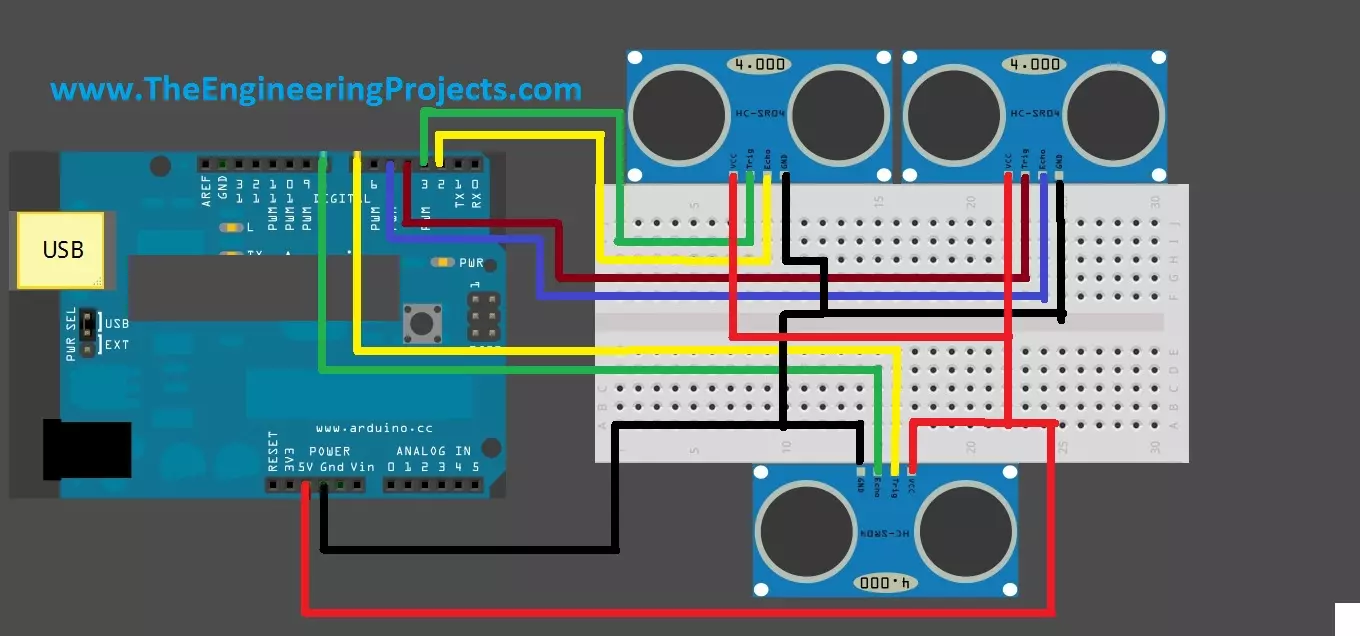
Hello friends, hope you are having fun and enjoying life. Today, I am gonna post about interfacing of multiple Ultrasonic sensor with Arduino. In the previous post, we have seen Interfacing of Ultrasonic Sensor With Arduino and in this post I have interfaced single ultrasonic sensor but in projects especially related to robotics, we have to interface multiple ultrasonic sensors. For example you have an obstacle detection robot, now in order to detect obstacle in front of robot you have to place once sensor on the front side but now you can't detect any object present on left or right side of your robot, so you have to place two sensors one on the left side of robot and one on the right side so in this project you need to use total three ultrasonic ...