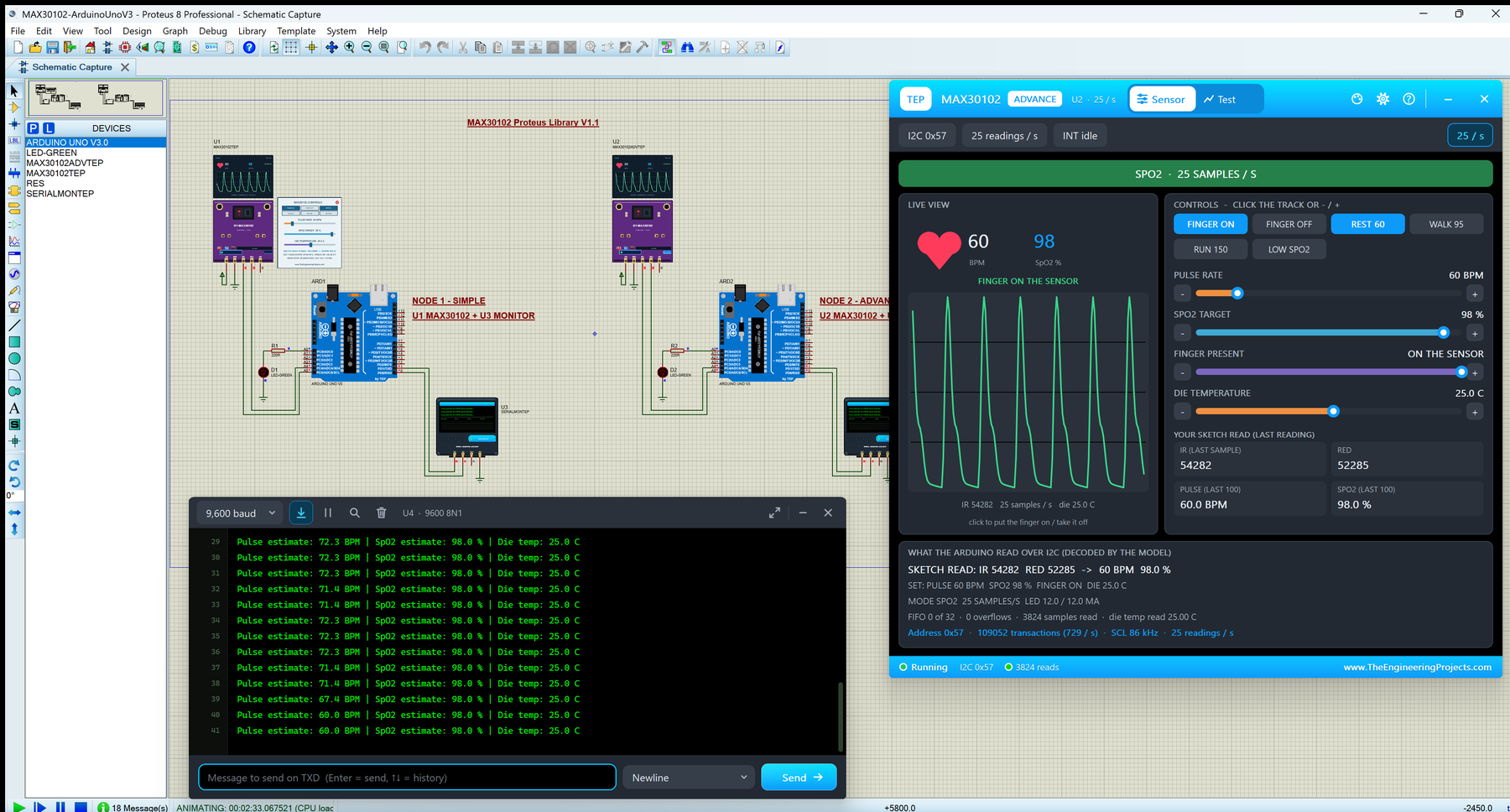
Hello friends, I hope you all are doing great. Today, I am going to share the new MAX30102 Sensor Library for Proteus V1.1 . The MAX30102 from Maxim (now Analog Devices) is a small pulse oximeter and heart-rate sensor , best known on the purple GY-MAX30102 breakout. With this MAX30102 Sensor Library for Proteus , you set the pulse rate, the SpO2 and the finger with presets and sliders, and your Arduino reads the red and infrared samples over I2C with the same SparkFun MAX3010x library you use on real hardware. Updates MAX30102 Sensor Library for Proteus Latest version: V1.1 (September 2026, this tutorial) Other health sensors: Heart Beat · MLX90614 · Flex Sensor Helping Tools Serial Monitor Advance : a serial terminal window for the UART of your board Serial Monitor Expert : the serial mon ...
Microcontroller-based IoT systems are commonly designed around a simple process. Sensors gather data, transmit it to a microcontroller, which then uploads it to the cloud for processing or storage. Edge computing reverses the situation and enables more local processing. This affects hardware selection, firmware development, data handling, security,and operation in the absence of a network connection. Source Processing Data at the Source Consider an ESP32 connected to vibration and temperature sensors on an industrial motor. A basic design could send every measurement to a cloud platform. An edge-oriented design can instead analyze some readings locally. The microcontroller could calculate temperature averages, identify unusual vibration patterns, or detect readings that exceed predefined l ...
A lot of engineering students know this feeling. The code uploads without any error, the laptop says everything is fine, and then the actual project does almost nothing. The motor does not spin. The sensor value jumps around. The board resets for no clear reason. That is usually when the real lesson starts. Good engineering is not only about writing code. It is also important to know what the circuit is doing when the code reaches the board. Code Can Look Right While the Hardware Fails Most small engineering projects need code now. Arduino, Raspberry Pi, ESP32, and STM32 boards all depend on it. But the code is only one part of the project. Once it reaches the board, the wiring, power, and parts all have a say too. A student may spend an hour changing a program when the real issue is a wea ...
Connecting inexpensive edge hardware to robust cloud architecture is the foundation of modern engineering projects. The ESP32 microcontroller has become a staple for developers due to its integrated Wi-Fi capability and low price point. However, capturing data locally on your workbench is vastly different from streaming data securely to an enterprise cloud system. While this tutorial will help you build a functional prototype on your workbench, companies looking to securely deploy thousands of these IoT nodes across a smart factory often team up with a Microsoft solutions partner to architect a highly scalable and secure Azure environment. For our purposes today, we will focus on bridging the gap between physical hardware and the cloud by setting up a reliable telemetry pipeline. Prerequis ...
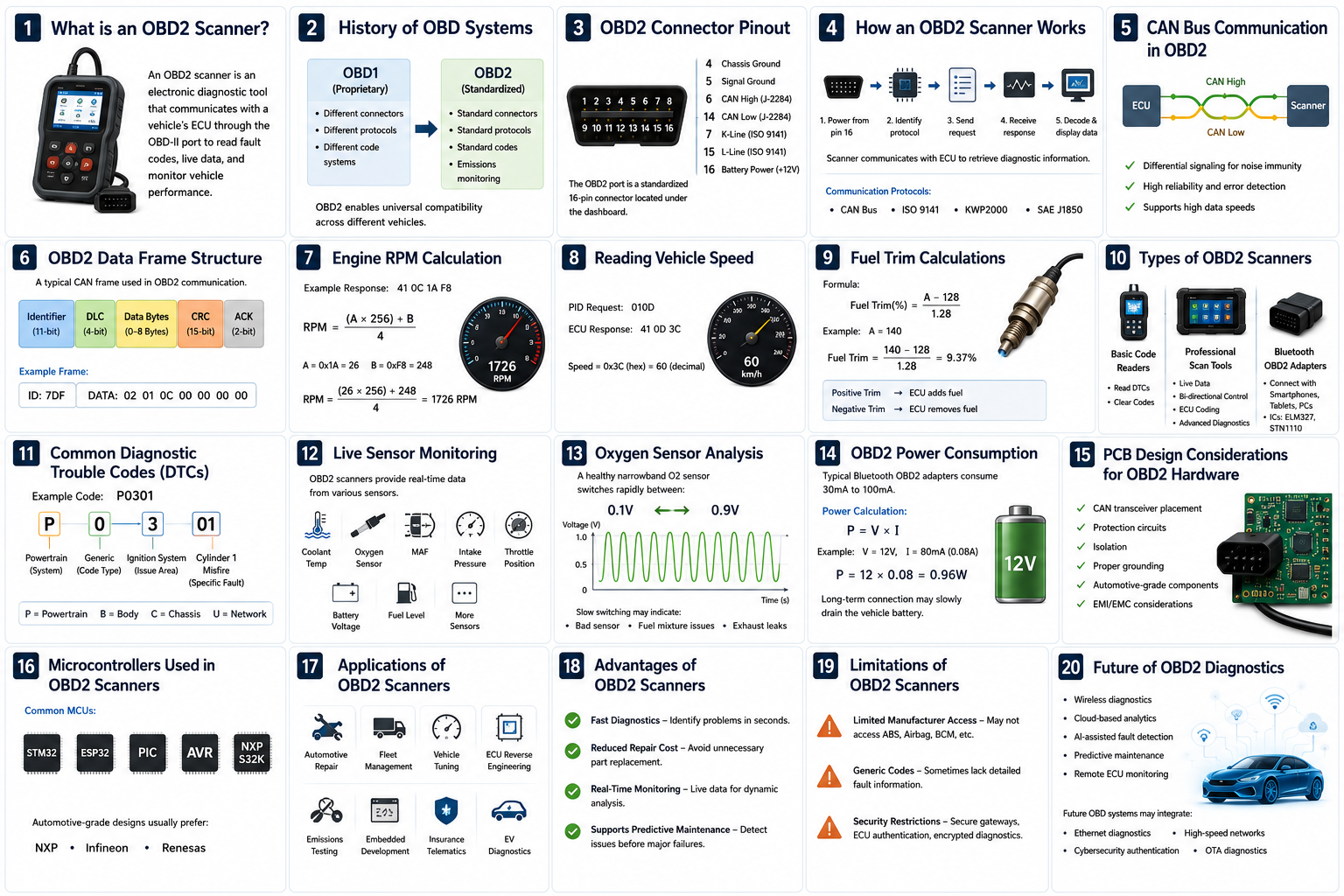
Modern vehicles are no longer just mechanical machines. Today’s cars contain dozens of Electronic Control Units (ECUs), sensors, communication buses, and embedded systems working together in real time. Whenever a fault occurs, these systems generate Diagnostic Trouble Codes (DTCs), and this is where an OBD2 scanner becomes an essential tool. Whether you are an automotive engineer, embedded developer, mechanic, or electronics hobbyist, understanding how OBD2 scanners work gives you deep insight into vehicle diagnostics, CAN communication, and automotive electronics. What is an OBD2 Scanner? An OBD2 scanner is an electronic diagnostic tool used to communicate with a vehicle’s onboard computer system through the OBD-II (On-Board Diagnostics) port. It allows us to: Read Diagnostic Trouble Code ...
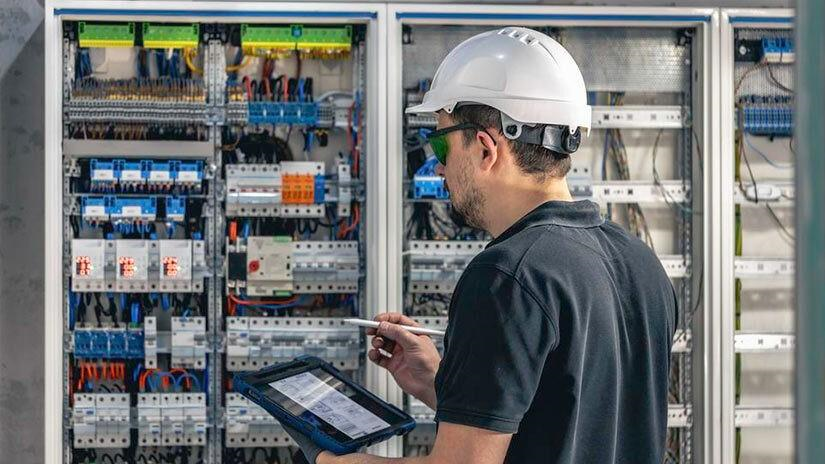
The prototyping trap is familiar: an engineer glues together an elegant control system on an Arduino or ESP32, it behaves perfectly on the bench — and then fails on the factory floor. This article explains the practical thresholds where microcontroller-based solutions stop being appropriate and why a programmable logic controller (PLC) becomes the correct engineering choice. The hardware divide: robustness vs. flexibility Input/Output (I/O) voltages and signal integrity Most MCUs operate at logic levels of 3.3 V or 5 V (TTL/CMOS). Those levels are fine for short, controlled interconnects on a workbench, but they are vulnerable to voltage drops, ground loops, and induced noise when the wiring runs meters across a plant. Industrial control systems overwhelmingly adopt 24 V DC I/O as a de-fac ...
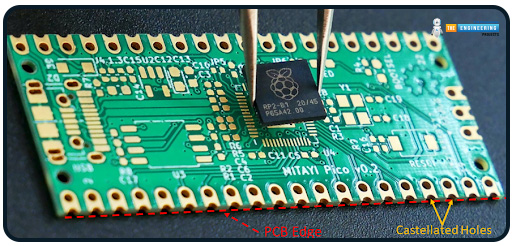
Hi readers! I hope you are having a great day and finding something new to learn. Today, the topic of our discourse is PCB Castellation and Castellated Holes. Printed Circuit Boards (PCBs) are the core of nearly all electronic devices and are a structured platform on which components are mounted and interconnected. As electronics are moving toward more miniaturization, modularization, and mass production, PCB technologies must advance to be able to support these new requirements. Part of this advancement is the use of PCB castellations or castellated holes, a technology that supports small, modular board-to-board connections. Castellated holes are tiny, plated half-holes on the border of a PCB. They allow one PCB, a module, or daughterboard, to be soldered onto another directly, much like ...
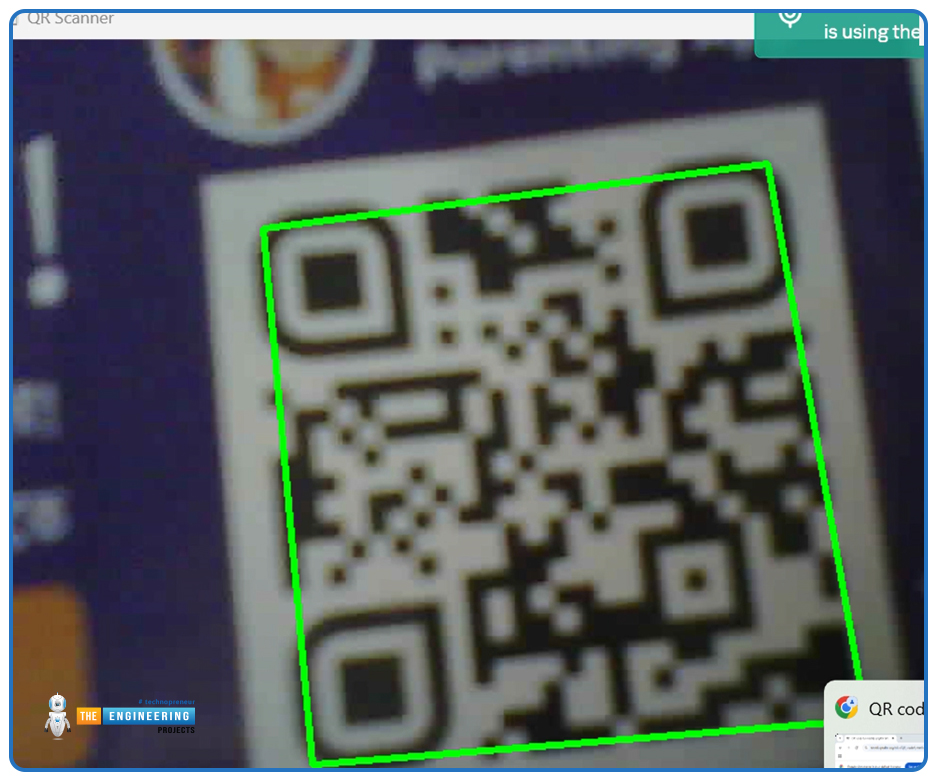
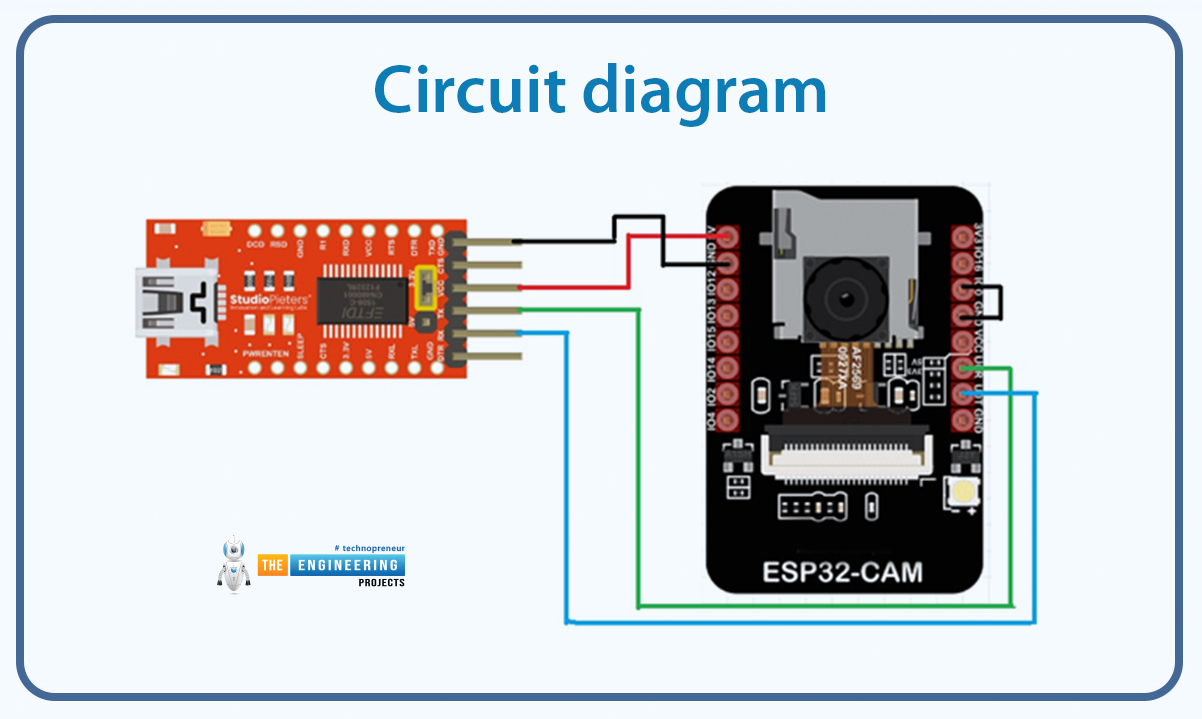
Hello friends! How are you today? Today we're going to discuss a project that is interesting and also useful in our everyday life. You see QR codes almost everywhere, right? They are printed on almost every product's package, leaflets, newspapers, and brochures. Perhaps, you often use QR code scanners on your mobile device. What about making such a program by yourself? Yes! That is exactly what we are going to do today. We will make a QR code scanner using the ESP32-CAM. For image processing, we will use the OpenCV library. If you’ve ever wanted to create a real-time QR code scanner using a low-cost, wireless camera module, you’re in the right place. In this tutorial, we’ll walk through setting up an ESP32-CAM to stream video and using OpenCV to detect and decode QR codes in real time. Int ...
Hello, dear tech savvies! We hope everything is going fine with you. Today we’re back with another interesting project. Do you ever wonder how amazing it would be to have a text reader that would be able to read texts from pictures and videos? Think about a self-driving car that can read the road signs meticulously and go to the right direction. Or imagine an AI bot that can read what is written on images uploaded to social media. How nice it would be to have such a system that will be able to read vulgar posts and filter them even when they are in picture format? Or imagine a caregiver robot that can read the medicine bottle levels and give medicines to the patients always on time. Now you understand how important it is for AI solutions to recognize texts, right? Today, we are going to do ...
Hello friends. We hope you are doing fine. The world is full of colours. Isn’t it? We humans can see and differentiate the colours very easily. But teaching robots and AI apps about colours is a real challenge. With the advancement of computer vision and embedded systems, this task has become easier than before. Today, we are going to make an RGB colour identifier using the ESP32-CAM. This project combines the power of OpenCV with the ESP32-CAM module to create a simple but effective system for detecting and tracking basic colors in real time. System Architecture 1. Overview This system consists of an ESP32-CAM module acting as a live-streaming camera server and a Python-based computer vision application running on a remote computer. The Python application fetches images from the ESP32-CAM ...