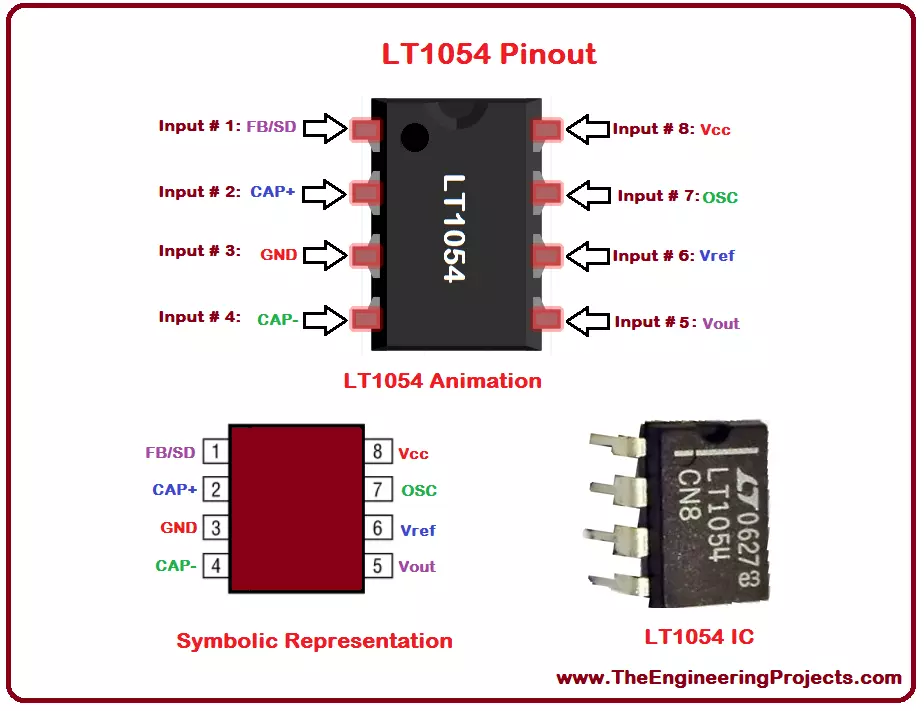
Hello everyone! I hope you all will be absolutely fine and having fun. I am going to elaborate you on Introduction to LT1054. It is a monolithic device. LT-1054 is also known as voltage regulator and bipolar capacitive voltage converter. Its mean feature is that it provides very low voltage losses as compared to the other common converters. LT 1054 also provides large output currents in comparison to general converters. It provides a voltage drop of around 1.1V while operating at 100mA. LT 1054 provides us with a feature of regulation. This feature was not available in earlier voltage converters. We can get a regulated output just by inserting an external resistance. We can shut down LT-1054, if we ground its feedback terminal. Its internal oscillator works at 25kHz frequency. Switching fr ...
Hello everyone! I hope you all will be absolutely fine and having fun. Today, I am going to share my knowledge about Introduction to 74HC245. 74HC 245 is a eight (8) bit transceiver. It has three (3) output states. 74HC-245 is designed for a-synchronous transfer of data between different data buses. The external timing requirement can be reduced by the implementation of control function. You should also have a look at Introduction to 74HC595 . There are two internal amplifiers in 74HS 245. They are named as A and B. Data is transferred from A amplifier to B amplifier and vice versa. Hence two way communication is done in 74HC-245. This communication depends upon the logic level on the direction control input (DIR). Out enable pin (OE) is used to enable and disable the device depending upon ...
Hello everyone! I hope you all will be absolutely fine and having fun. Today I am going to given elaboration on Introduction to L293D. L 293D is basically a high current dual motor driver/controller Integrated Circuit (IC). It is able to drive load having current up to 1A at the voltage ranging from 4.5V to 36V. Motor driver usually act as current amplifier because they receive a low current signal as an input and provides high current signal at the output. Libraries Motor Driver Simulation Libraries Motor drivers: L298 · L9110S · TB6612FNG · BTS7960 · A4988 / DRV8825 · 28BYJ-48 + ULN2003 · PCA9685 Servo · Relay Module · 30A Brushless ESC · TB6600 Stepper Driver · 60A Brushed ESC · DRV2605L Haptic Driver · ZS-X11H BLDC Driver · SimpleFOC Mini Driver · AC Dimmer Module · TMC2209 Stepper Dri ...
Hello everyone! I hope you all will be absolutely fine and having fun. Today, I am going to elaborate you about Introduction to LM1458. Lm 1458 is basically a general purpose dual Operational Amplifier (Op-amp) i.e. it consists of two internal amplifiers. The internal amplifiers has both common power supply as well as common biased network. This is done so that their operation remains dependent on each other. If the power supply and biasing is not common then they will be totally independent. LM 1458 is a device which is protected from short circuit and it requires no external components for the frequency compensation. LM 1458 is considered to be and ideal amplifier for voltage followers. This is due to its latch-up free operation and high common mode voltage range. LM 1458 has amazing fea ...
Hello everyone! I hope you all will be absolutely fine and having fun. Today, I am going to give you a detailed Introduction to PC817. PC-817 is also known as an optocoupler / optoisolator. It consists of Infrared Emitting Diode (IRED). This IRED is coupled to a photo transistor optically and not electrically. It is closed in a four (4) pin package. This package is usually available in two different forms. The first one is wide lead (Pb) spacing option and the second one is SMT gullwing lead form option. Libraries PC817 Simulation Libraries Latest library: PC817 Library for Proteus V1.0 (February 2019) Other component libraries: C945 Transistor · Relay Module · Resistor · 5 mm LED · Designer Colour LED · Push Button · Active Buzzer · Electrolytic Capacitor · Ceramic Capacitor · Tantalum Ca ...
Hello everyone! I hope you all will be fine and having fun. Today, I am going to give you a detailed Introduction to MAX232. It is an Integrated Circuit(IC) embedded in a single chip and acts as a voltage-level converter. MAX 232 is capable of converting 5V TTL Logic level to TIA/EIA-232-F level and can take up to +-30V input. It is normally used for the communication between microcontroller and Laptop/PC. We can use MAX-232 to convert Transistor Transistor Logic (TTL) voltage level to RS232 and vice versa. RS232 is the method of transferring data using serial communication. MAX 232 is a dual receiver or driver having a capacitive voltage generator to supply RS232 voltage levels from a single supply of 5V. Each receiver converts RS232 inputs to 5V either Transistor Transistor Logic (TTL) o ...
Hello everyone! I hope you all will be absolutely fine and having fun. Today, I am going to share my knowledge about Introduction to 2N3906. It is most common Positive Negative Positive (PNP) Bipolar Junction Transistor (BJT) available in the market now a days. 2N 3906 is specially designed for low power amplification purposes as well as for switching purposes. 2N 3906 is designed for low current, power and for medium voltages. It is capable of operating at moderately high speeds. The range of its collector current is form 10uA to 100mA. Further detail about 2N-3906 will be given later in this tutorial. Note: You should download 2n3906 Datasheet by clicking below button: [dt_default_button link="https://www.sparkfun.com/datasheets/Components/2N3906.pdf" button_alignment="default" animation ...
Hello everyone! I hope you all will be absolutely fine and having fun. Today, I am going to explain you about Introduction to TL431. TL 431 are programmable shunt regulator diodes having three terminals. Its a low temperature coefficient diode and can be programmed from reference voltage (Vref) up to 36V when it is attached to 2 external resistors. TL 431 has an impedance of 0.22 ohms and has a current range from 1mA to 100mA. In several different applications zener diodes can be replaced with TL 431 diode due to its efficiency. These applications include power supplies, Operational Amplifier (Op-amp) circuitry and digital voltmeters. TL-431 can either be used as positive or as negative voltage reference because it operates as shunt regulator. TL-431 has low output noise voltage. It is lea ...
Hello everyone! I hope you all will be absolutely fine and having fun. Today, I am going to share my knowledge about Introduction to 1N4007. It is a PN junction diode. Diodes can be made by combining two different types of semiconductor e.g. P and N. PN junction is a junction formed between P and N types of semiconductors. You guys should also have a look at Introduction to 1N4148 . 1N 4007 belongs to the series of 1NXXXX devices. Its an American standard numbering system standard used for semiconductor devices. This standard has been adopted globally now. In 1N 4007 the first part 1N indicates single junction semiconductor. 1N indicates 1 junction whereas N indicates the semiconductor diode. 4007 is the specific number to indicate the particular diode. From the electrical point of view, 1 ...
Hello everyone! I hope you all will be absolutely fine and having fun. Today, I am going to share my knowledge about Introduction to LM358. LM-358 consists of two independent high gain frequency compensated operational amplifier. They are specially designed to operate from a single supply or split supplies over a wide range of voltages. LM-358 have lot of amazing features associated with them. These features include wide supply ranges, low supply current drain, independent of supply voltage, wide unity gain bandwidth, ground includes I common mode input voltage range, low input bias, open loop differential voltage gain, internally frequency compensation etc. LM 358 has a lot real life applications e.g. Operational Amplifier (Op-amp) circuits, transducer amplifiers, DC gain blocks etc. LM-3 ...