


Project Files of IoT Car Dashboard with ESP32 - Proteus Simulation
 Libraries
 Code
 Projects
 Simulation
508e003d7cdf423b98ba6e15ac02eb1c.zip

IoT Car Dashboard with ESP32 - Proteus Simulation V1.0
IoT Car Dashboard with ESP32 - Proteus Simulation V1.0 comes as a ZIP archive of 21 files (4.0 MB, 8.7 MB unpacked) holding Proteus library files, simulation model DLLs, a Proteus simulation, an Arduino sketch and compiled HEX firmware.
- LIBProteus library
- DLLProteus model
- DSNProteus simulation
- INOArduino sketch
- HEXHEX firmware
Description
IoT-Car-Dashboard-ESP32-Proteus-Simulation-v1.0.zip: the complete Proteus simulation project (ESP32 DevKit V1, X27.168 speedometer, air-core tachometer, L9110S, LM393 speed sensor, the Laptop and Mobile WiFi Monitors), the Arduino sketch, every LIB and DLL the simulation needs and a README.

File Structure
 File Structure
11.7 KB32.6 KB36.6 KB78.5 KB39.5 KB103.4 KB13.1 KB32 KB308.5 KB295 KB300 KB2.9 MB325.5 KB47.5 KB76.3 KB308.5 KB295 KB300 KB2.9 MB325.5 KB11.1 KBGallery12 images from the tutorialOpen the tutorial
 Gallery12 images from the tutorial
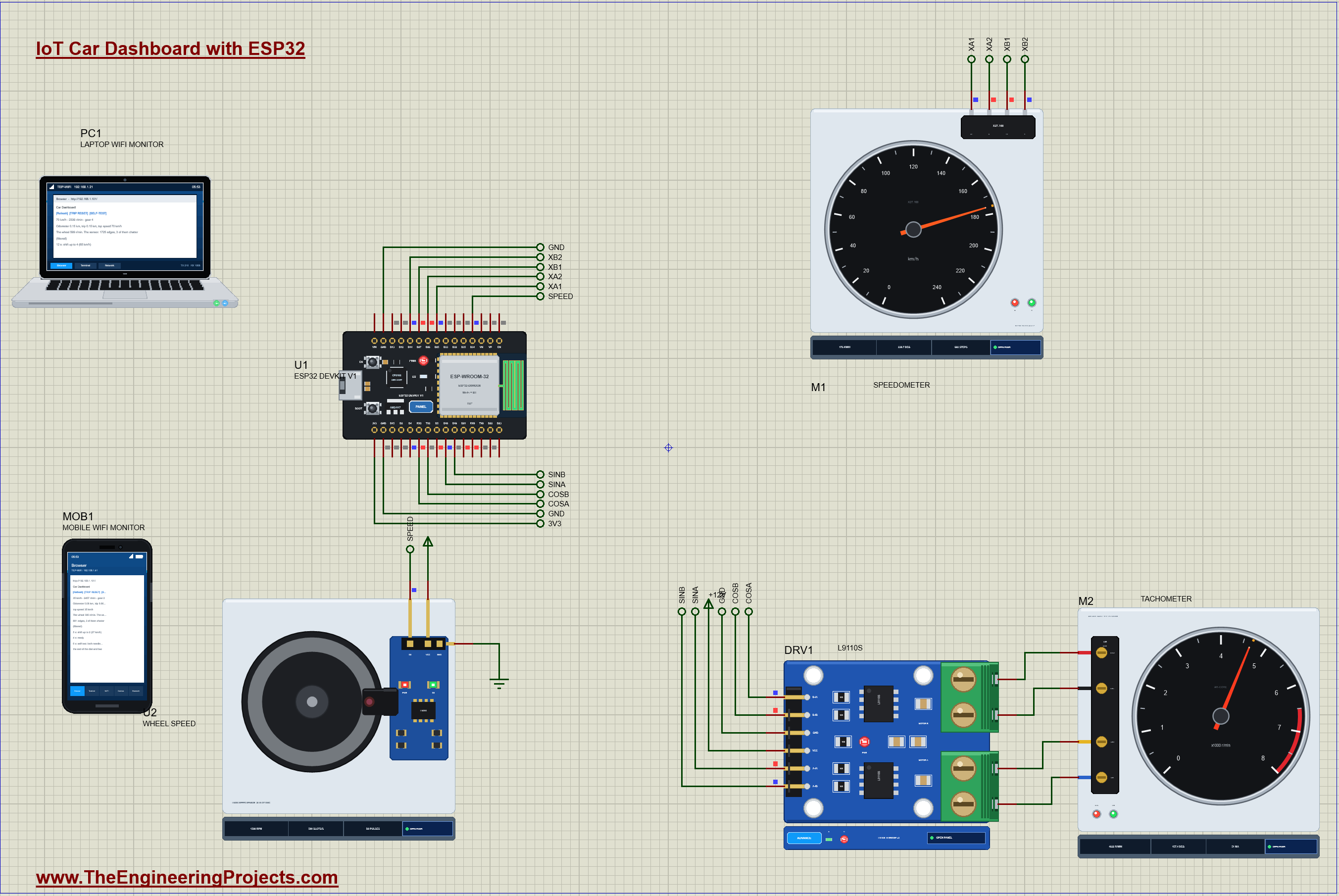
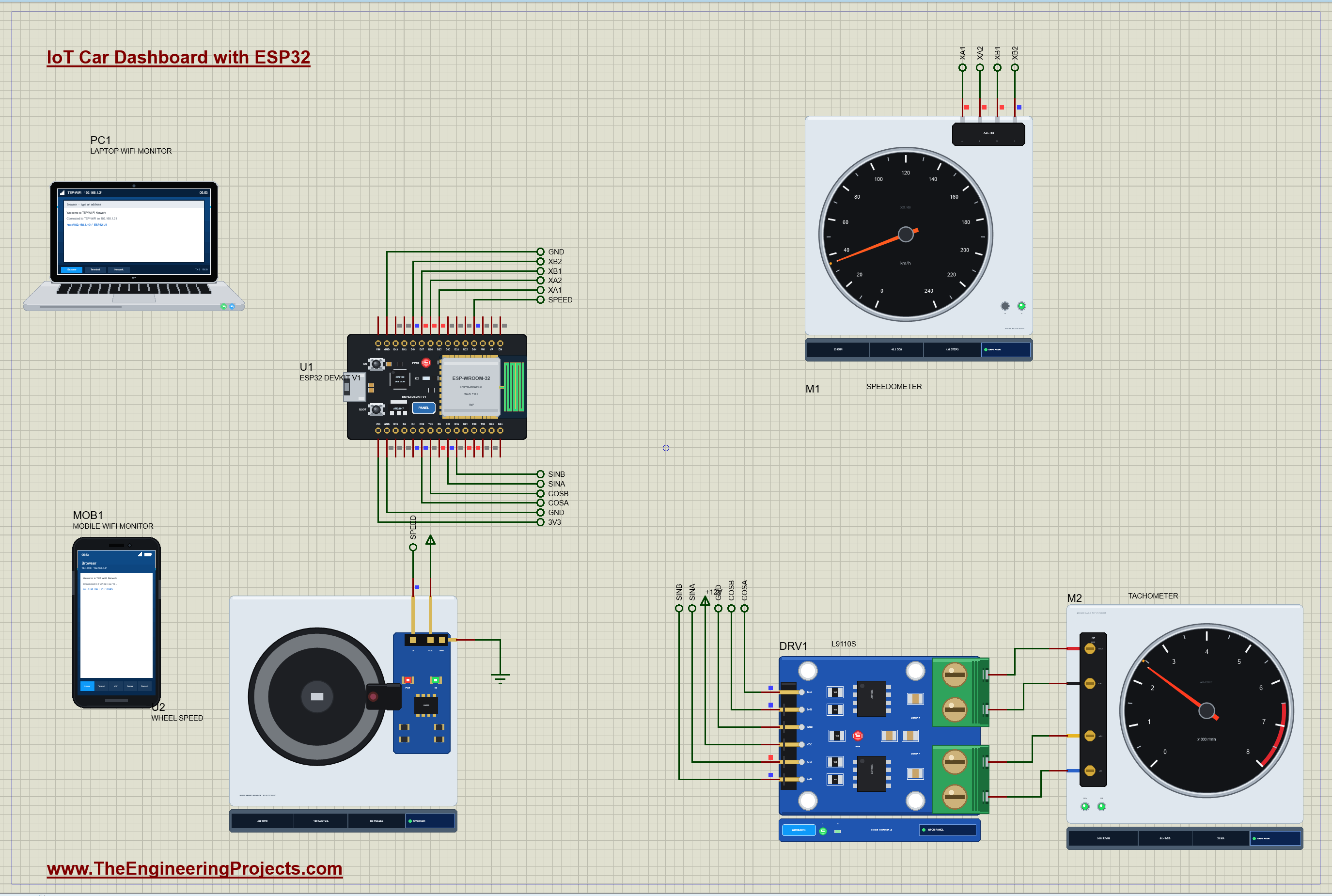
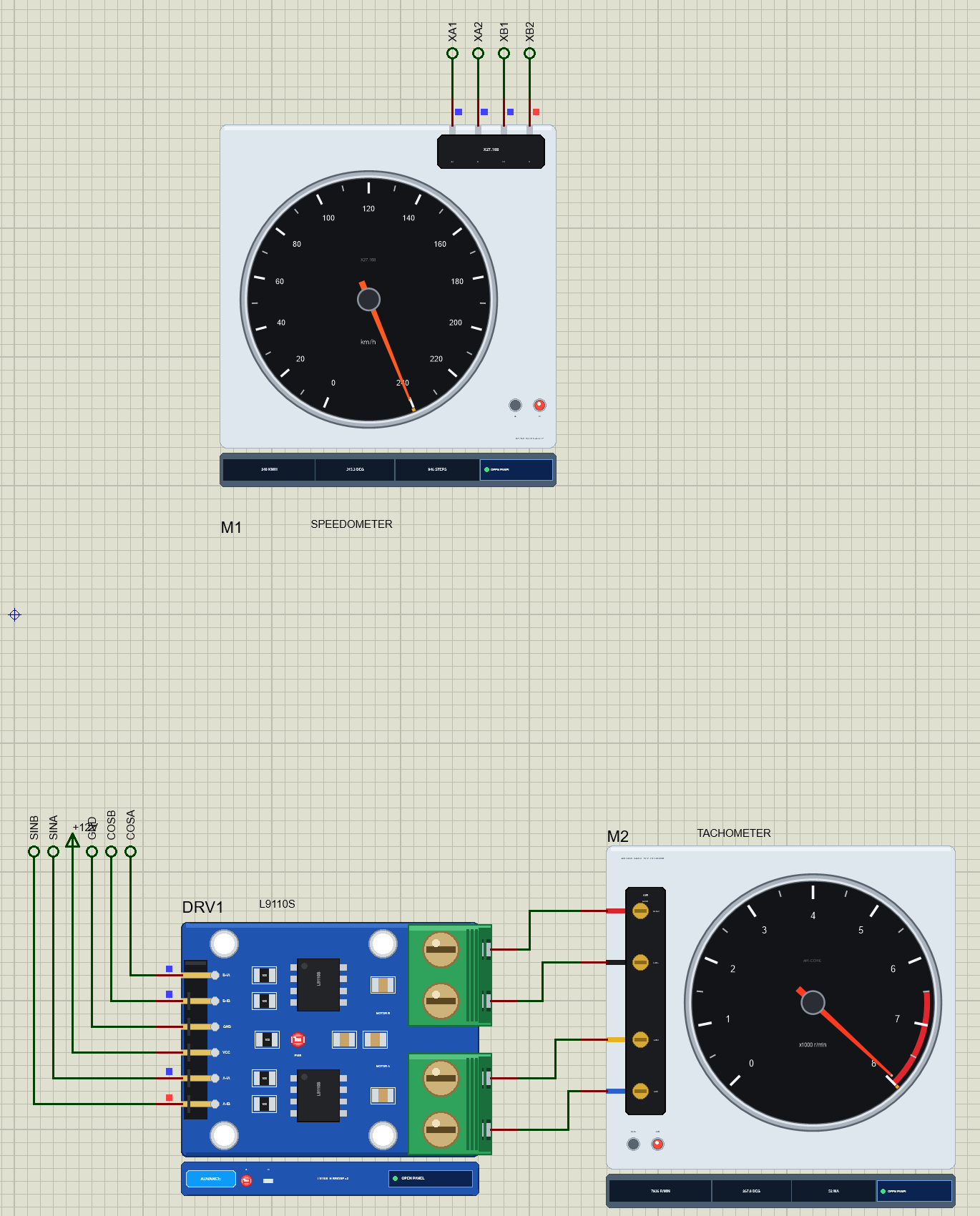
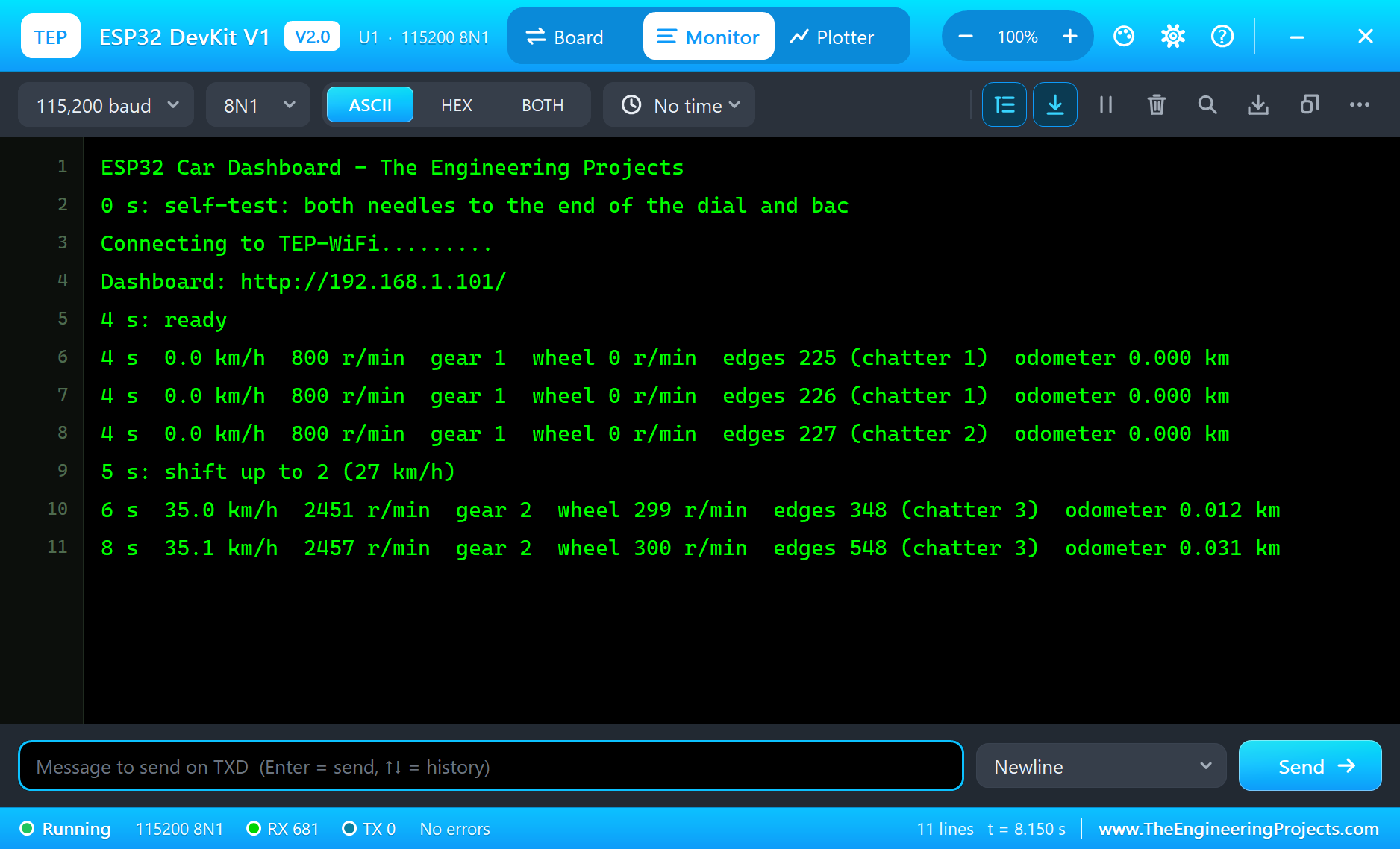
The circuit, the board and the results as they appear in IoT Car Dashboard with ESP32 - Proteus Simulation. Open an image for its full size.
README
 README
===============================================================================================================
  IoT Car Dashboard with ESP32 - Proteus Simulation Project V1.0
  The Engineering Projects - www.TheEngineeringProjects.com
===============================================================================================================

IMPORTANT LINKS
  The project tutorial (circuit, code, simulation results):
    https://www.theengineeringprojects.com/2026/11/iot-car-dashboard-esp32-proteus-simulation.html
  The libraries this project is built from (each post has its own full download and tutorial):
    ESP32 DevKit V1 board:
      https://www.theengineeringprojects.com/2026/10/esp32-devkit-v1-library-for-proteus-v2-0.html
    X27.168 speedometer gauge (stepper):
      https://www.theengineeringprojects.com/2026/10/x27-168-speedometer-gauge-library-for-proteus-v1-0.html
    Air-core gauge (the tachometer):
      https://www.theengineeringprojects.com/2026/11/air-core-gauge-library-for-proteus-v1-0.html
    L9110S dual motor driver:
      https://www.theengineeringprojects.com/2026/10/l9110s-motor-driver-library-for-proteus-v1-0.html
    LM393 speed sensor:
      https://www.theengineeringprojects.com/2026/10/lm393-speed-sensor-library-for-proteus-v1-0.html
    Laptop WiFi Monitor:
      https://www.theengineeringprojects.com/2026/10/laptop-wifi-monitor-library-for-proteus.html
    Mobile WiFi Monitor:
      https://www.theengineeringprojects.com/2026/10/mobile-wifi-monitor-library-for-proteus.html
  Support our free work: https://www.theengineeringprojects.com/donate

FILE STRUCTURE
ESP32-Car-Dashboard-TEP-v1.0/
|-- Proteus Library Files/
|   |-- TEPAIRCORE.LIB                                 32.6 KB   a part of the project -> LIBRARY folder
|   |-- TEPESP32V1.LIB                                 36.6 KB   a part of the project -> LIBRARY folder
|   |-- TEPL9110S.LIB                                  78.5 KB   a part of the project -> LIBRARY folder
|   |-- TEPLAPTOP.LIB                                  39.5 KB   a part of the project -> LIBRARY folder
|   |-- TEPLM393.LIB                                  103.4 KB   a part of the project -> LIBRARY folder
|   |-- TEPMOBILE.LIB                                  13.1 KB   a part of the project -> LIBRARY folder
|   |-- TEPX27.LIB                                     32.0 KB   a part of the project -> LIBRARY folder
|-- Proteus Model Files/
|   |-- TEPAIRCORE.DLL                                308.5 KB   a model -> MODELS folder
|   |-- TEPL9110S.DLL                                 295.0 KB   a model -> MODELS folder
|   |-- TEPLM393.DLL                                  300.0 KB   a model -> MODELS folder
|   |-- TEPNET.DLL                                     2.89 MB   a model -> MODELS folder
|   |-- TEPX27.DLL                                    325.5 KB   a model -> MODELS folder
|-- Proteus Simulation/
|   |-- ESP32_Car_Dashboard.hex                        76.3 KB   the firmware
|   |-- ESP32-Car-Dashboard.pdsprj                     47.5 KB   the project simulation
|   |-- TEPAIRCORE.DLL                                308.5 KB   copy of the model
|   |-- TEPL9110S.DLL                                 295.0 KB   copy of the model
|   |-- TEPLM393.DLL                                  300.0 KB   copy of the model
|   |-- TEPNET.DLL                                     2.89 MB   copy of the model
|   |-- TEPX27.DLL                                    325.5 KB   copy of the model
|-- Arduino Code/
|   |-- ESP32_Car_Dashboard/ESP32_Car_Dashboard.ino    11.7 KB   the sketch (source of the .hex)
|-- README.txt                                        ~11.3 KB   this file
Total: 8.66 MB (unzipped). The C++ source code of the models is not included.

WHAT IS IT?
  A car's instrument cluster you can run in Proteus: an ESP32 measures the wheel's speed with an LM393 slotted
  optical sensor, shows it on an X27.168 stepper speedometer, works out the engine's r/min through a five-speed
  automatic gearbox and shows it on an air-core tachometer, counts the odometer and the trip, warns of overspeed and
  serves a web dashboard.
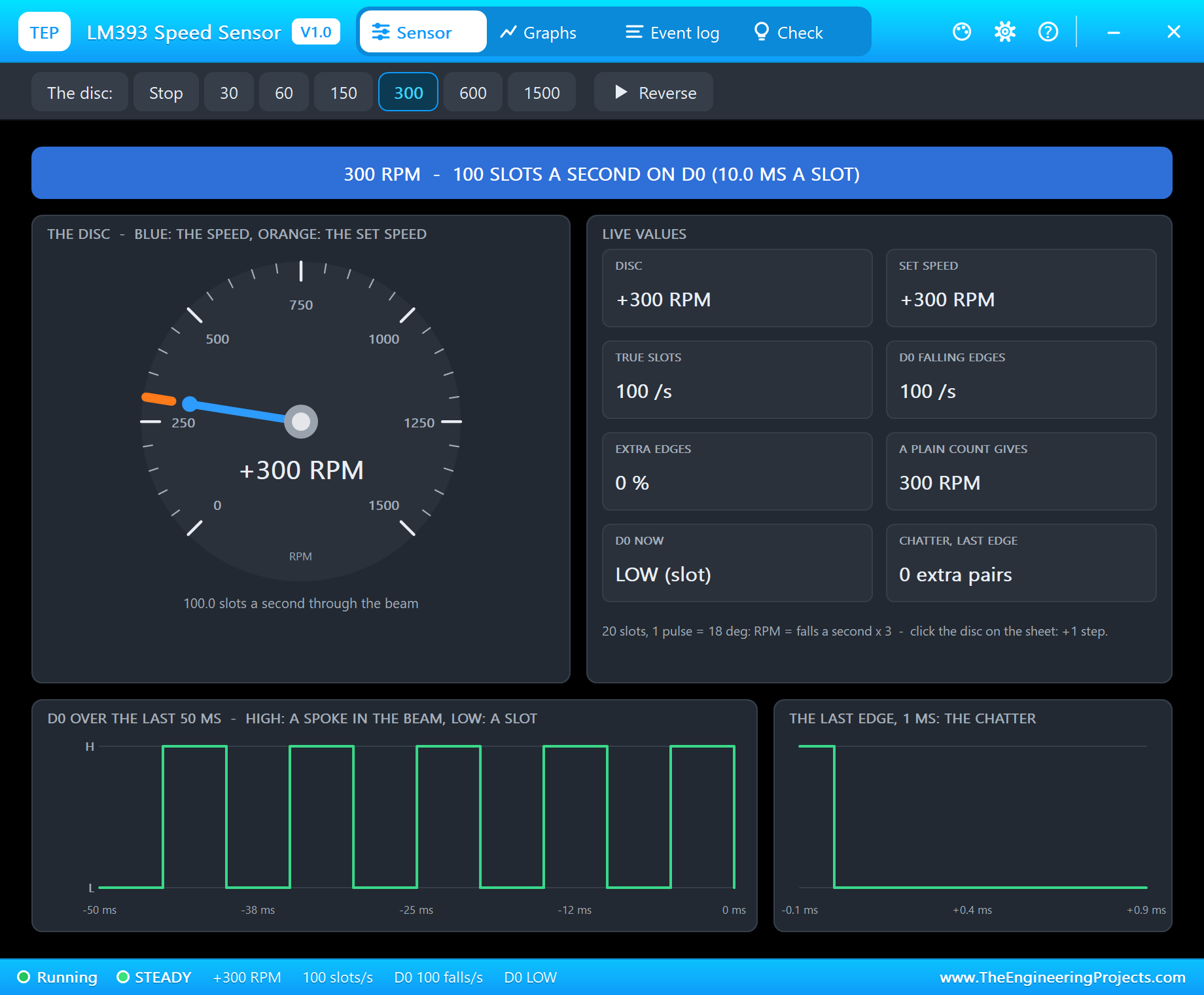
    * LM393 speed sensor (LM393SPEEDTEP, U2) on a 20-slot disc on the wheel: D0 on D34 (LOW while the light passes a
      slot), VCC on the 5 V rail (the model wants it; a real module runs on 3.3 V next to an ESP32), GND. 20 pulses a
      turn. Slow slot edges make the comparator chatter below about 200 r/min: a burst of falls at both edges of a
      slot. Below 250 r/min the sketch reads D0 when a burst is over (1 ms quiet): LOW = a slot began, HIGH = it ended.
    * X27.168 speedometer (X27168TEP, M1): A+ D25, A- D26, B+ D27, B- D14 - straight on the pins (260 ohm coils), the
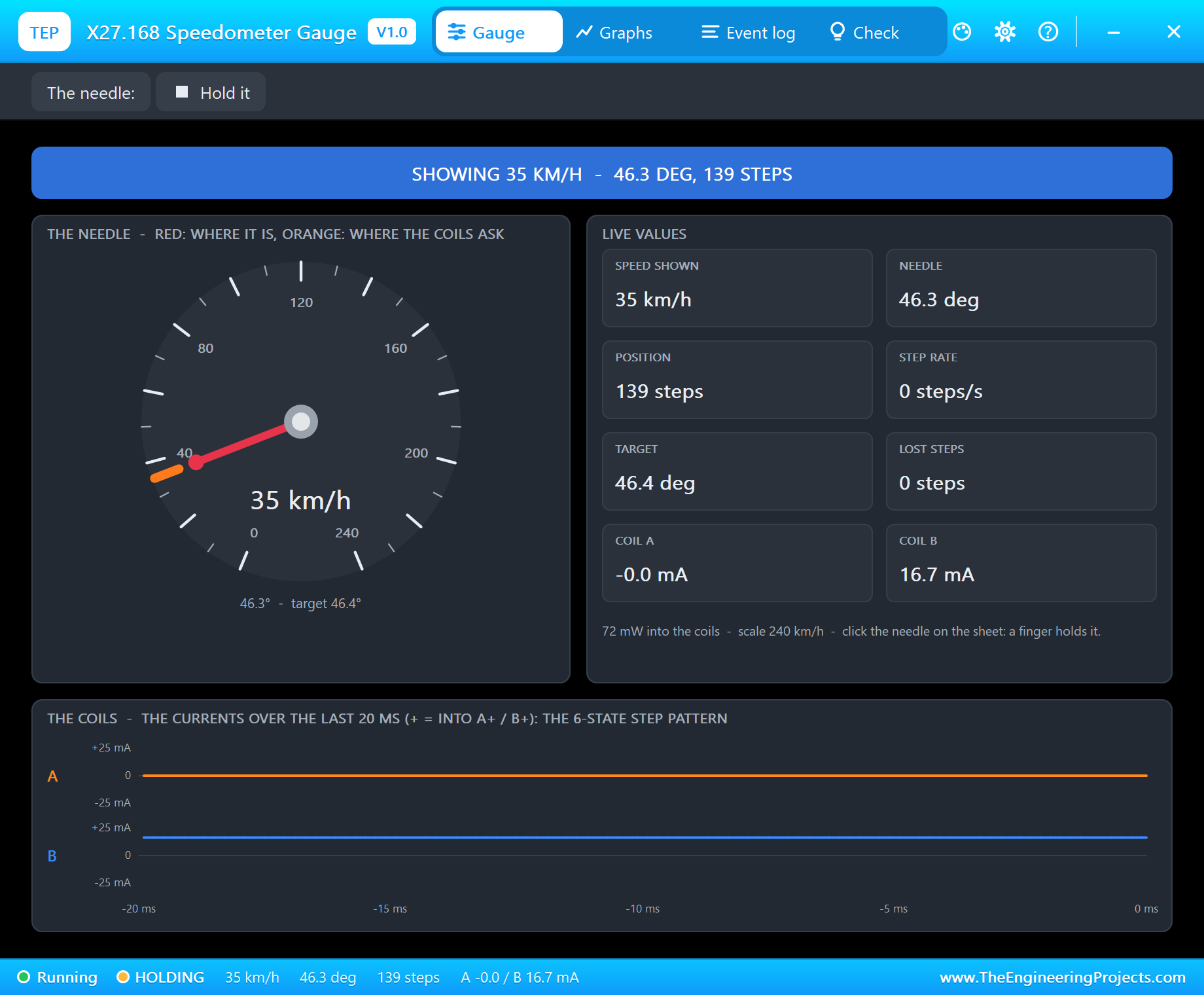
      Switec six-state sequence, 945 steps of 1/3 deg = 315 deg = 0 - 240 km/h. At power-up 1000 steps down zero it
      against its stop.
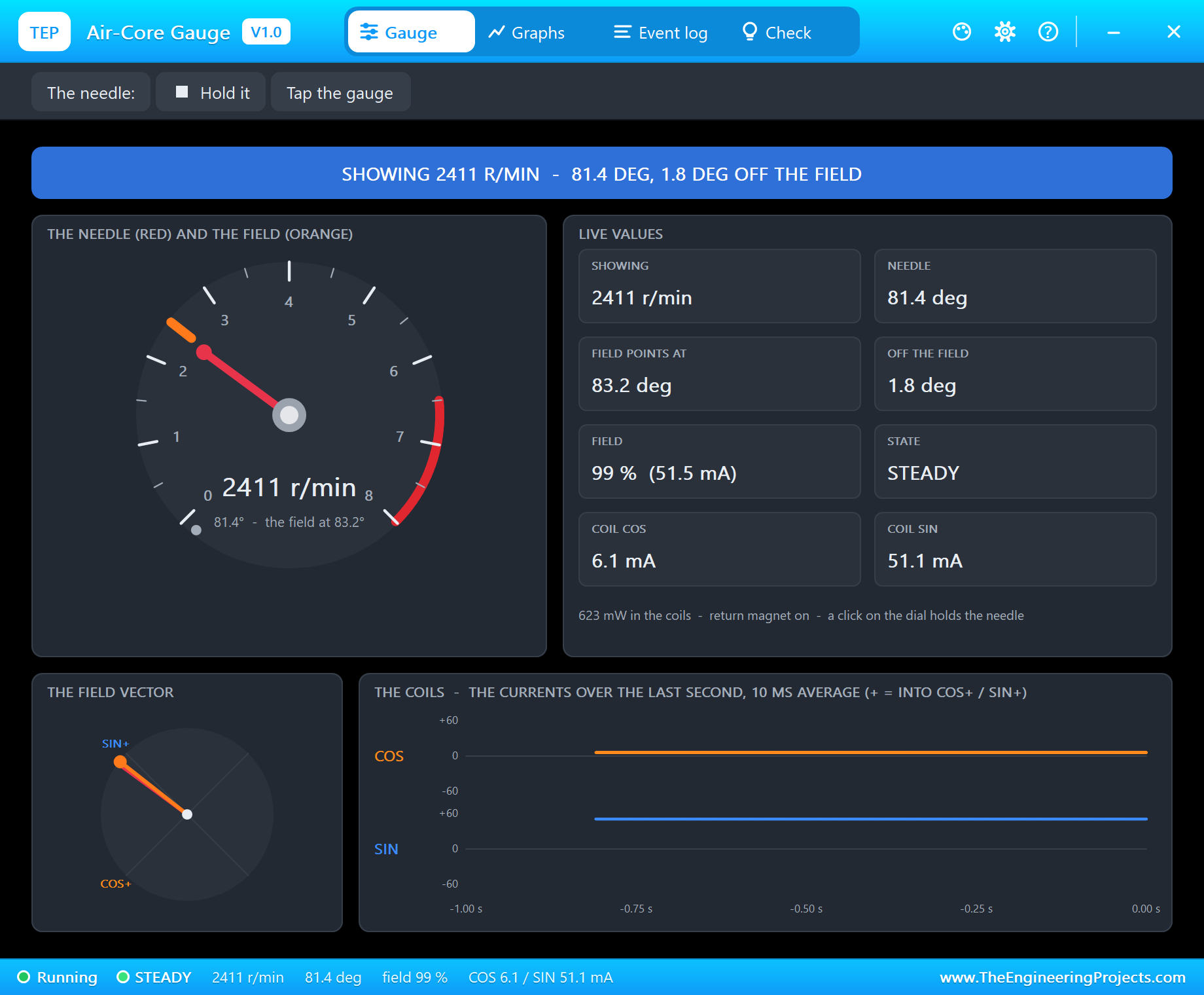
    * Air-core tachometer (AIRCORETEP, M2): 0 - 8000 r/min over 270 deg, red line 6500. Its COS coil on the L9110S's
      motor B (B-OA / B-OB), its SIN coil on motor A (A-OA / A-OB).
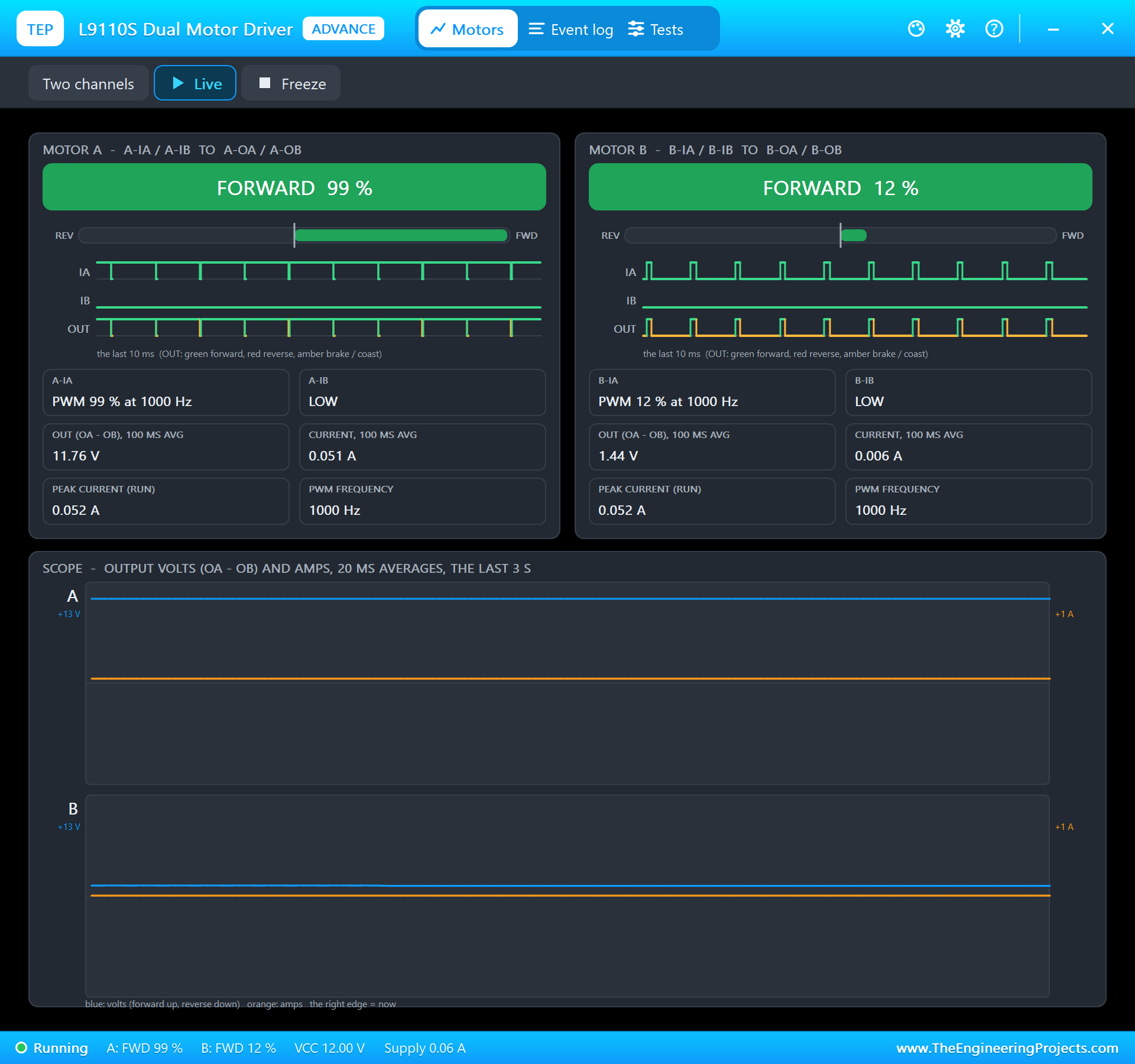
    * L9110S dual H-bridge (L9110SADVTEP, DRV1) on +12V: B-IA RX2 (GPIO16), B-IB TX2 (GPIO17), A-IA D18, A-IB D19 -
      each coil gets a PWM (analogWrite, 1 kHz) on one input and LOW on the other: COS = cos(angle), SIN = sin(angle).
      The field turns at most 4 deg every 10 ms.
    * ESP32 DEVKIT V1 (U1) runs ESP32_Car_Dashboard.hex on TEP-WiFi at 192.168.1.101 (port 80).
    * Laptop WiFi Monitor (PC1) and Mobile WiFi Monitor (MOB1) open http://192.168.1.101/.
  The numbers (at the top of the sketch):
    * km/h = the wheel's r/min x 1.95 m (the rolling circumference of a 195/65 R15 tyre) x 60 / 1000;
      the wheel's r/min = 60,000,000 / (the time between two slots in us x 20), smoothed; no slot for 1 s = stopped;
    * the engine = the wheel's r/min x the gear's ratio (3.50, 2.10, 1.40, 1.00, 0.80) x the final drive 3.90, never
      under 800 (the idle); up a gear above 3000 r/min, down under 1500;
    * the odometer and the trip: the slots x 1.95 m / 20 (9.75 cm a slot); OVERSPEED above 120 km/h (back under 115).
  At power-up the cluster's self-test: both needles to the end of the dial and back.
  Its pages:
    /          the dashboard: the speed, the engine, the gear, the odometer, the trip, the sensor, the events
    /trip      reset the trip
    /test      the self-test sweep
    /data      everything as JSON
  No extra library: the sketch drives the gauges and reads the sensor itself.

TEST STATUS
  Tested in Proteus 8 Professional on Windows 11, the run that made the tutorial's screenshots (the sketch's times):
    * 0 - 4 s: the zeroing and the self-test (both needles to the end and back); "4 s: ready".
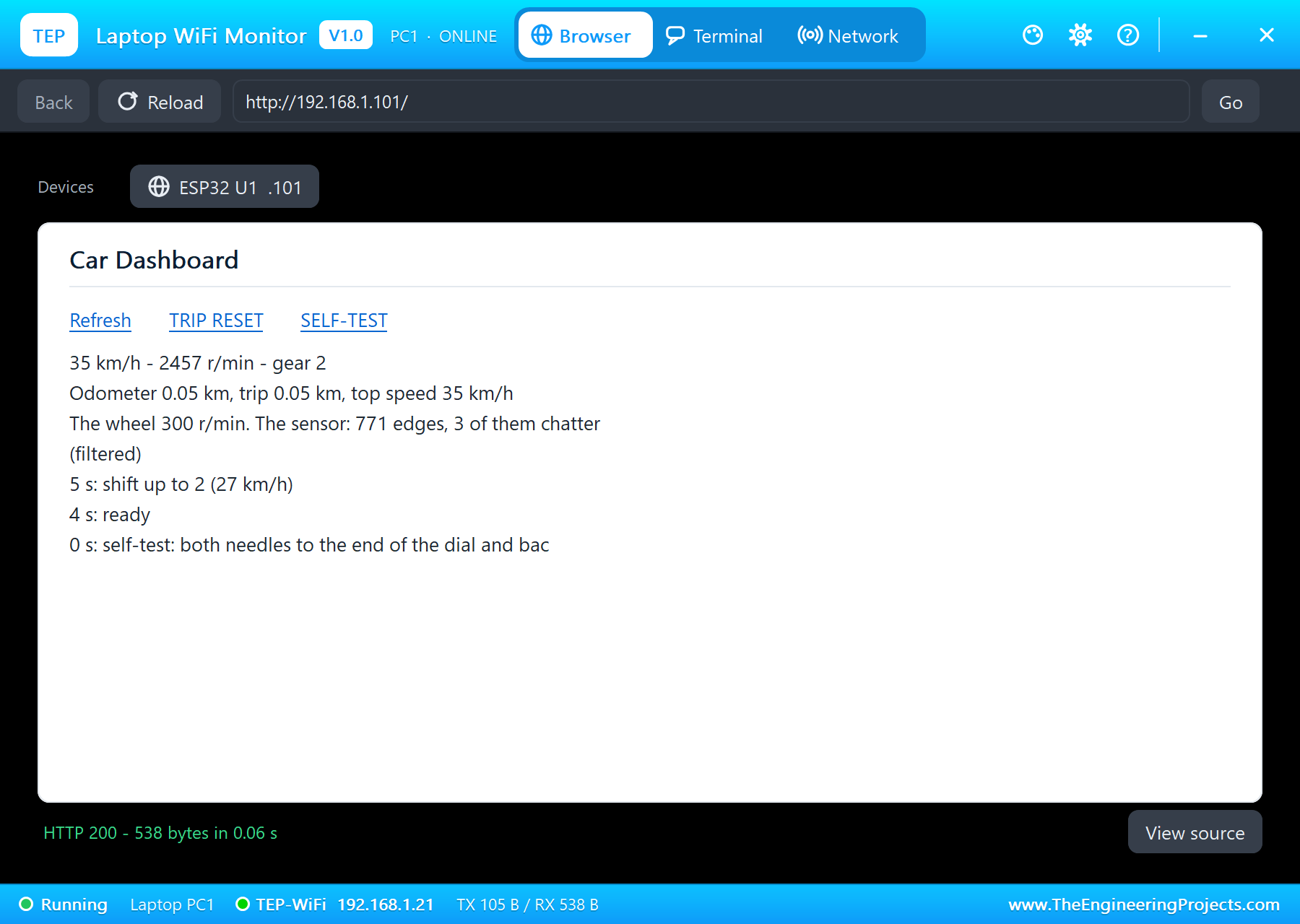
    * 300 r/min on the wheel (the LM393's property): "shift up to 2 (27 km/h)" at 5 s; 35.1 km/h, 2457 r/min, gear 2.
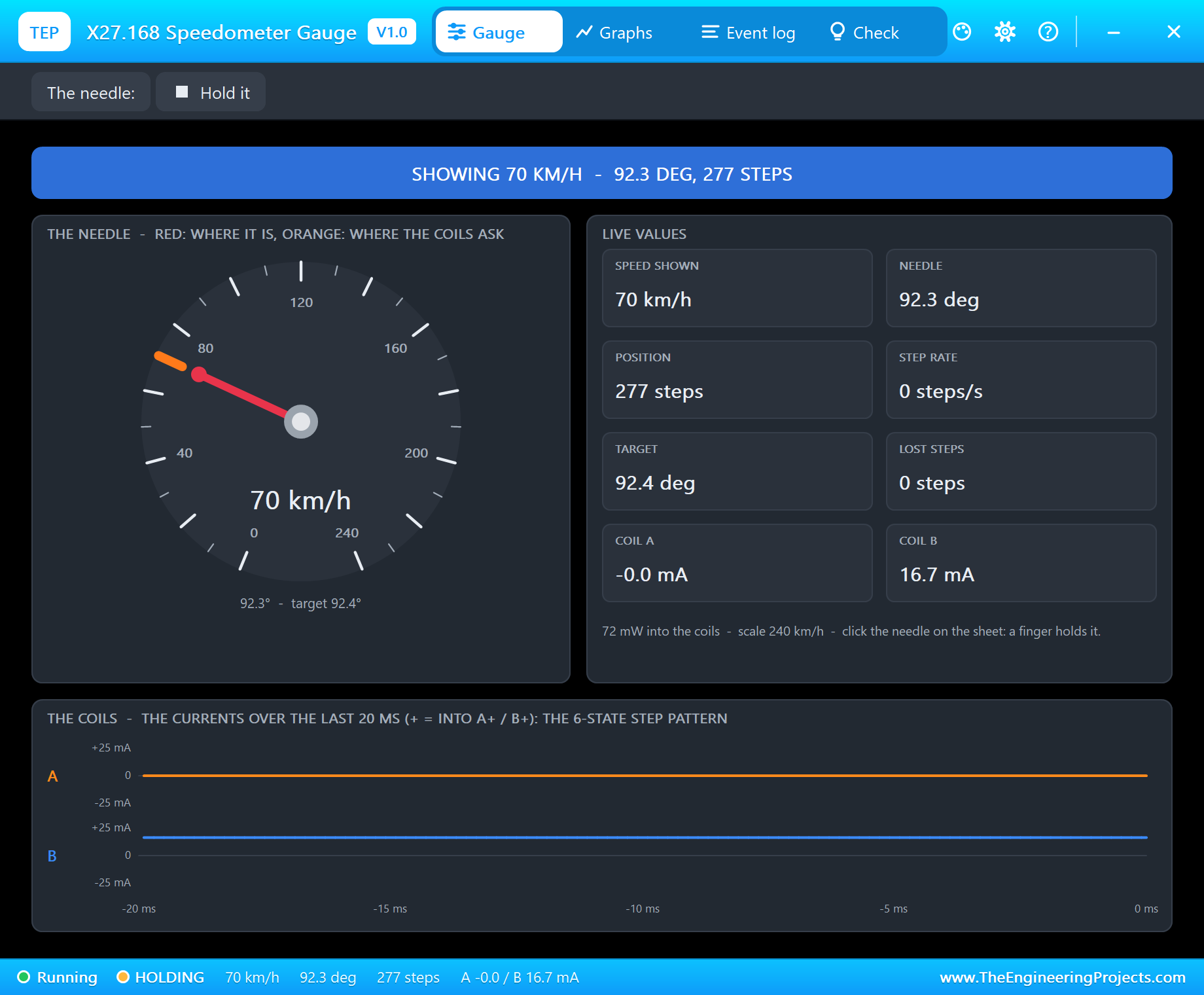
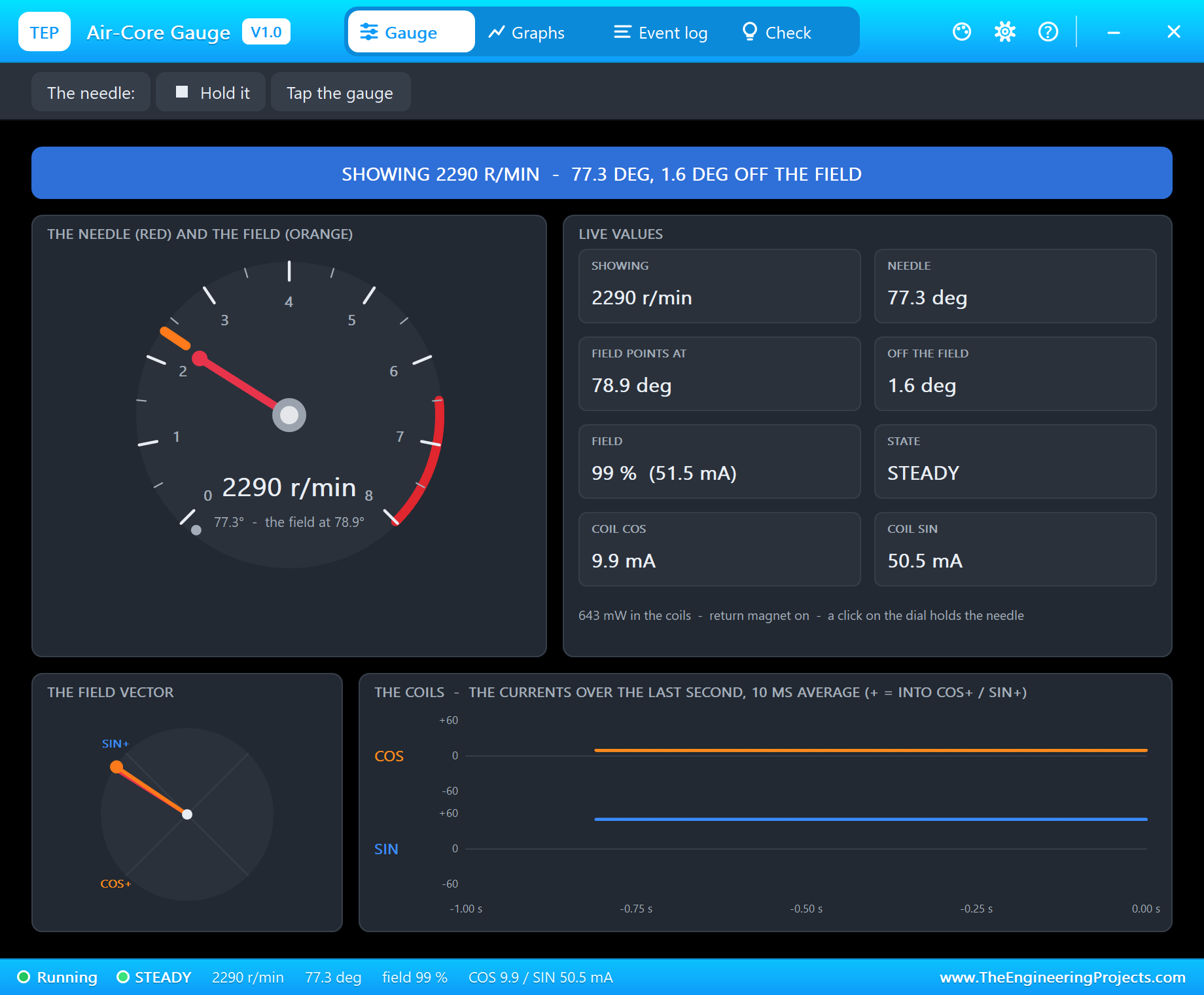
    * 600 r/min: "shift up to 3", "shift up to 4" at 12 s; 70.2 km/h, 2340 r/min, gear 4. The speedometer: 277 steps =
      92.3 deg, 0 lost steps, 16.7 mA a coil; the tachometer: 2290 r/min, the needle 1.6 deg behind the field (the
      return magnet), the coils 9.9 / 50.5 mA (cos / sin of 78.9 deg).
    * 1500 r/min: "shift up to 5" at 16 s, "OVERSPEED: 126 km/h" at 17 s; 175.5 km/h, 4679 r/min. The speedometer
      692 steps = 230.7 deg; the tachometer 4662 r/min, the COS coil -47.6 mA, the SIN coil 19.0 mA; the L9110S: motor
      B reverse 92 %, motor A forward 37 % at 1000 Hz.
    * 150 r/min: "shift down to 4, 3, 2, 1" at 21 - 22 s; 17.6 km/h, 2051 r/min, gear 1.
    * 30 r/min: the LM393 made 50 falling edges a second for 10 slots (400 % extra - a plain count reads 150 r/min);
      the sketch read 30 r/min, 3.5 km/h, the engine at its 800 r/min idle; 362 chatter edges filtered by the end.
    * Stop: 0.0 km/h at 34 s; TRIP RESET from the phone and SELF-TEST from the laptop at 36 s.
  Three earlier runs taught the chatter rule: a 300 us lockout read 472 km/h at 30 r/min, a quarter-period lockout
  read exactly double (the comparator chatters at both edges of a slot), and reading D0 inside a CHANGE interrupt
  misread the 15 - 50 us chatter pulses (75,000 r/min). Reading D0 once a burst is over is right at every speed.
  42 s of simulation took about 10 minutes on our PC with all the captures.

INSTALLATION
  1. Close Proteus. Extract the WHOLE zip file, for example to your Desktop.
  2. Copy the files from "Proteus Library Files" into the LIBRARY folder of Proteus, for example
     C:\Program Files (x86)\Labcenter Electronics\Proteus 8 Professional\LIBRARY
  3. Copy the files from "Proteus Model Files" into the MODELS folder (next to LIBRARY).
  4. Start Proteus. Press P in the schematic and search for ESP32 DEVKIT V1, X27168TEP, AIRCORETEP, L9110SADVTEP or
     LM393SPEEDTEP to check that the parts are there.

RUN THE SIMULATION
  1. Open "Proteus Simulation\ESP32-Car-Dashboard.pdsprj". Keep the HEX and the DLL files beside it.
  2. Press Play. Both needles sweep to the end and back, then the wheel turns at 300 r/min: 35 km/h in gear 2.
  3. In the LM393's pop-up (U2) pick the wheel's speed: Stop, 30, 60, 150, 300, 600 or 1500 r/min.
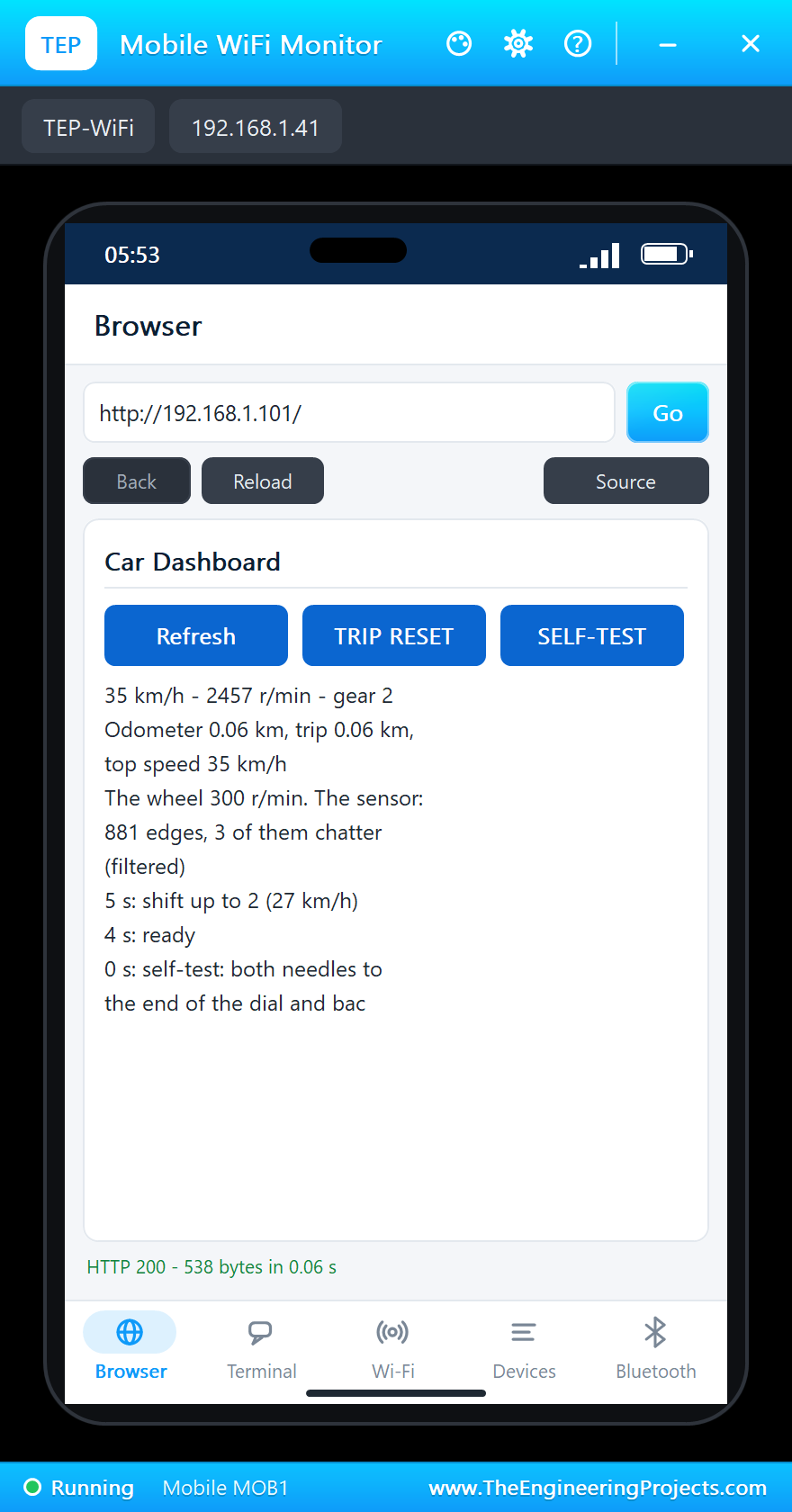
  4. Open the Laptop WiFi Monitor (PC1) or the Mobile WiFi Monitor (MOB1) and press Go; Refresh, TRIP RESET and
     SELF-TEST are the links.
  The simulation runs slower than real time (the gauges' coils are simulated as analog loads under PWM).
  Your own sketch: compile it, export the compiled binary and set U1's PROGRAM property to the new file.

PROPERTIES USED IN THIS PROJECT
  U1 ESP32 DEVKIT V1           PROGRAM=ESP32_Car_Dashboard.hex, AUTOOPEN=YES (TEP-WiFi, 192.168.1.101)
  M1 X27168TEP                 (no changes: SCALE 240 km/h)
  M2 AIRCORETEP                (no changes: RANGE 8000, REDLINE 6500, RETURN YES)
  DRV1 L9110SADVTEP            (no changes) on +12V
  U2 LM393SPEEDTEP             RPM=300 at the start, CHATTER=YES
  PC1, MOB1                    HOMEPAGE=http://192.168.1.101/

TROUBLESHOOTING
  * The speed reads too high at a crawl: the chatter - keep the burst rule (a lockout fails at 30 r/min).
  * The speedometer is wrong after a reset: it has no position sensor - the zeroing at power-up sets it.
  * The speedometer loses steps: the steps come too fast - keep the ramp (600 us at the fastest).
  * The tachometer needle sticks at its pin: the field jumped more than 180 deg - turn it in small steps.
  * The tachometer reads backwards: COS and SIN (or + and -) swapped.
  * LM393 NO POWER: VCC must be on the 5 V rail in the simulation.

LICENCES
  * The project, the sketch, the parts (LIB files) and the models (DLL files) are made by The Engineering Projects
    and are free for learning and for your own projects. The models use only standard Windows libraries.
    The C++ source code of the models is not included; the source code is not included for any model.
  * Proteus is a product of Labcenter Electronics and is not included. ESP32 is a product of Espressif Systems; the
    X27.168 is a Switec-style gauge stepper made by several companies. This project is not made or endorsed by them.

VERSION
  V1.0 - the first release of the project.
===============================================================================================================Development1 release
 Development1 release
-
V1.0IoT Car Dashboard with ESP32 - Proteus Simulation V1.0this page
V1.0 is the only release in the Download Center so far. When a newer version is published, it appears above with its own download page.
Installation8 steps
 Installation8 steps
From the download to a working project, in order. The steps follow what the package contains.
You will need
- Proteus Design SuiteProteus 8 or newer (Labcenter), on Windows
- Arduino IDE1.8 or 2.x, with the board of the tutorial chosen under Tools → Board
- Any archive toolWindows, macOS and Linux extract ZIP files on their own
Steps
- 1
Extract the archive
Right-click 508e003d7cdf423b98ba6e15ac02eb1c.zip and choose Extract All (or open it with 7-Zip or WinRAR) into a folder you can find again. Keep its folder structure (ESP32-Car-Dashboard-TEP-v1.0) as it is.
- 2
Copy the library files into Proteus
Move TEPAIRCORE.LIB, TEPESP32V1.LIB and TEPL9110S.LIB and 4 more and the files into the LIBRARY folder of your Proteus installation: C:\Program Files (x86)\Labcenter Electronics\Proteus 8 Professional\LIBRARY for Proteus 8, or the matching Proteus 7 folder. Older versions keep it under ProgramData\Labcenter Electronics. If Proteus is open, close it first.
- 3
Add the simulation model
Copy TEPAIRCORE.DLL, TEPL9110S.DLL and TEPLM393.DLL and 2 more into the MODELS folder next to LIBRARY, so the component can run, not only be drawn.
- 4
Restart Proteus and place the component
Start Proteus, open a schematic, press P (Pick Devices) and search for the component by the name used in the tutorial. It appears with its pins ready to wire.
- 5
Open the sketch in the Arduino IDE
Open ESP32_Car_Dashboard.ino, select your board and port under Tools, then Verify. Sketch → Export Compiled Binary writes the HEX file a simulation needs.
- 6
Load the HEX file
In Proteus double-click the microcontroller, set Program File to ESP32_Car_Dashboard.hex and run the simulation. For real hardware, flash the same file with your programmer.
- 7
Open the example simulation
Open ESP32-Car-Dashboard.pdsprj in Proteus to see the wiring exactly as in the tutorial. Check the controller's Program File path, then press Play.
- 8
Follow the tutorial
IoT Car Dashboard with ESP32 - Proteus Simulation explains every connection and setting in order; keep it open beside the files while you build.
FAQs9 questionsContact TEP
 FAQs9 questions
How do I download IoT Car Dashboard with ESP32 - Proteus Simulation V1.0?
Wait for the 30-second guest countdown on this page, then press the download button; the file comes straight from our storage. Members who are logged in skip the wait. If the browser opens the file instead of saving it, use its Save as option. The download link is made for you when the countdown ends and works for 15 minutes; a saved or shared link stops working, so share this page instead.
What is inside the archive?
IoT Car Dashboard with ESP32 - Proteus Simulation V1.0 comes as a ZIP archive of 21 files (4.0 MB, 8.7 MB unpacked) holding Proteus library files, simulation model DLLs, a Proteus simulation, an Arduino sketch and compiled HEX firmware. Open the File Structure tab for the full list of 21 files.
What should I do if the download does not start?
Check the browser's download list first; an ad blocker or a company firewall can also hold it back, so try another browser or network. If the file arrives incomplete, download it again. For an installation problem, read the Install tab or tell us in the comments with your software version and the exact error message.
Is this file free?
Yes. Every file in the TEP Download Center is free for learning, personal and student projects. If you share it, link back to this page or the tutorial so others find the latest version.
How do I check that the file arrived complete?
Compare its SHA-256 with the one on this page, 6eec9c3258d4e101122d73102401f6f6feab949fcc39e67beb1405c1b01014e2. In PowerShell run Get-FileHash "508e003d7cdf423b98ba6e15ac02eb1c.zip"; on macOS or Linux run shasum -a 256 "508e003d7cdf423b98ba6e15ac02eb1c.zip". The same value means the file is exactly the one in our storage; a different one means the download broke off, so download it again.
Do I need WinRAR to open the ZIP file?
No. Windows, macOS and Linux open ZIP archives on their own (Extract All, or double-click). WinRAR and 7-Zip work too. Extract the whole archive before using the files.
Where do I put the LIB and IDX files?
Both files go into the LIBRARY folder of your Proteus installation (Proteus 8: C:\Program Files (x86)\Labcenter Electronics\Proteus 8 Professional\LIBRARY; Proteus 7 has the same folder under its own name). Restart Proteus afterwards and search for the component with P.
Which Proteus version does the library need?
The tutorial names the Proteus version the library was made and tested with. Most TEP libraries work in Proteus 7 and Proteus 8; if the component does not appear after a restart, check that both the LIB and the IDX file were copied and that Proteus was fully closed while copying.
How do I get the HEX file into the simulation?
Compile the sketch in the Arduino IDE (Sketch → Export Compiled Binary gives you the HEX next to the sketch), then in Proteus double-click the board, set Program File to that HEX and run.
Members skip the wait. Log in or join TEP.

- 1Total downloads
- 4%Popularity
- ESP32 ProjectsCategory
- 0Comments
- ssyedzainnasirUploaded by
- 16 Nov 2026Uploaded at


 SHA-256
6eec9c3258d4e101122d73102401f6f6feab949fcc39e67beb1405c1b01014e2


 Need help with this file?
 Tags
Related ESP32 Projects
All ESP32 Projects tutorials




More ESP32 project files
All ESP32 tutorials


Comments
0