Hi Geeks, welcome to our new project. Our new project is one of the most common issues you’ve seen in your cities. In this project, we are going to make a car parking system with automatic billing. In the entire world, there are an estimated 1.4 billion cars on the road, which is absolutely great news if we are considering the development of the Automobile industry. But the most serious issue is that the number of cars exceeds the number of available parking places, resulting in traffic congestion. Damaged cars due to this lack of space, fewer parking locations, lack of parking signage, informal parking, and overcharging for parking are just a few of the issues. People are still choosing manual parking methods, which have a number of drawbacks, such as searching for a vacant spot in a park ...
In the highly competitive world of electronics, it has become obvious for leading companies to stick to the adhere standards of quality and consistency. Hence, many times companies and organizations prefer to adopt globally known standards to maintain singularity and high quality within the organization. Because IPC is considered the gold of all standards, many companies and organizations tend to follow it. For that very same reason, companies always prefer employees who demonstrate his/her ability to deliver as per IPC standards. It is vital to becoming an established professional in the field of electronics assembly and quality inspection to find a suitable job in the field of the electronics manufacturing industry. What could be the better way to showcase that other than proving your ex ...
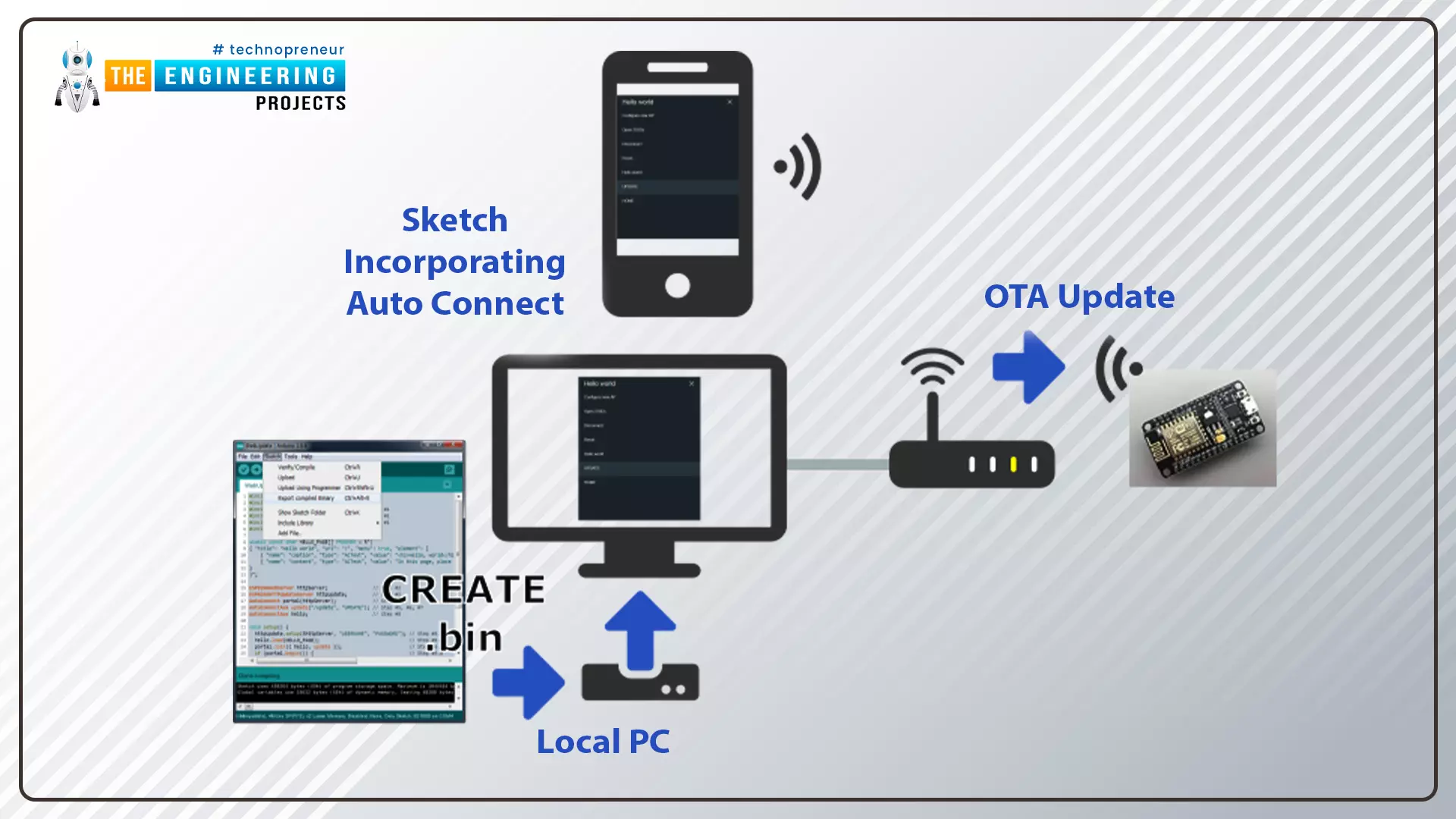
Hello readers, I hope you are all doing great. In this tutorial, we are going to discuss the OTA web updater on the ESP32. We already covered the fundamentals of OTA programming in ESP32 , in our previous tutorial where we used the Arduino IDE to upload OTA code into the ESP32 module using the network port. In the OTA web updater, you need to create a web server page for OTA programming. [caption id="attachment_166886" align="aligncenter" width="1920"] ESP32 OTA web updater[/caption] Fig.1 ESP32 OTA web updater Over the Air Web Updater "Over-the-air" refers to the ability to wirelessly download an application, configuration, or firmware to internet-enabled devices, also known as IoT. (OTA). It functions similarly to our computers, laptops, tablets, and phones. Instead of using a serial por ...
PWM stands for P ulse- W idth M odulation. Once the switching frequency (f sw ) has been chosen, the ratio between the switch-on time (T ON ) and the switch-off time (T OFF ) is varied. This is commonly called duty-cycle (D). The duty cycle can be between 0 and 1 and is generally expressed as a percentage (%). D = T ON / (T ON + T OFF ) = T ON x f sw The variation of the pulse width, made at a high frequency (kHz), is perceived as continuous and can be translated into a variation of the rotation speed of a motor, dimming a LED, driving an encoder, driving power conversion, and etc. The use of PWM is also widely used in the automotive sector in electronic control units (ECU - Electronic Control Unit) to manage the energy to be supplied to some actuators, both fixed and variable frequency. A ...
Hello friends, I hope you’re all well and healthy. In today’s tutorial, we will be going through a simple, yet effective practice to design a 4-way traffic light simulation in Proteus software. This project is designed for undergrad engineering students with majors in electronics, electrical and mechatronics engineering. It is also useful for people that want to learn the basics of circuit design and Arduino programming. 4-Way Traffic Light Control using Arduino: Traffic lights are an integral part of the world’s transportation systems. Over the years a number of different algorithms regarding traffic lights have been developed. The algorithm being used at any place for the purpose of controlling traffic takes into account of various factors, such as number of lanes, people that cross a ce ...
Hello everyone, I hope you all are doing great. Today, we are going to share the 9th chapter in the PCB learning series, where we will have a look at the difference between Through-hole and Surface-mount technology. In our previous lectures, we studied both THT and SMT methods separately and have seen that both are used for components mounting on the PCB board. So, today, we will have a look at the difference between the two techniques. So, let's get started without wasting any time. Through-Hole vs Surface-Mount Let us know have a look at these differences and get to know the way forward when it comes to the process of component selection whether SMT or DIP. Definition - THT vs SMT THT stands for through-hole technology. In Through-hole technology, components are mounted by the use of hol ...
Greetings and welcome to today’s lecture. It's our 7th tutorial in the PCB learning series. In our previous lectures, we have studied the two main types of PCB i.e. Single-sided and Double-sided PCB. Today is going to be a very interesting and interactive class about Through Hole Technology(THT) , which is applied in the process of designing printed circuit boards. A PCB board has a properly designed circuit on it and it's composed of connecting traces/paths and various electronic components. The electronic components are mounted on the board in two different ways i.e. Through-hole and Surface-mount. We will cover Surface-mount in our next lecture and today, we will discuss how to mount components on PCB boards using though-hole technology. So, let's get started with Through-hole technolog ...
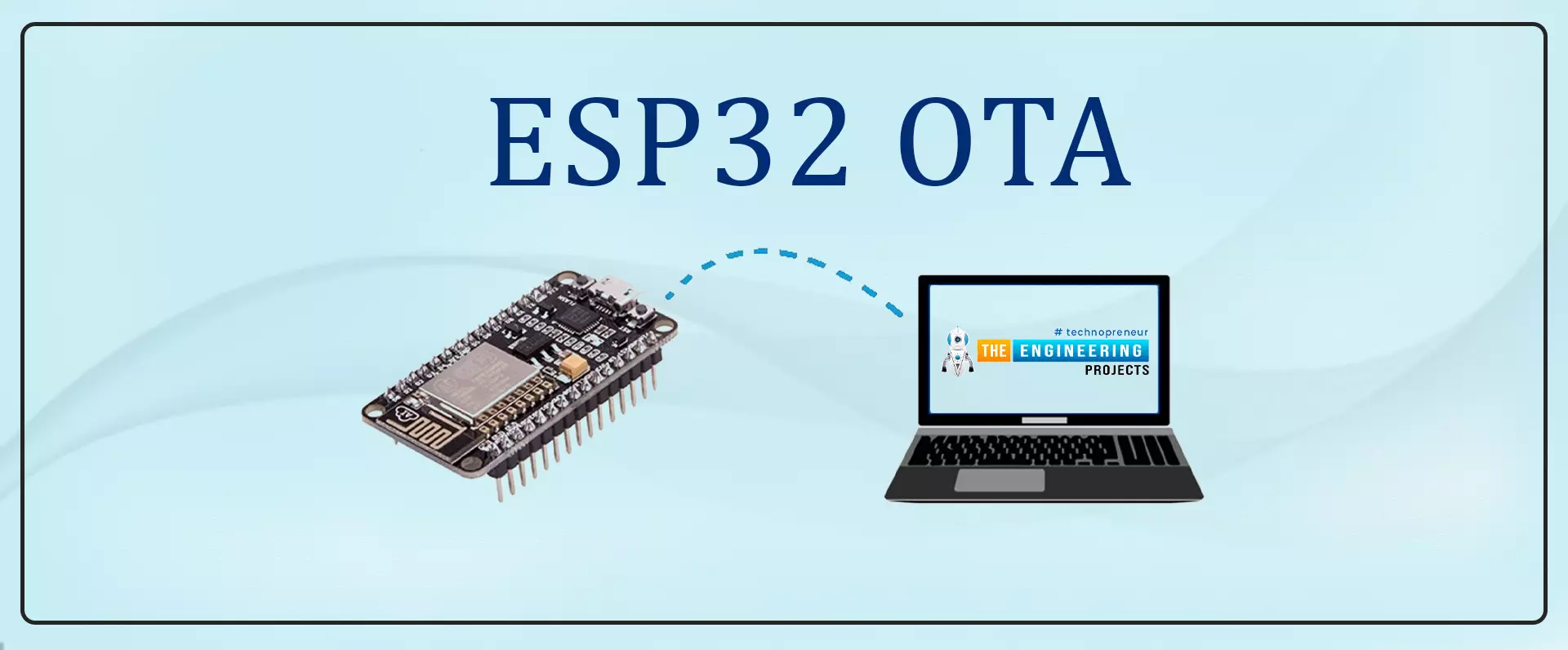
Hello readers, hope you all are doing great. In this tutorial, we are going to discuss a mechanism that allows users to update the ESP32 with a new program wirelessly or over the air (without using a USB cable to upload a new program). Over-The-Air (OTA) programming Fig. 1 ESP32 OTA OTA programming is the mean by which a product manufacturer or product service provider can update the features or functionality of the device wirelessly or over the air, after the device has been deployed in the field where connecting a cable or uploading the code serially is difficult. One key advantage of OTA is that a single central node can send an update to multiple ESPs on the same network. The device must have a provisioning client capable of receiving, processing, and setting parameters in order to rec ...
Hello everyone, Welcome to our new project. Our new project plays a very important role in our daily life as it is directly connected to our lives. In this project, we are going to design an Accident Detection module. Accidents are the most common thing we hear about in the news, and in social media. Everyone here or there has seen accidents or has been with one. So when any such incidents happen, we inform respective stations or hospitals in that emergency situation. But what about the accidents that happen at night, or in places where there is very less crowd or you are alone. So, to address this issue and provide a potential solution for that, we are going to learn how to detect an accident automatically and inform nearby aid/help stations. We can use this useful project for an engineer ...
A D igital to A nalog C onverter( DAC ) performs the task of converting digital words of n bits into voltages whose amplitude will be proportional to the value of the code expressed by the words themselves. Since the input binary words represent a succession of finite codes, the voltage coming out of a DAC cannot be continuous over time but is made up of as many levels as the converted codes are. This means that the devices to which the analog signal produced by a DAC is sent must filter it with a low-pass characteristic (integrating action). The operating criterion of a DAC is simple: in fact, it is sufficient to have a succession of as many voltages as there are convertible codes, obtained for example by means of a weighted resistance network (i.e. the value proportional to the code impl ...