Hey Guys! Welcome you onboard. Today, I'll discuss the details on the Introduction to IRF4905. It is a P-Channel HEXFET Power MOSFET available in a TO-220AB package and is based on Advanced Process Technology. It is mainly used for fast switching purpose, capable of providing ultra-low on-resistance.
This tiny device comes with three terminals called gate, drain and source where the gate terminal is used to control the current on remaining two terminals. The area between source and drain is known as a channel that is widely dependent on the voltage applied to the gate terminal.
In this post, I'll cover each and everything related to this P channel MOSFET, its main features, working, pinout and applications. Let's jump right in and explore everyt ...
Hello friends, I hope you all are doing great. In today's tutorial, we are gonna have a look at detailed Introduction to A4988. The A4988 is a micro-striding driver for governing the stepper motors, it is incorporated with the interpreter (translator) for the tranquil process. By this controller stepper motor can control by 2 pinouts, one pin is to regulate the direction of motor revolutions and other is for steps regulation of motor.
It works on 3 to 5.5V and it consumes per phase two amperes current in presence of the proper cooling environment. It consists of an immovable off-time current controller which has the capacity to works in sluggish or assorted falling-off styles. In today's post, we will have a look at its cascading, pinout, sorts, uses, etc. I will also share some li ...
Hi folks! Hope you’re well today. I welcome you on board. In this post today, I’ll detail the complete Introduction to BC517.
BC517 is an NPN bipolar junction transistor made up of silicon material and comes in a TO-92 package. It carries collector-current 1A, projecting it can drive loads under 1A. Total power dissipation is 625mW, indicating it releases power around 625mW while working. Collector-emitter and collector-base voltages are 30 and 40 respectively. The emitter-base voltage is 10V which means it requires only 10V to trigger the electron action inside the transistor.
Read this post all the way through as I’ll be documenting pinout, working, power ratings, alternatives, applications, and physical dimensions of transistor BC517.
Let’s ...
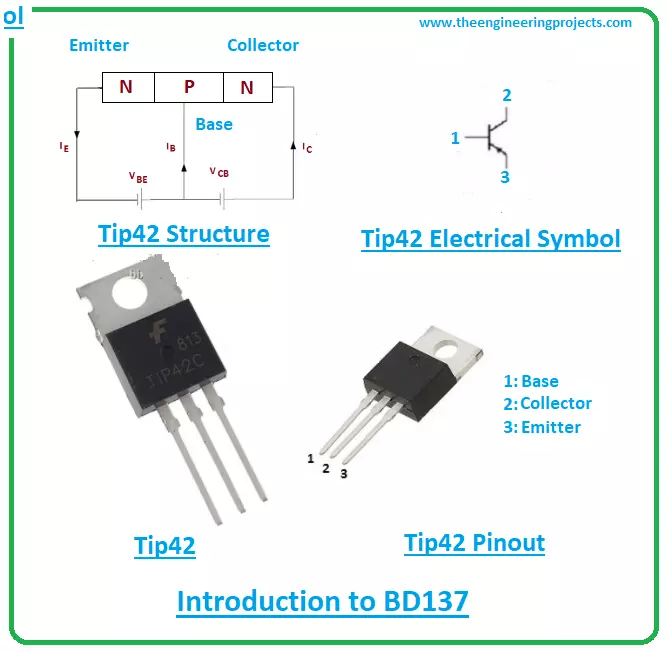
Hi Guys! Thank you for clicking this read. Hope this finds you well. In this post today, I’ll document the Introduction to Tip42.
Tip42 is a medium power silicon transistor mainly used for switching and amplification purpose. It belongs to the PNP transistor family and comes in the TO-220 package. The collector current is 6A which signals it can support load under 6A. Both collector-base and the collector-emitter voltages are 40V. And the only 5V is required to initiate the transistor action as the emitter-base voltage is 5V. The power dissipation is 65W which defines the amount of energy released during the working of this transistor. The storage junction temperature is -65 to 150C and transition frequency is 3MHz.
Just stay with me for 2-min a ...
Hello readers, I hope you are all doing great. Welcome to the 2nd lecture of Section 5(ESP32 Sensors) in the ESP32 Programming Series. In the previous tutorial, we discussed the built-in ESP32 Hall Effect Sensor. In this tutorial, we will discuss another inbuilt sensor of the ESP32 i.e. Capacitive Touch Sensor.
ESP32 Board has 10 built-in capacitive touch pins, which generate an electrical signal when someone touches these pins. These ESP32 touch pins are normally used to wake up the board from deep sleep mode. These touch pins are also used to replace the normal mechanical buttons with touch pads, improving the presentation of the IoT projects.
Here's the video demonstration of the ESP32 Capacitive Touch Sensor:
Before going forward, let's first understand how this touch sens ...
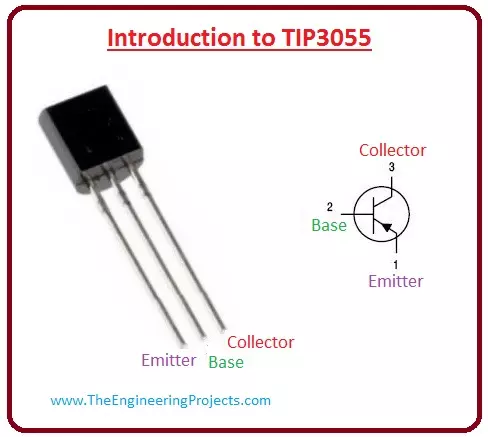
Hello friends, I hope you all are doing great. In today's tutorial, we are gonna have a look at detailed Introduction to TIP3055. TIP3055 is a silicon epitaxial-ignoble NPN transistor, which is assembled in TO-218 malleable parcels. It is the best device for power swapping circuits, parallel and series controllers (regulators), output phases and high power amplifiers. Its corresponding PNP transistor is TIP2955.
It is a universal device used in many industrial projects where audio amplification is required. Its structures are attractive much the identical excluding for the maximum power indulgence that is a slightly lesser. In today’s post, we will have a look at its fortification, smashup, prominence, proposals, etc. I will also share some links ...
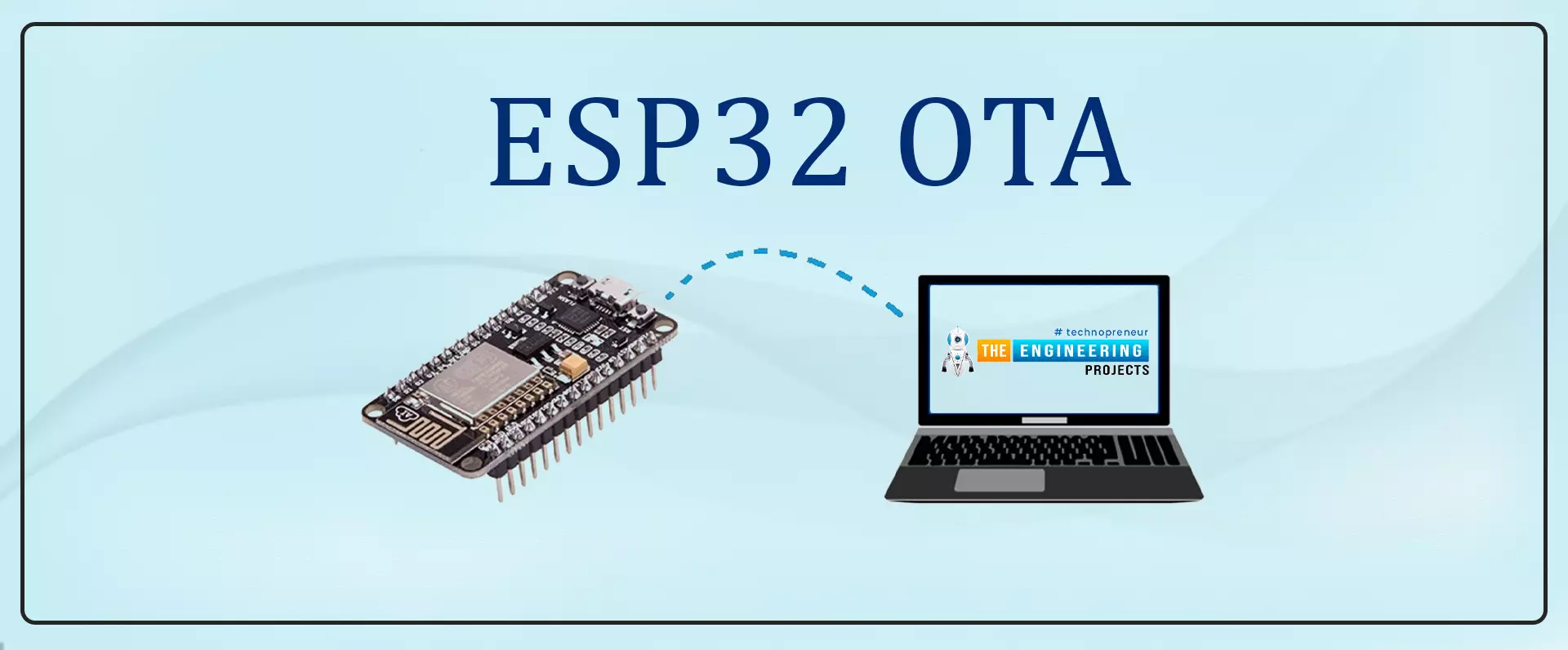
Hello readers, hope you all are doing great. In this tutorial, we are going to discuss a mechanism that allows users to update the ESP32 with a new program wirelessly or over the air (without using a USB cable to upload a new program).
Over-The-Air (OTA) programming
Fig. 1 ESP32 OTA
OTA programming is the mean by which a product manufacturer or product service provider can update the features or functionality of the device wirelessly or over the air, after the device has been deployed in the field where connecting a cable or uploading the code serially is difficult.
One key advantage of OTA is that a single central node can send an update to multiple ESPs on the same network.
The device must have a provisioning client capable of receivin ...
Hi there! Hope this finds you well. I welcome you on board. Thanks for clicking this read. In this post today, I’ll be discussing the Introduction to D882 transistor.
D882 is a general-purpose transistor mainly famous for its high performance. It falls under the category of NPN transistor and is an ideal pick for commercial, educational, and hobbyists’ electronic projects. It comes in TO-126 with collector current 3A, projecting it can drive loads under 3A. There are three pins incorporated on the transistor which are used for external connections. The collector-emitter and collector-base voltages are 30V and 40V respectively with emitter-base voltage 5V, indicating only 5V are required to bias the component.
Read this post all the way through as ...
Hello friends, I hope you all are doing great. Today, we will create a web server with ESP8266 microcontroller to control the activation of an LED. The goal is to understand how the ESP8266 connects to a WiFi network, how it sets up a web server, and how it is possible to exchange information between the browser and the esp8266.
Components Required
1x Computer/notebook with Arduino
1x Mini-USB cable.
1x NodeMCU (ESP8266 Breakout Board)
Internet Browser (Chrome, Firefox, IE…)
ESP8266 Libraries for Arduino IDE
For this project, we will use two libraries:
ESP8266WiFi: This library carries all the functions necessary for the ESP8266 to connect to a wifi network.
ESPAsyncWebServer: This library carries the functions needed to create an ...
Hello everyone! I hope you all will be absolutely fine and having fun. Today, I am going to give you an elaboration on Introduction to LM2575. LM2575 is specially designed to simply the design of switching power supplies. It can be done by providing all the necessary active functions required in Integrated Circuit (IC) for step down regulators. LM-2575 can deliver load current of around 1A along with the good line regulation as well as load regulation. LM 2575 has different builtin functions e.g. frequency compensation, cycle by cycle current limiting, oscillator with the fixed frequency and a lot more.
LM-2575 has many amazing features i.e. it can reduce the heat sink size due to its higher efficiency parameter. In some cases even heat sink is ...