


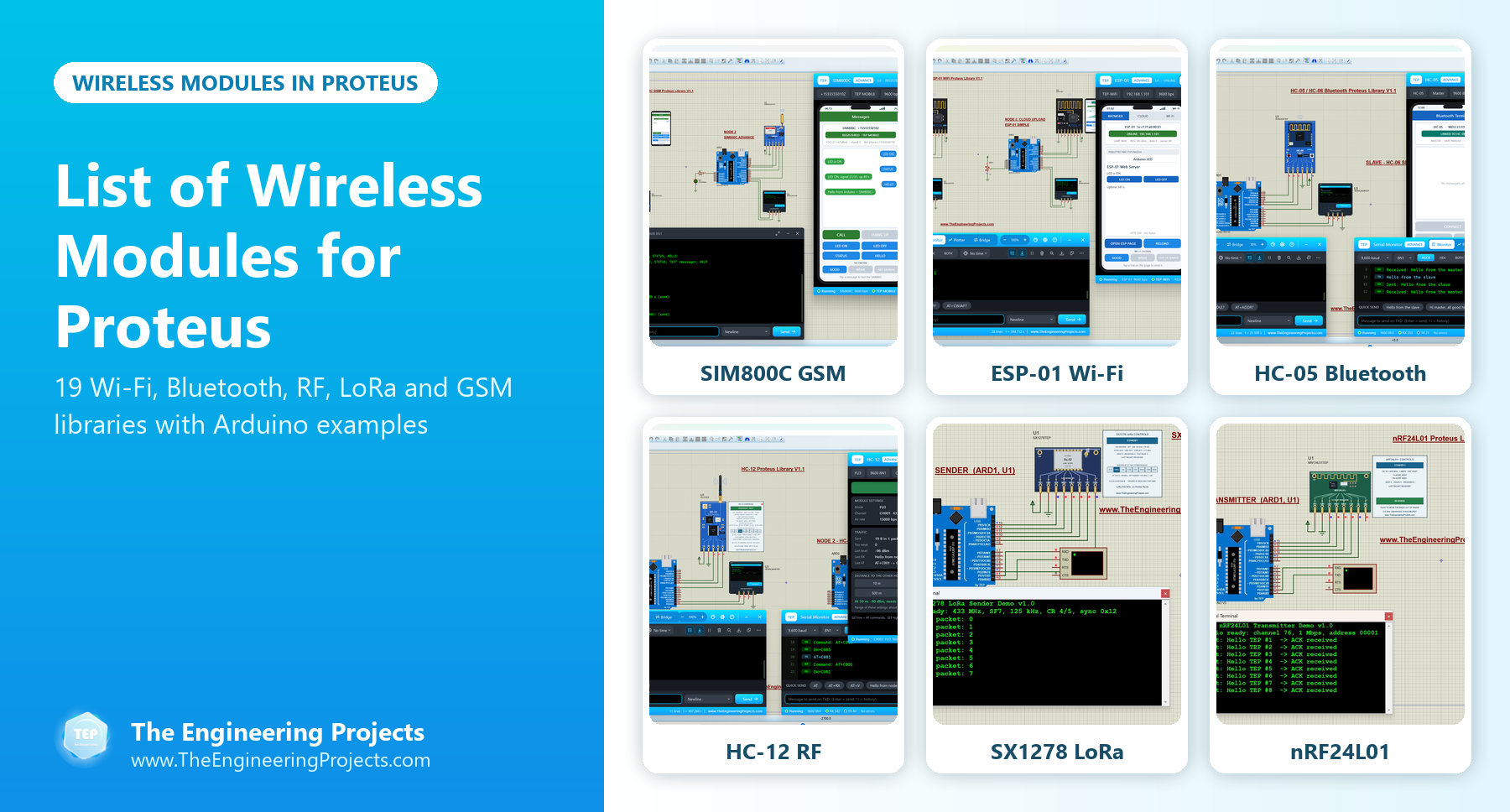
List of Wireless Modules for Proteus: Wi-Fi, Bluetooth, RF, LoRa and GSM Libraries


Hello friends, I hope you all are doing great. Today, I am going to share a complete List of Wireless Modules for Proteus. Wireless is the one thing almost every final year project needs: a phone app over Bluetooth, a web page over Wi-Fi, an SMS alert over GSM, or two Arduino boards talking over RF or LoRa. Proteus doesn't have these modules in its own component library, so our team has designed them one by one, and today I have collected all 19 of our wireless libraries in one place.
The choice of a wireless module decides how far your data can go, how fast it travels and whether you need a router or a SIM card. That's why I have grouped this list by technology and added a comparison table, so you can pick the right module before you look at the details. Each entry has a short introduction, the picture of its simulation and a link to its complete tutorial.
Our new 2026 libraries come first, starting with GSM, Wi-Fi and Bluetooth, followed by RF and LoRa. Our older wireless libraries are at the end of the list. If you are new to Proteus libraries, read How to Add New Library in Proteus 8 first. So, let's get started with the List of Wireless Modules for Proteus:
Wireless Technologies Compared
Before we go through the modules, here is how the five technologies of this list differ. The ranges are typical values for real modules and depend on antennas, walls and settings.
| Technology | Typical range | Data | Needs | Our libraries |
|---|---|---|---|---|
| GSM | Anywhere with 2G coverage | SMS, calls and GPRS data | A SIM card and a 2G network | SIM800C, SIM900A, SIM800L, SIM808, SIM900D |
| Wi-Fi | A home or an office | Fast: web pages and cloud uploads | A router (or the module's own access point) | ESP-01, ESP32, NodeMCU |
| Bluetooth | A room | Serial data to a phone or a module | Pairing | HC-05, HC-06 |
| RF (2.4 GHz and sub-GHz) | Tens of metres to a few kilometres | Packets between your own nodes | Nothing but a second module | HC-12, nRF24L01, nRF24L01 PA LNA, RFM69HCW, CC1101, XBee |
| LoRa | Several kilometres | Small, slow packets | Nothing but a second module | SX1262, SX1278, RFM95W |
New GSM Libraries for Proteus
1. SIM800C GSM Library for Proteus V1.1
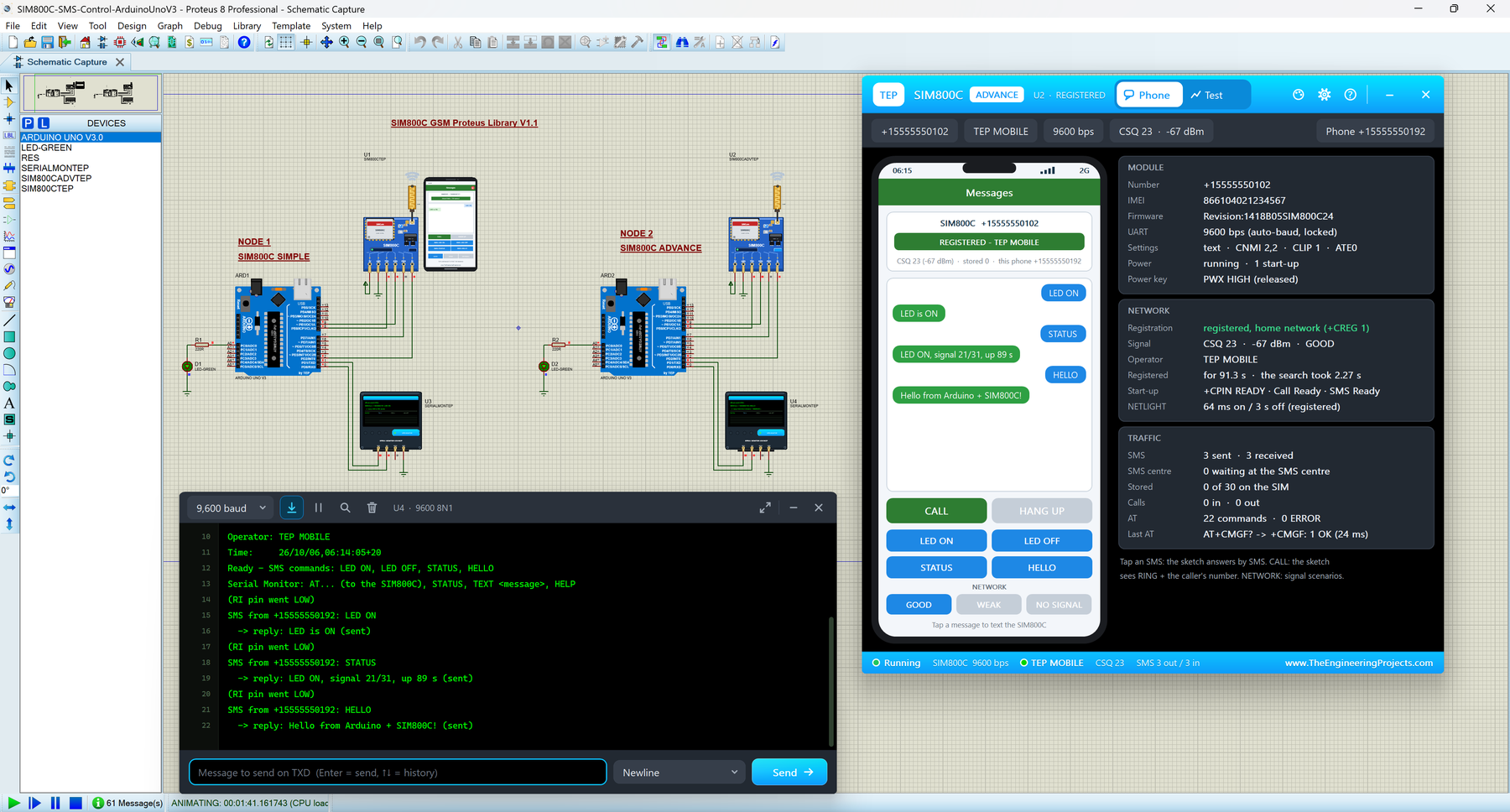
The quad-band SIM800C on its blue HW-537 board stays off until its PWX power key is held LOW, and our model does the same. After that, it registers on a simulated network, sends SMS and handles calls with a virtual phone, and its Advance device adds four GSM test tools. Read the complete tutorial: SIM800C Library for Proteus V1.1
2. SIM900A GSM Library for Proteus V1.1
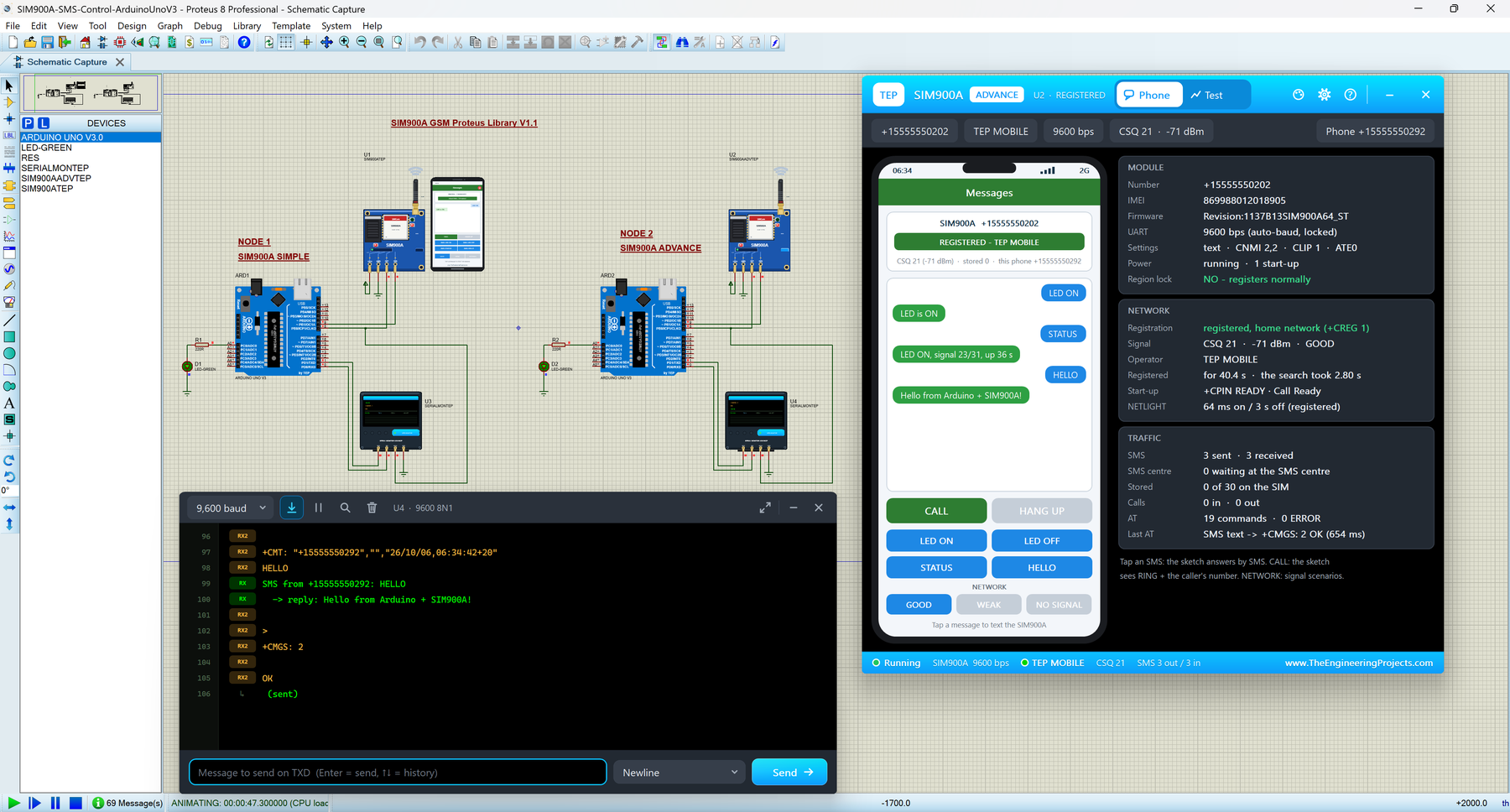
The SIM900A MINI board switches itself on, and our model can even simulate the region lock that stops many new SIM900A modules from registering. It shares its model file with the SIM800C, so the two can text each other in one design. Read the complete tutorial: SIM900A Library for Proteus V1.1
3. SIM800L GSM Library for Proteus V1.1
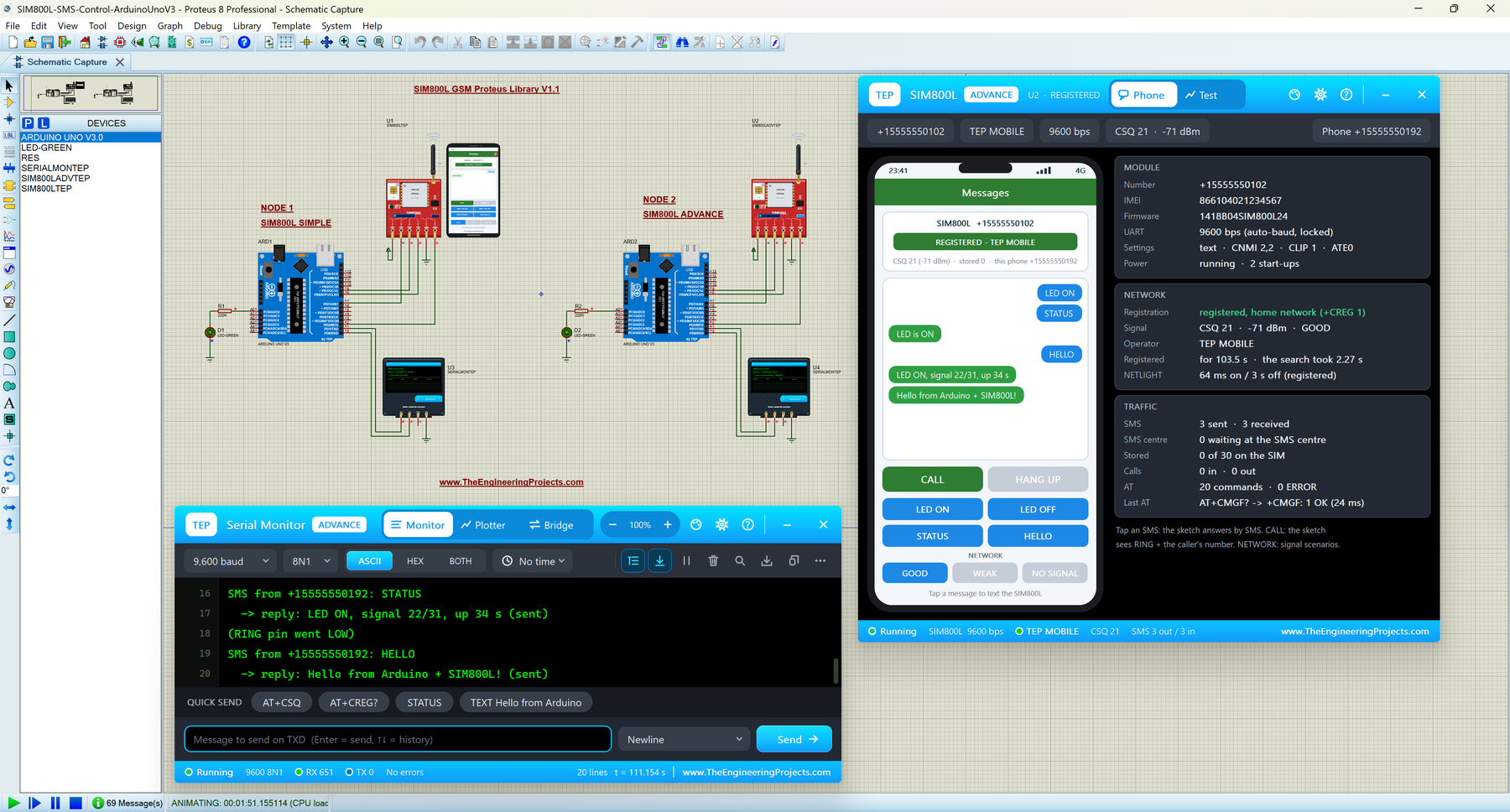
The small red SIM800L is the GSM module of most student projects. Our library has a virtual phone, four GSM test tools and an SMS remote-control demo that switches an LED and rejects calls. Read the complete tutorial: SIM800L Library for Proteus V1.1
4. SIM808 GSM + GPS Library for Proteus V1.1
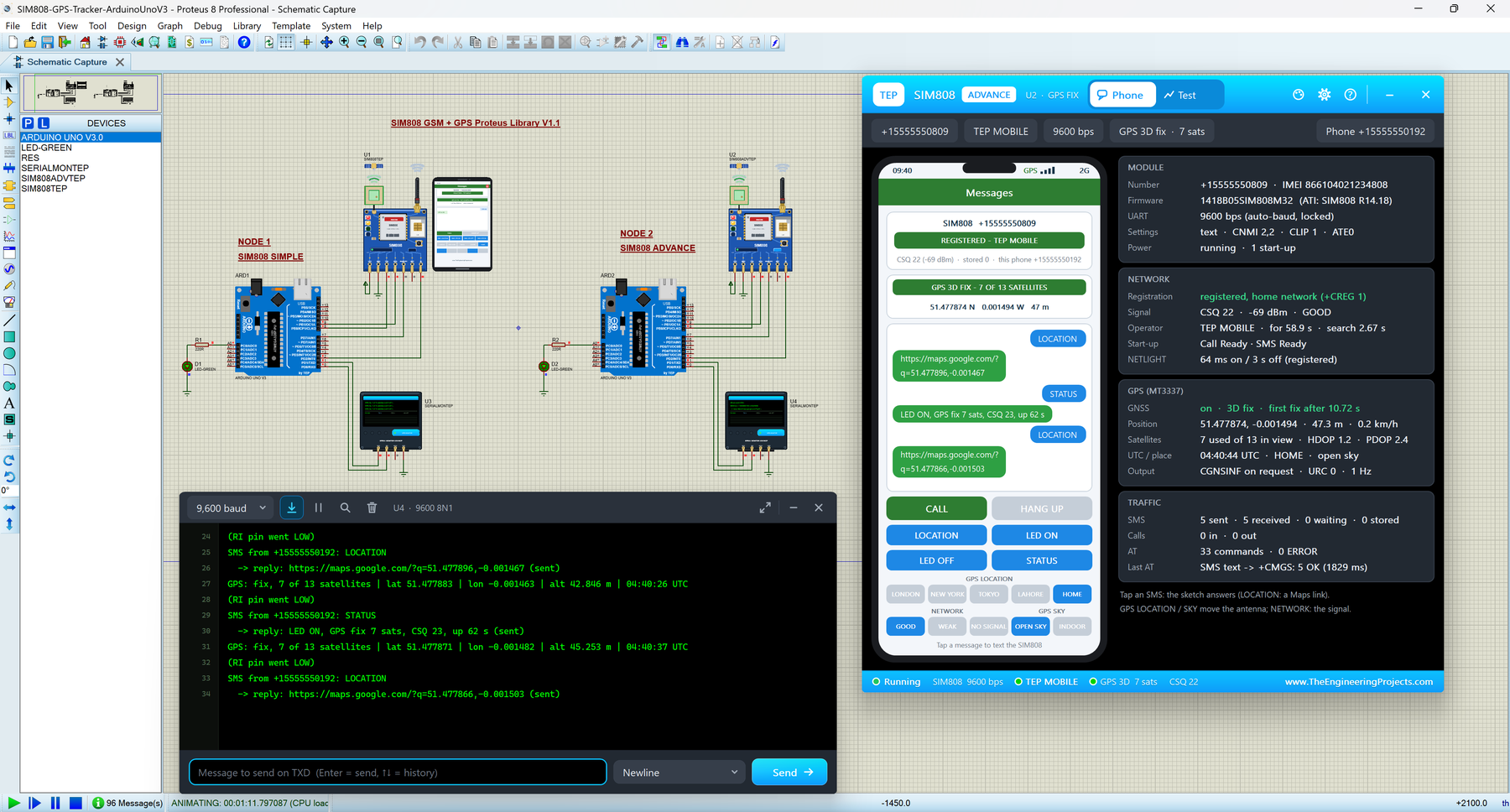
The SIM808 combines GSM and GPS. Our model waits for its PWRKEY, answers AT commands, sends SMS, rings on calls and gets a GPS fix, and its Advance device adds five GSM + GPS test tools. The Arduino tracker replies to a "LOCATION" SMS with a Google Maps link. Read the complete tutorial: SIM808 Library for Proteus V1.1
New Wi-Fi and Bluetooth Libraries for Proteus
5. ESP-01 Wi-Fi Library for Proteus V1.1
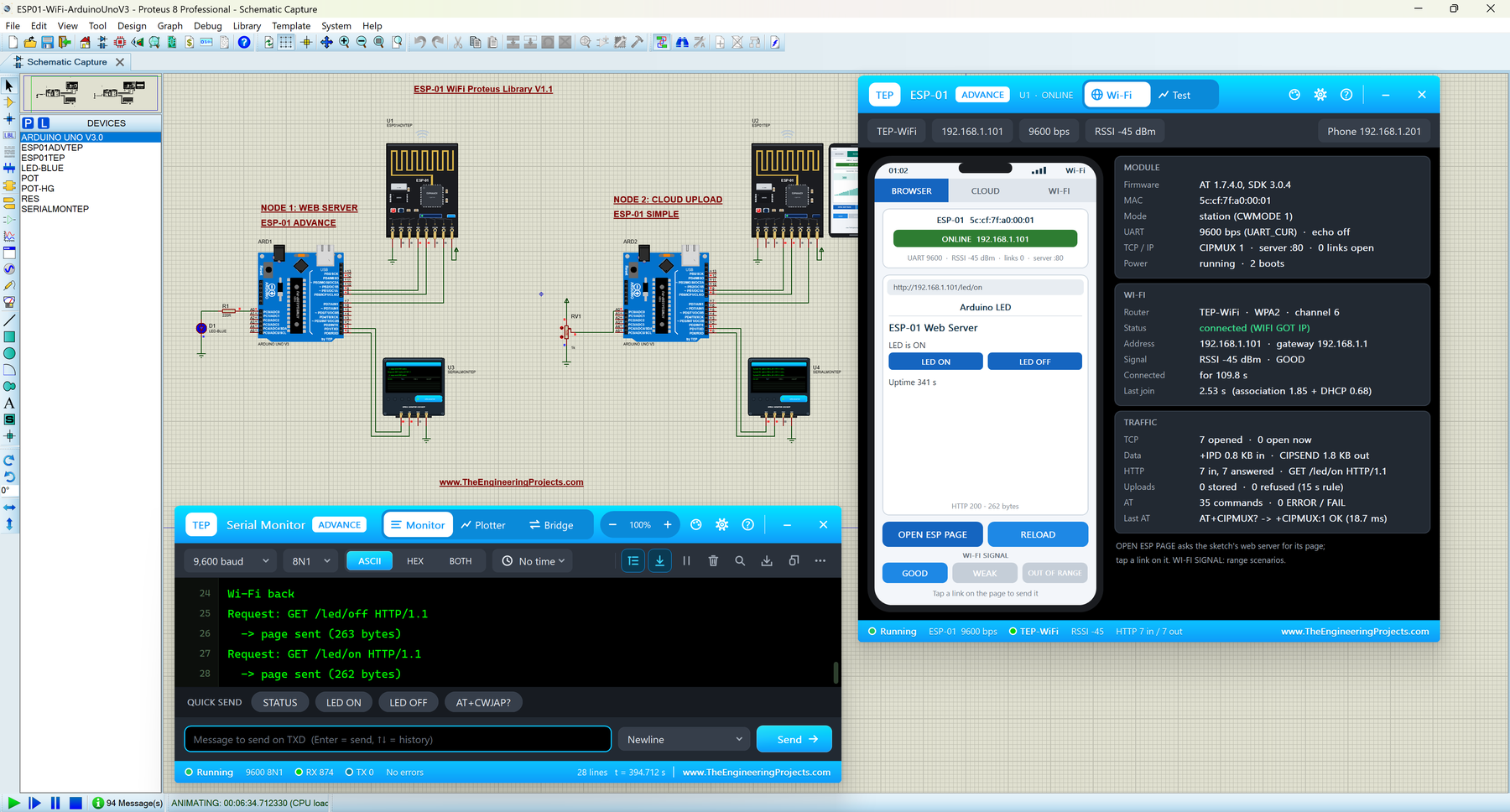
The ESP-01 gives an Arduino Wi-Fi through the ESP8266 AT commands. Our model brings a virtual router, a virtual phone with a browser and an internet host into Proteus, so your sketch can join a network, serve a web page and upload readings to the cloud. The Advance device adds four Wi-Fi test tools. Read the complete tutorial: ESP-01 Library for Proteus V1.1
6. HC-05 & HC-06 Bluetooth Library for Proteus V1.1
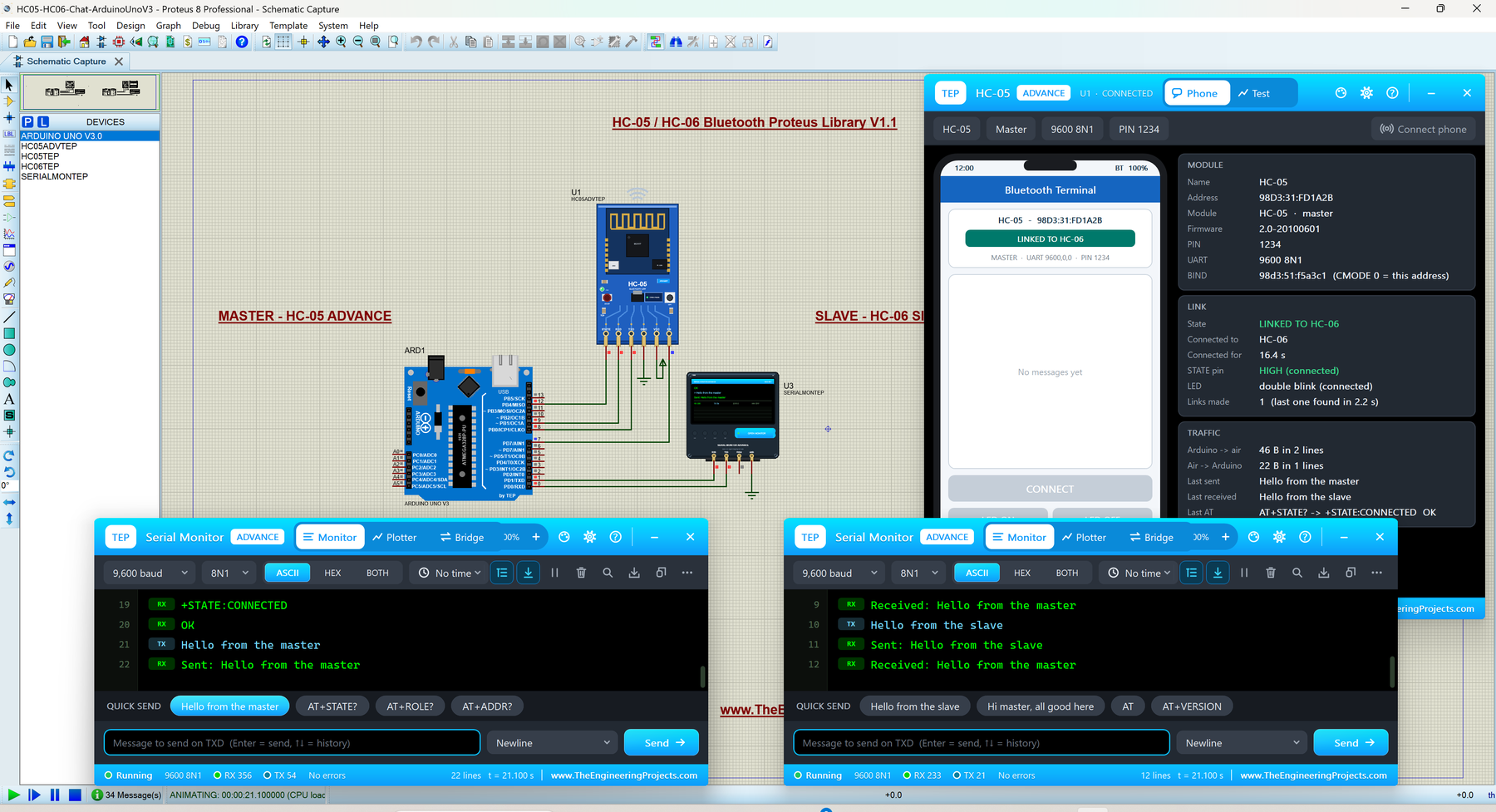
The HC-05 (master or slave) and the HC-06 (slave only) pair with a virtual phone or with each other. The model follows their AT command sets, including the 38400 bps AT mode of the HC-05 that confuses so many beginners. Read the complete tutorial: HC-05 Library for Proteus V1.1
New RF Module Libraries for Proteus
7. HC-12 Library for Proteus V1.1
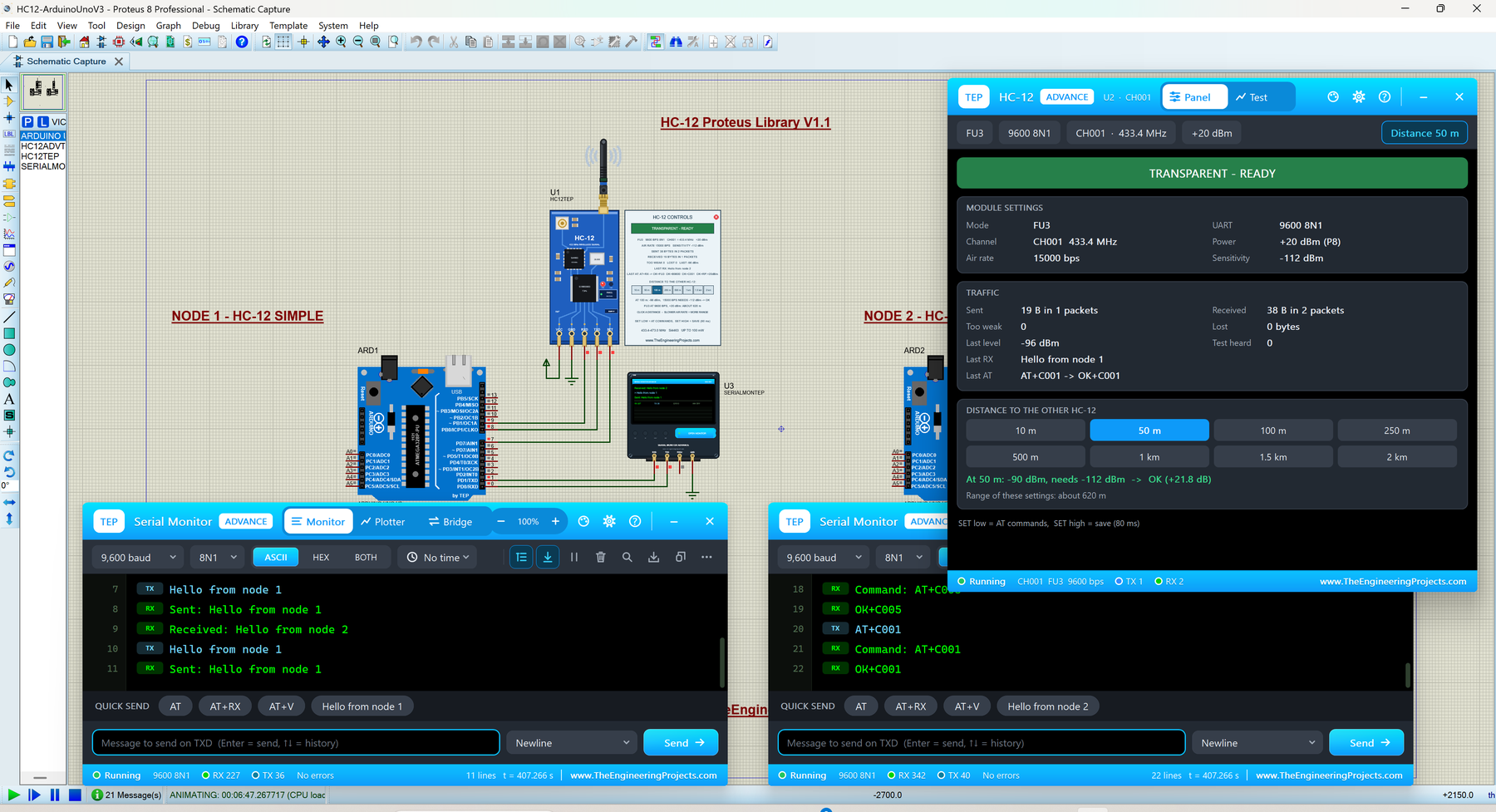
The HC-12 is a 433 MHz serial port in the air: no radio library, just Serial.print(). Our model follows its SET pin, AT commands and four FU modes, and the Advance device adds a link test, a range sweep and a radio scan. Read the complete tutorial: HC-12 Library for Proteus V1.1
8. nRF24L01 PA LNA Proteus Library
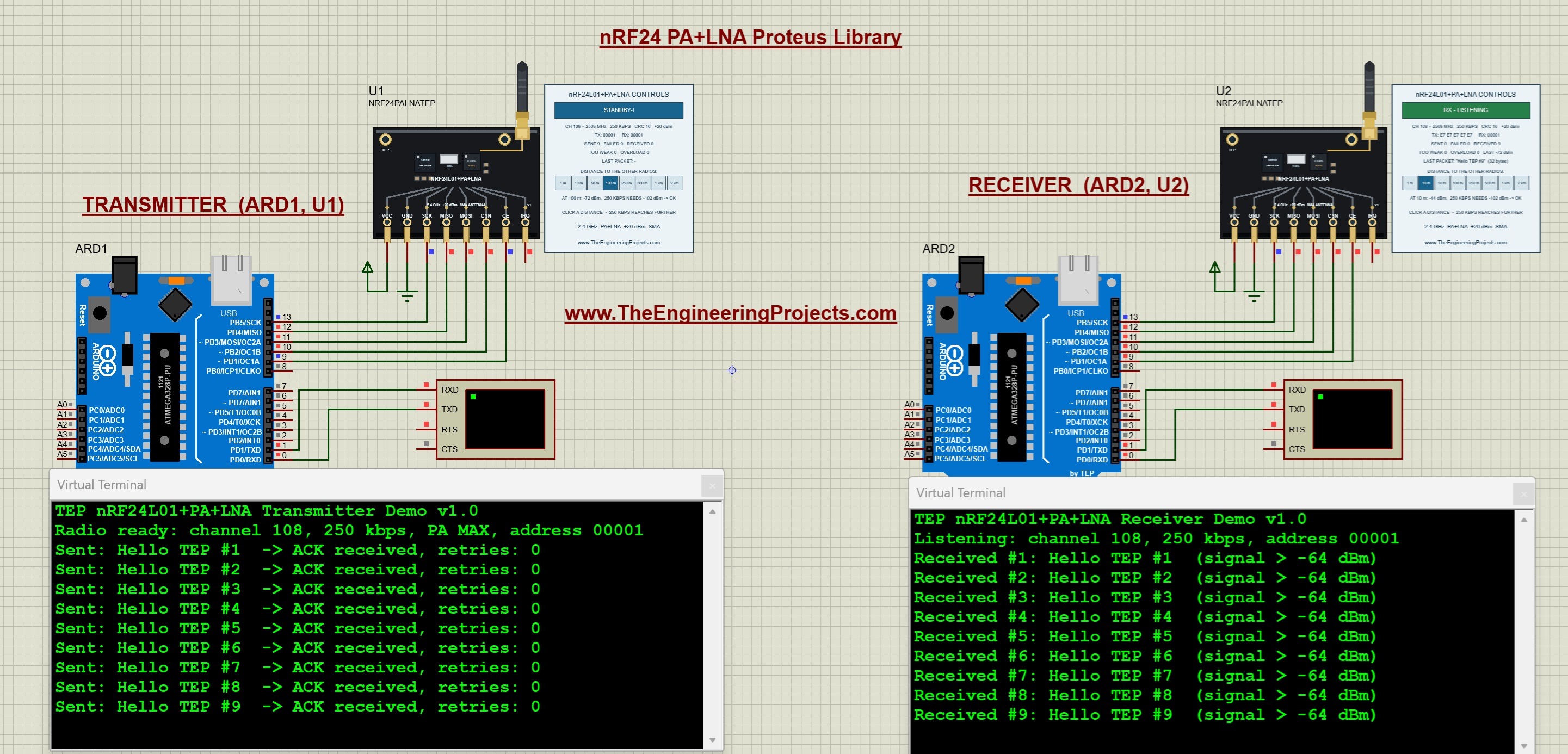
The long-range nRF24L01 PA LNA has distance buttons from 1 m to 2 km, and the model checks every packet and every acknowledgement against the sensitivity and the overload limit of the chip. Read the complete tutorial: nRF24L01 PA LNA Proteus Library
9. RFM69HCW Proteus Library
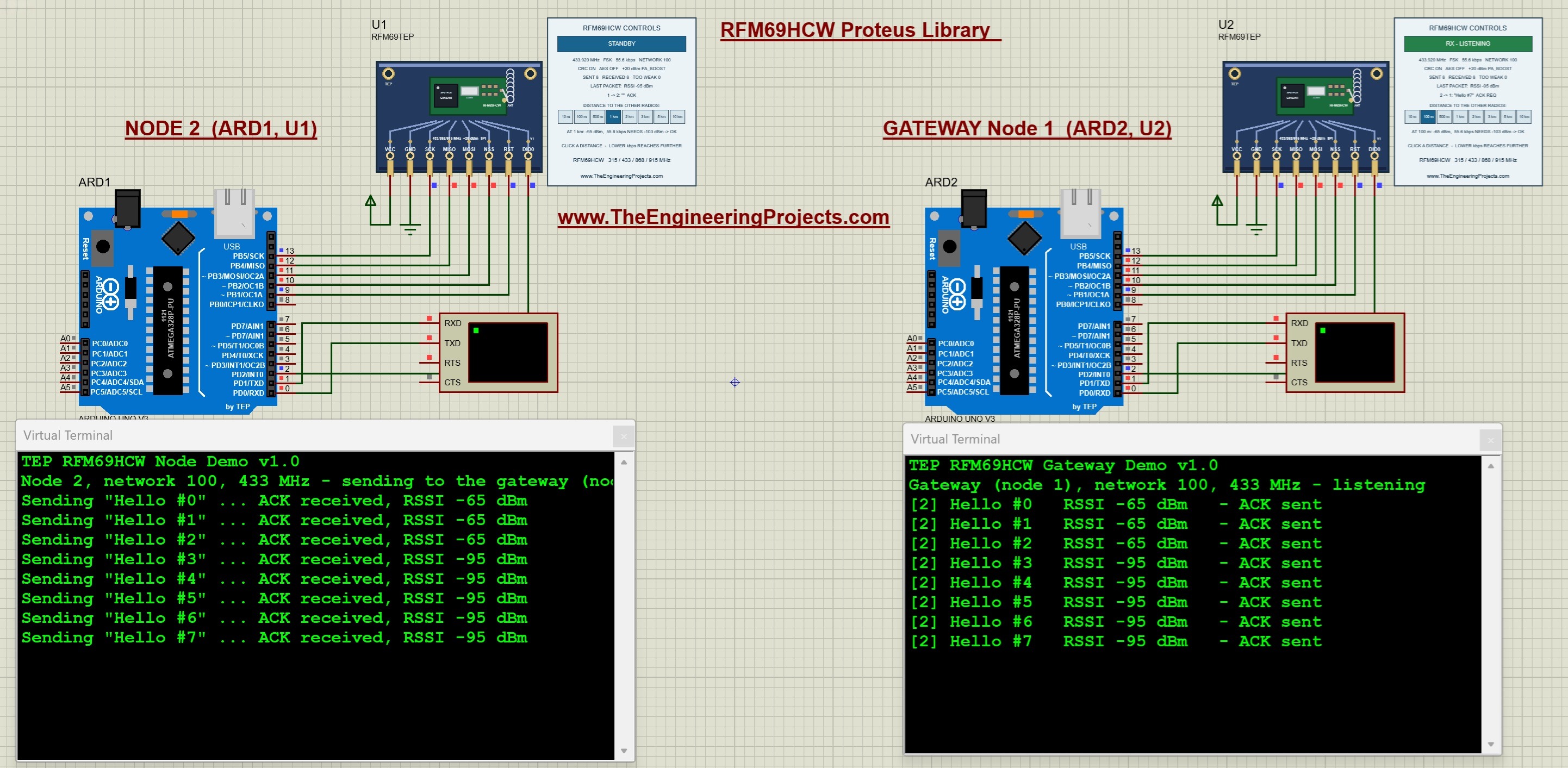
The RFM69HCW example has a node and a gateway at 433 MHz with acknowledgements, RSSI and distance buttons from 10 m to 10 km. Read the complete tutorial: RFM69HCW Proteus Library
10. CC1101 Proteus Library
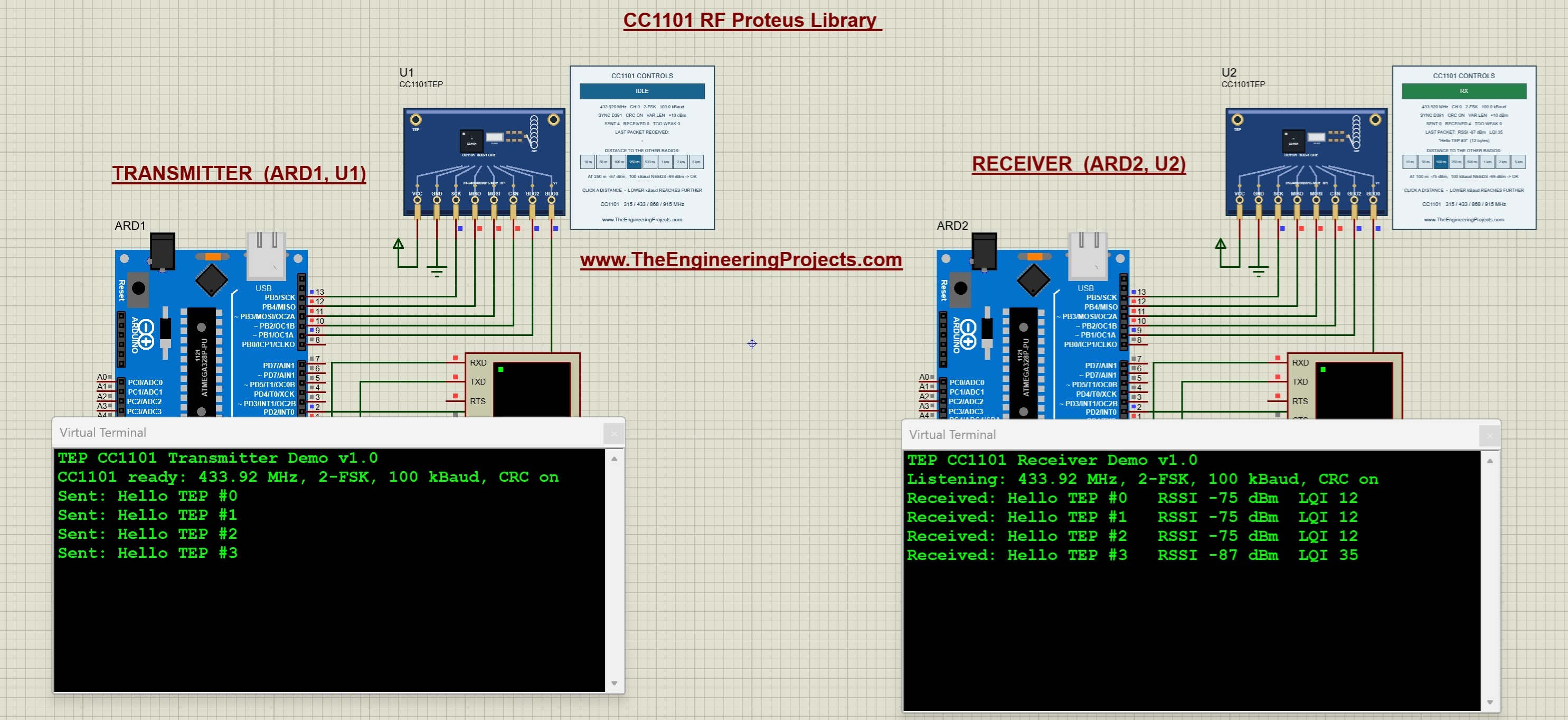
The CC1101 sends messages at 433.92 MHz, and the receiver reports RSSI and LQI for every packet, with distance buttons from 10 m to 5 km. Read the complete tutorial: CC1101 Proteus Library
11. nRF24L01 Proteus Library
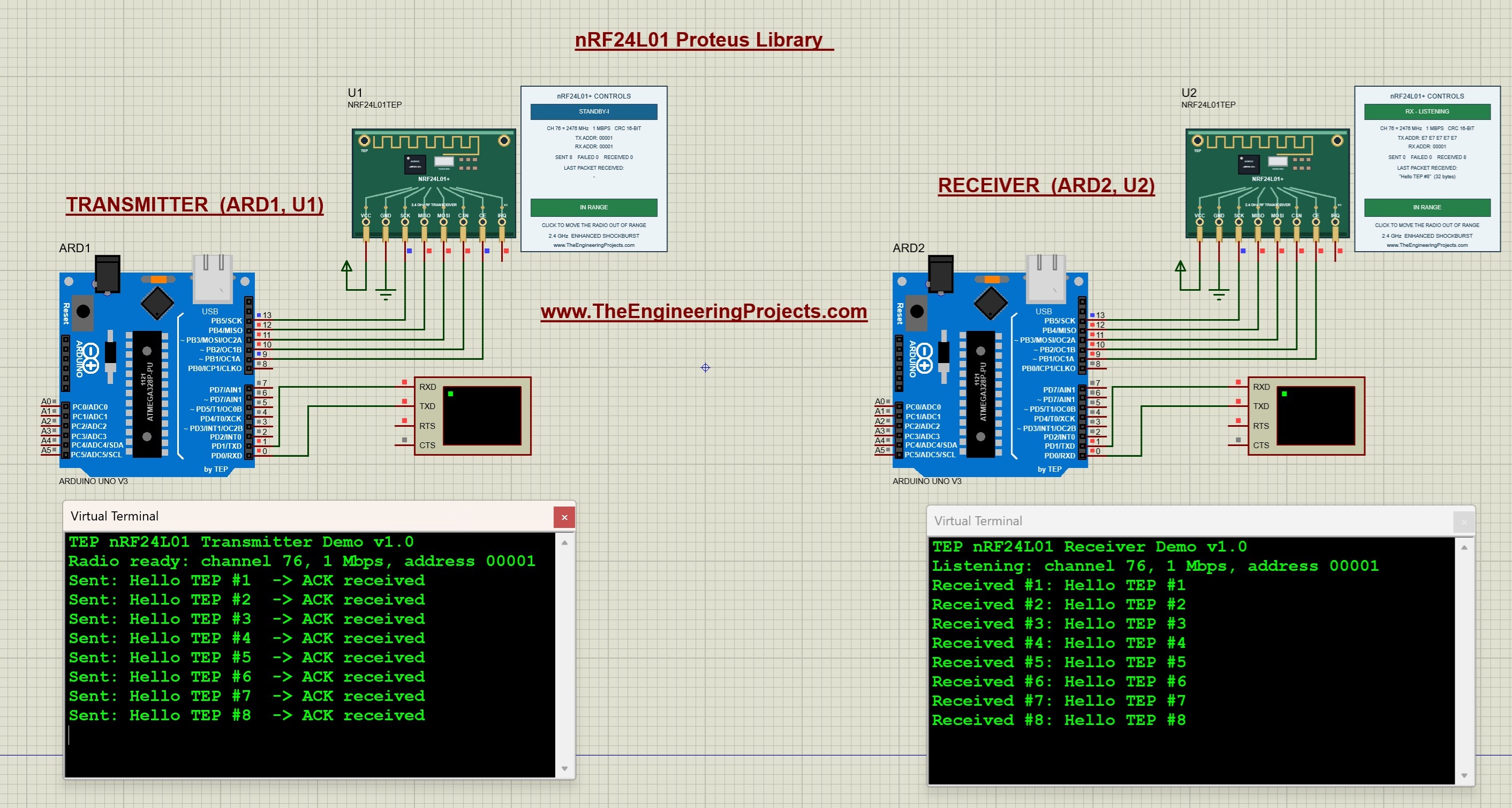
The plain nRF24L01 model focuses on the digital side of the chip: real SPI registers, automatic acknowledgements and retries, and a range switch that takes a radio off the air. Read the complete tutorial: nRF24L01 Proteus Library
New LoRa Libraries for Proteus
12. SX1262 LoRa Proteus Library
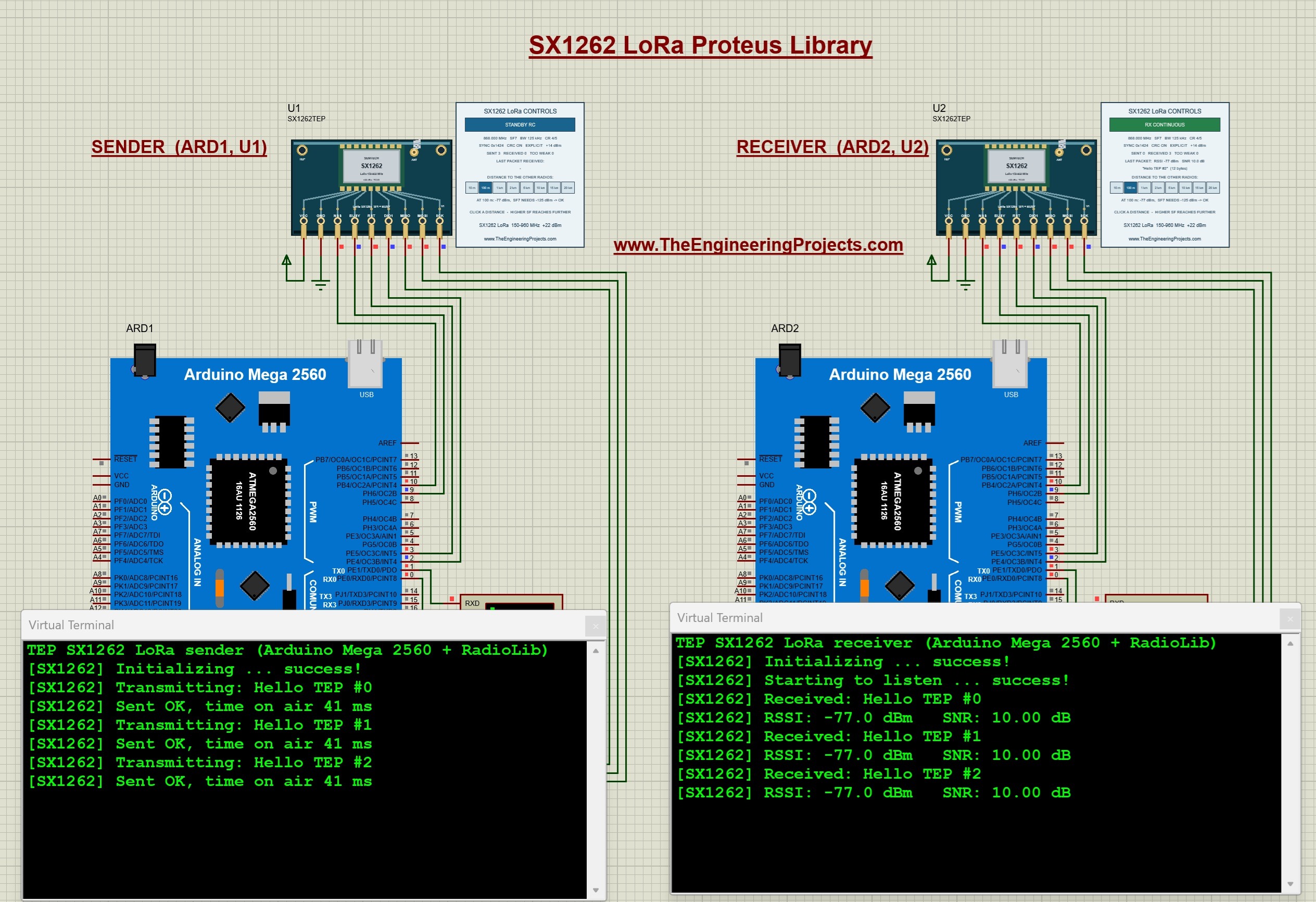
The newer Semtech SX1262 runs with the unmodified RadioLib driver on two Arduino Mega 2560 boards at 868 MHz, with distance buttons up to 20 km and a prediction line for the selected settings. Read the complete tutorial: SX1262 LoRa Proteus Library
13. SX1278 LoRa (Ra-02) Proteus Library
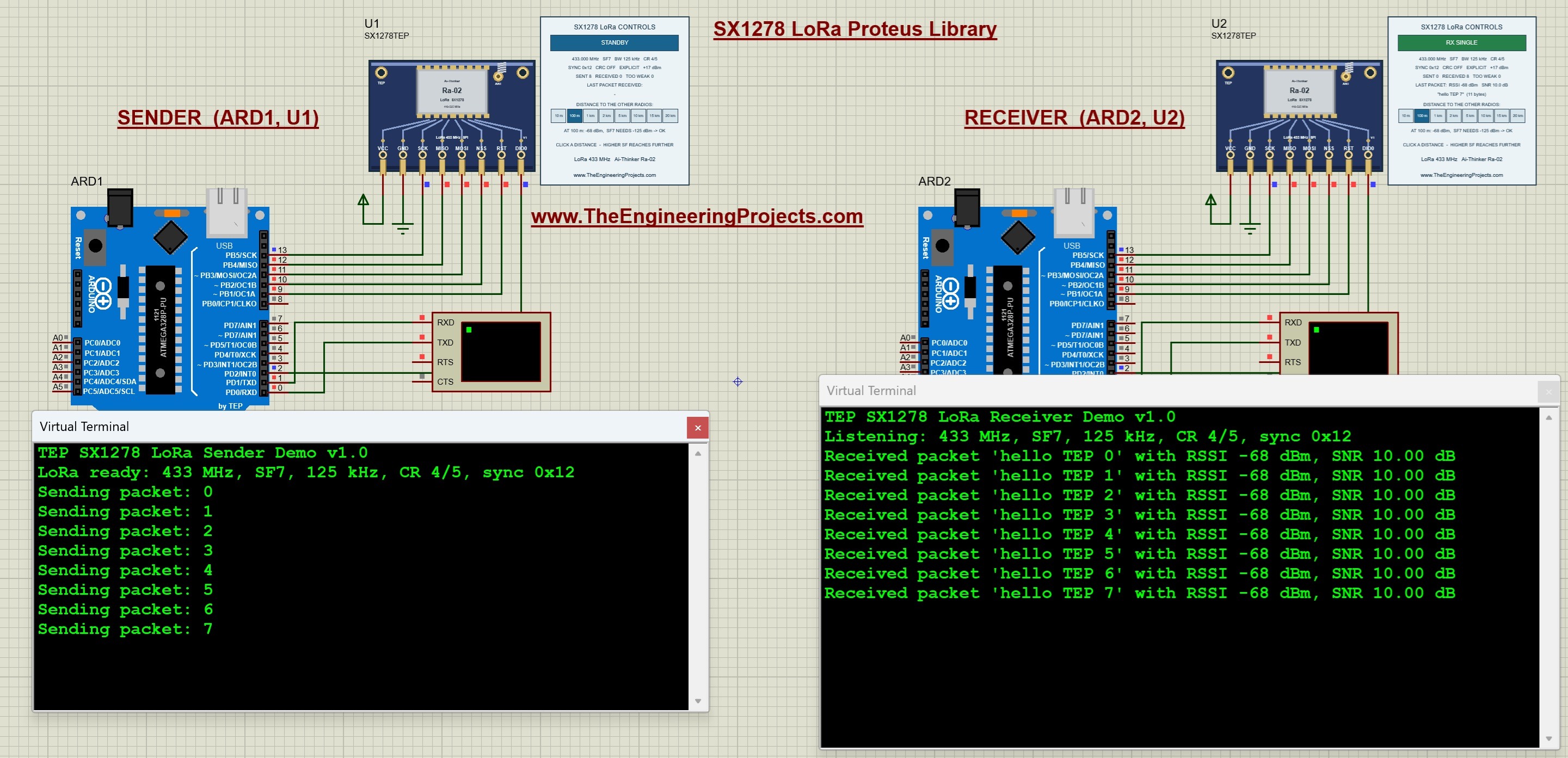
The SX1278 library shows the Ai-Thinker Ra-02 module at 433 MHz. The receiver prints RSSI and SNR, and the path loss in version 1.1 depends on the frequency. Read the complete tutorial: SX1278 LoRa Proteus Library
14. RFM95W LoRa Proteus Library
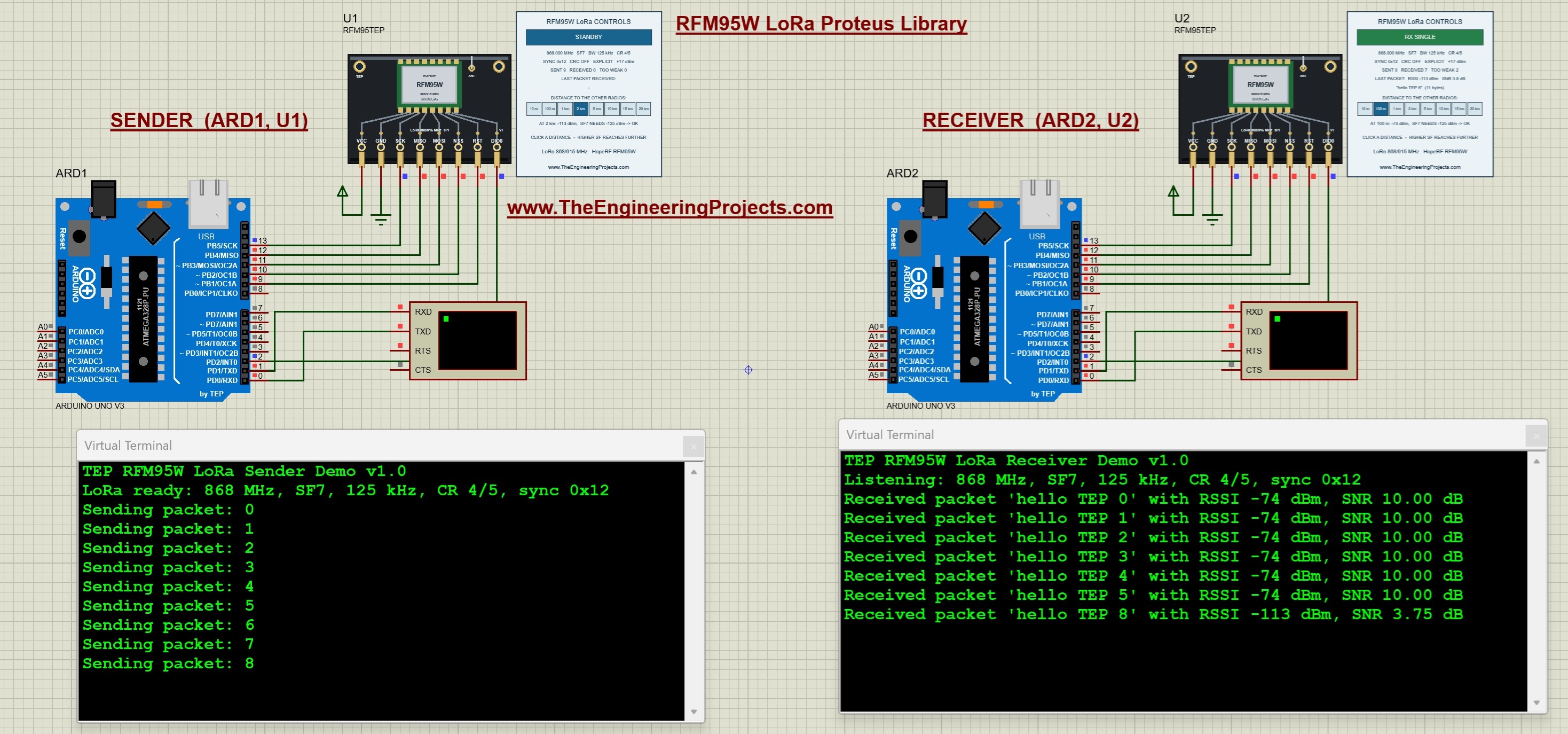
The RFM95W runs an 868 MHz LoRa link between two Arduino Uno boards and shows how the spreading factor, the bandwidth and the power change the range. Read the complete tutorial: RFM95W LoRa Proteus Library
Our Older Wireless Libraries for Proteus
Before 2026, our team designed these wireless libraries. They are simpler models, but they are still useful for circuit diagrams and older projects.
15. ESP32 Library for Proteus
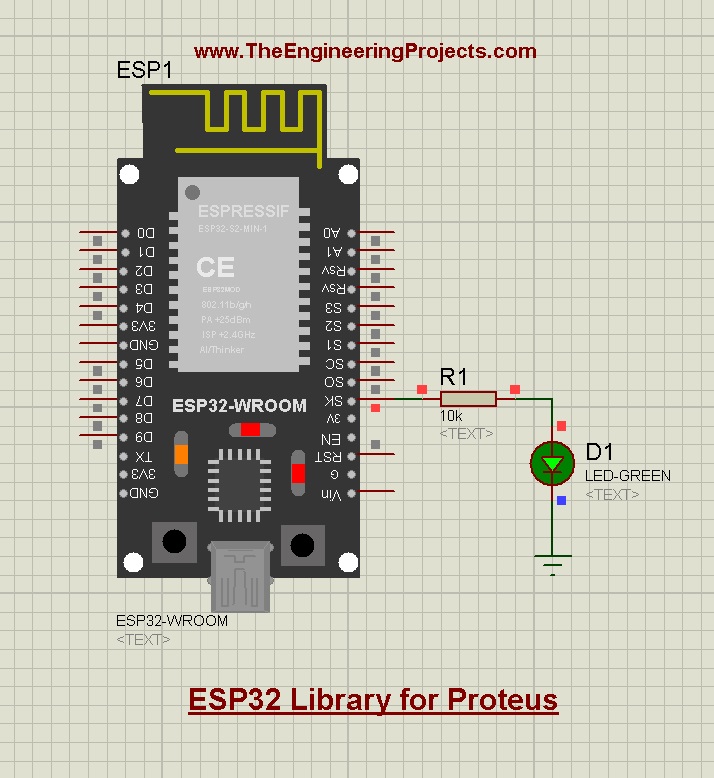
The ESP32 board library simulates the pins of the board, PWM and the sensors you connect to it. Proteus can't run its Wi-Fi or Bluetooth radio, so for a Wi-Fi simulation, use the ESP-01 above. Read the complete tutorial: ESP32 Library for Proteus
16. NodeMCU Library for Proteus
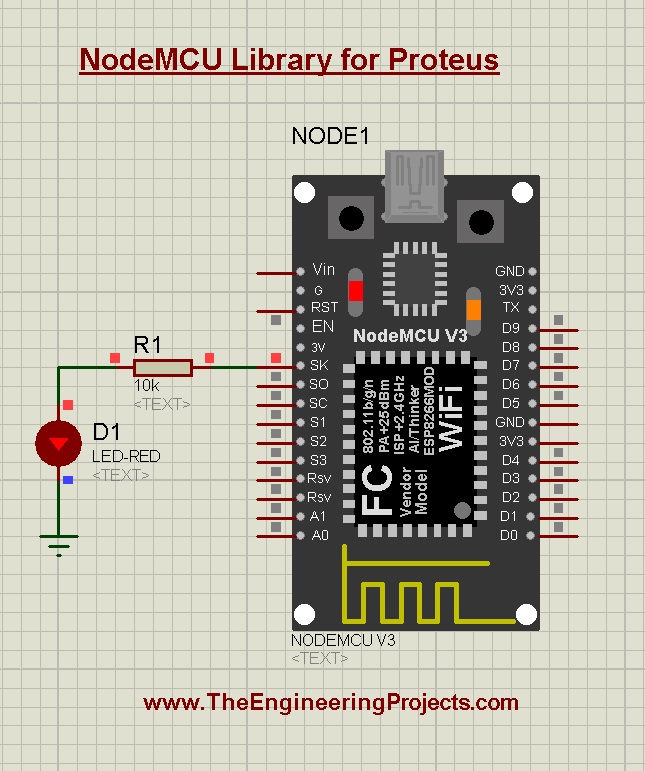
The NodeMCU library works the same way as the ESP32 library: basic I/O, PWM and sensor interfacing for simple code tests and circuit diagrams. Read the complete tutorial: NodeMCU Library for Proteus
17. GSM Library for Proteus (SIM900D)
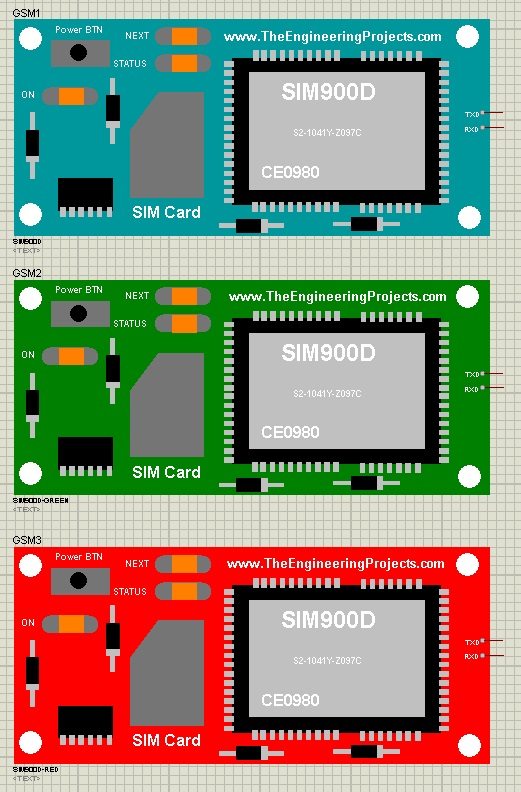
Our first GSM model, the SIM900D, supports a basic set of AT commands that you can send from the Virtual Terminal. Read the complete tutorial: GSM Library for Proteus
18. Bluetooth Library for Proteus
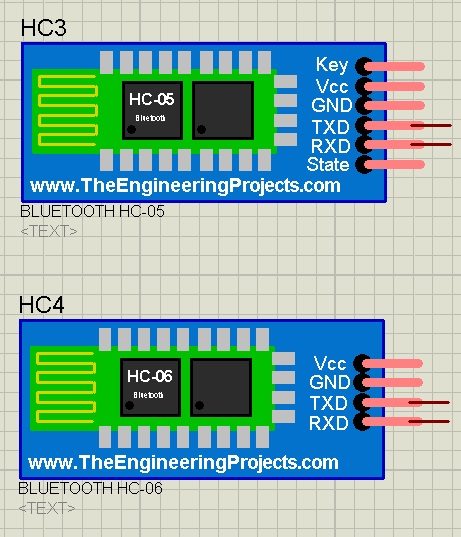
Our first Bluetooth library has HC-05 and HC-06 modules for basic serial communication, without AT commands. Read the complete tutorial: Bluetooth Library for Proteus
19. XBee Library for Proteus
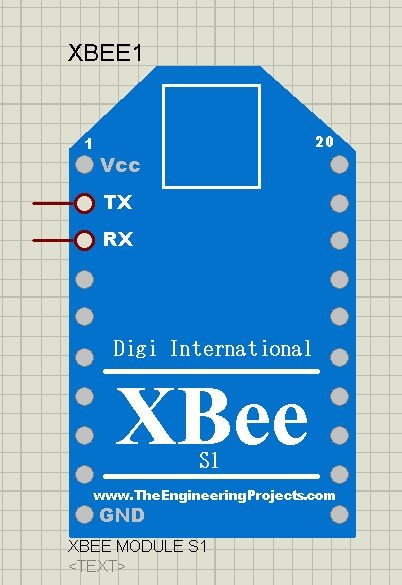
The XBee library was our very first wireless module for Proteus, with TX and RX pins for serial communication. We used it in our home automation and DC motor control projects. Read the complete tutorial: XBee Library for Proteus
How to Choose a Wireless Module for Your Project
Ask yourself these four questions, and the list above becomes much shorter:
- Who is on the other side? A phone app points to Bluetooth (HC-05 / HC-06). A web browser or a cloud dashboard points to Wi-Fi (ESP-01). A normal phone that can only receive SMS points to GSM (SIM800L, SIM800C, SIM900A). Another Arduino points to RF or LoRa.
- How far is it? A room: Bluetooth or the nRF24L01. A building or a campus: the HC-12, CC1101 or RFM69HCW. Several kilometres: LoRa. Another city: GSM.
- How much data? A few bytes every minute is perfect for LoRa. Live data or web pages need Wi-Fi or the nRF24L01.
- Is there a network? Wi-Fi needs a router and GSM needs a SIM card and 2G coverage. RF, LoRa and Bluetooth only need a second module.
Once you have picked a technology, open its dedicated list for more details: GSM Libraries for Proteus, Wi-Fi and Bluetooth Libraries for Proteus, RF Module Libraries for Proteus and LoRa and RF Libraries for Proteus. If your project also needs a position, see our GPS Libraries for Proteus. You can also browse all of these modules in our Proteus Libraries tutorial series.
What the Simulations Can and Can't Show
Our new wireless models answer real commands, keep real timings and show the signal level for the distance you choose, so they are excellent for testing your code and your logic. They are still simulations: they don't model antennas, walls, interference or a crowded 2.4 GHz band, and the GSM and Wi-Fi networks are virtual. So, use them to get your sketch right, and then test the range and the power supply on real hardware.
More Lists of Proteus Libraries
We have grouped our Proteus libraries into several lists, so you can quickly find the right ones for your project:
- 30 New Proteus Libraries for Engineering Students (2026)
- GSM Libraries for Proteus
- GPS Libraries for Proteus
- RF Module Libraries for Proteus
- LoRa and RF Libraries for Proteus
- Wi-Fi and Bluetooth Libraries for Proteus
- Top IoT Libraries for Proteus
- RFID and NFC Libraries for Proteus
- List of Embedded Sensors in Proteus
- I2C Sensor Libraries for Proteus
- Environmental Sensor Libraries for Proteus
- Motion and Distance Sensor Libraries for Proteus
- Smart Agriculture Sensor Libraries for Proteus
- Medical Sensor Libraries for Proteus
- Must-Have Proteus Libraries for Arduino Simulation
- Microcontroller Board Libraries for Proteus
Conclusion
So, that was the complete List of Wireless Modules for Proteus. I hope it helps you find the right module for your project in a few minutes instead of a few days. Our team is still adding new wireless modules, so if you need one that is not on this list, please tell us in the comments or in the Proteus Libraries category of our forum. Till the next tutorial, take care and have fun!
Comments
0